
At least 19 local governments have introduced an accommodation tax in response to the growing influx of foreign visitors, while 35 others are scheduled to impose similar levies within fiscal 2026.
They are using the new revenue source to help remedy congestion and other problems at tourist destinations.
Local governments impose the tax on guests staying at hotels, ryokan and other establishments, and it is counted as a form of tourist tax.
But the lodging tax is not specified in the Local Tax Law, so revenue must be used exclusively for predetermined purposes. It can be incorporated only after winning the approval of the internal affairs minister.
Tokyo became the first in Japan in October 2002 to adopt the accommodation tax, followed by Osaka Prefecture in January 2017.
Taxable hotel fees generally do not include meal costs or the consumption tax. Students on school trips are also exempt from the tax payment in many regions.
Although discussions on the taxation setup died down during the COVID-19 pandemic, momentum has again grown since the recovery in inbound tourism.
The system has an advantage for local governments: the increase in fiscal revenue from an accommodation tax does not lead to a reduction in the local tax allocation distributed by the central government.
According to the internal affairs ministry, eight local governments, including Atami city in Shizuoka Prefecture and Takayama city in Gifu Prefecture, embraced the accommodation tax framework in fiscal 2025.
By Feb. 13 this year, 19 local governments, including Kyoto city, were imposing the tax.
Hokkaido, Okinawa Prefecture and Nasu town in Tochigi Prefecture are among 35 others that will adopt the same mechanism in fiscal 2026, bringing the number of areas with the levy framework to more than 50.
Miyagi Prefecture and its capital, Sendai, initiated the lodging tax in January. Accommodation guests spending 6,000 yen ($38) or more per night are charged a flat rate of 300 yen per person.
After starting separate debates on the tax, the prefecture and the city both agreed that all travelers would pay an amount not exceeding 300 yen per person, and the prefecture would collect only 100 yen from each traveler in Sendai.
Miyazaki city is scheduled to impose a flat accommodation tax of 200 yen starting in July.
“We are determined to exhaustively polish our welcoming environment and tourism resources to improve the low ratio of visitors” with the tax, a Miyazaki city representative said.
Some municipalities are seeking increased revenue from the accommodation tax.
Kyoto city, for example, raised its maximum tax amount from 1,000 yen to 10,000 yen on March 1.
Kutchan town in Hokkaido will increase its fixed accommodation levy rate of 2 percent to 3 percent in April.
Kyoto city collected 6 billion yen from the accommodation tax in fiscal 2025. The amount is projected to more than double to 13.2 billion yen in fiscal 2026.
Sightseers account for 10 percent of people present across the city, according to Kyoto municipal government data.
Kyoto city estimated that doubling the tax revenue would be indispensable to overcome traveler-related challenges and redevelop infrastructure to establish a sustainable tourism industry.
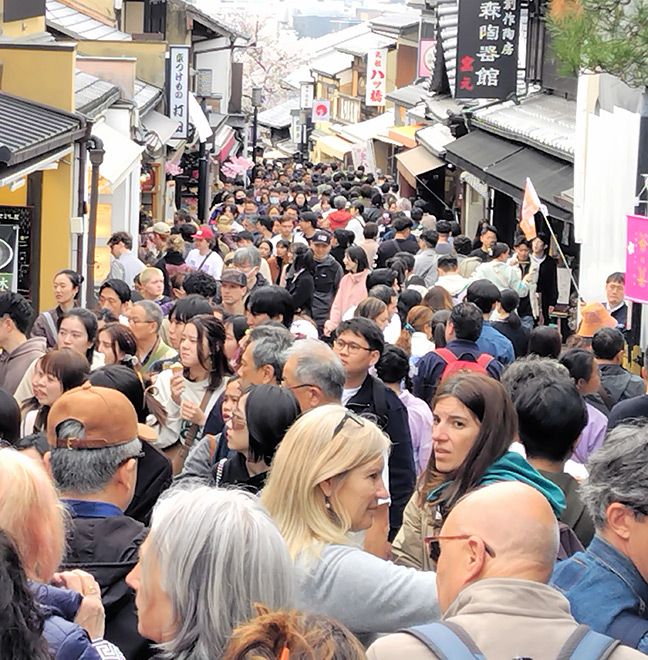
The municipality has particularly struggled with congestion on buses and other public places, as a record high of 16.3 million overnight guests arrived in the ancient capital in 2024.
Taking into account the increase in luxury hotels, Kyoto recently replaced its three-tier taxation system with a five-category one to “realize a fair distribution of the burden based on individual guests’ ability to pay.”
Kutchan town is currently the sole municipality implementing a flat-percentage accommodation tax.
However, Okinawa Prefecture has decided to incorporate the fixed-percentage framework in February 2027. Tokyo and Niseko town in Hokkaido are also weighing replacing their conventional setups with flat-percentage ones.
Constant-percentage systems are expected to generate tax revenues that are higher than the levels collected under flat-price rates.
Accommodation facilities are responsible for collecting the tax from guests. Hotel and ryokan operators must bear the burden of separating food costs from accommodation fares to accurately calculate the tax total.
The fixed-percentage idea was among options even for Kyoto city. But the municipality dropped the plan.
“It would take several years to design the whole flat-percentage mechanism before incorporation,” Kyoto Mayor Koji Matsui said during a news conference in January 2025.
Takahiro Ikeji, a lawyer specializing in studies on financial sources for tourism and a senior researcher at the Japan Travel Bureau Foundation, recounted the merits and demerits of the accommodation tax.
“What is important in introducing the accommodation tax is to form a thorough consensus with local lodging operators, as they are tasked with gathering it,” Ikeji said. “Failure to make the most (of the revenue) may cause accommodation providers to feel that they alone are simply shouldering a heavier burden.”
Ikeji said that merely putting the system in place is insufficient. Close attention to detail is essential.
He also referred to the flat-percentage solutions.
“More and more regional governments will begin thinking of adopting such a framework to ensure fairness in the burden among payers, as accommodation fees continue to rise,” Ikeji said.
AloJapan.com