
This weekly round-up contains the key nature and climate news from the past week.Top nature and climate news: Mount Fuji missing snow for longer than before; What happened at the COP16 biodiversity conference?; UN warns of climate “crunch time”.
1. Mount Fuji without snow for longer than ever before
By early October each year, Japan’s highest mountain, Mount Fuji, is usually capped with snow.
But this year, as the end of the month approached, its peaks remained snowless. This marked the latest date since records began 130 years ago that Mount Fuji had not seen snowfall.
Snow falls on the mountain on an average date of 2 October. Last year, it was recorded on the 5th, though it was reported most of that melted by early November due to warm temperatures. At the time of writing, local forecasters were predicting that in 2024, the first snow on the mountain “may be observed on the morning of the 7th”.
So how big a deal is a month or so’s difference? Experts think the lack of snow is one of a host of global indicators of the effects of warmer temperatures on snow and water. Japan just had its hottest summer ever for the second consecutive year, with the warmer temperatures hanging around into Autumn. And a recent study suggested that the climate crisis is behind a lack of snow in the Northern Hemisphere during the past 40 years.
El Nino, a weather pattern that warms the surface waters in the eastern Pacific Ocean, is also known to be pushing temperatures higher.
Warmer winters don’t just have an impact on snow, but also on tourism, local economies and food and water supplies. But it’s not just winters that are warming. Globally, the whole of last year was – by some distance – the hottest year since records began, and scientists already think 2024 will top that record.
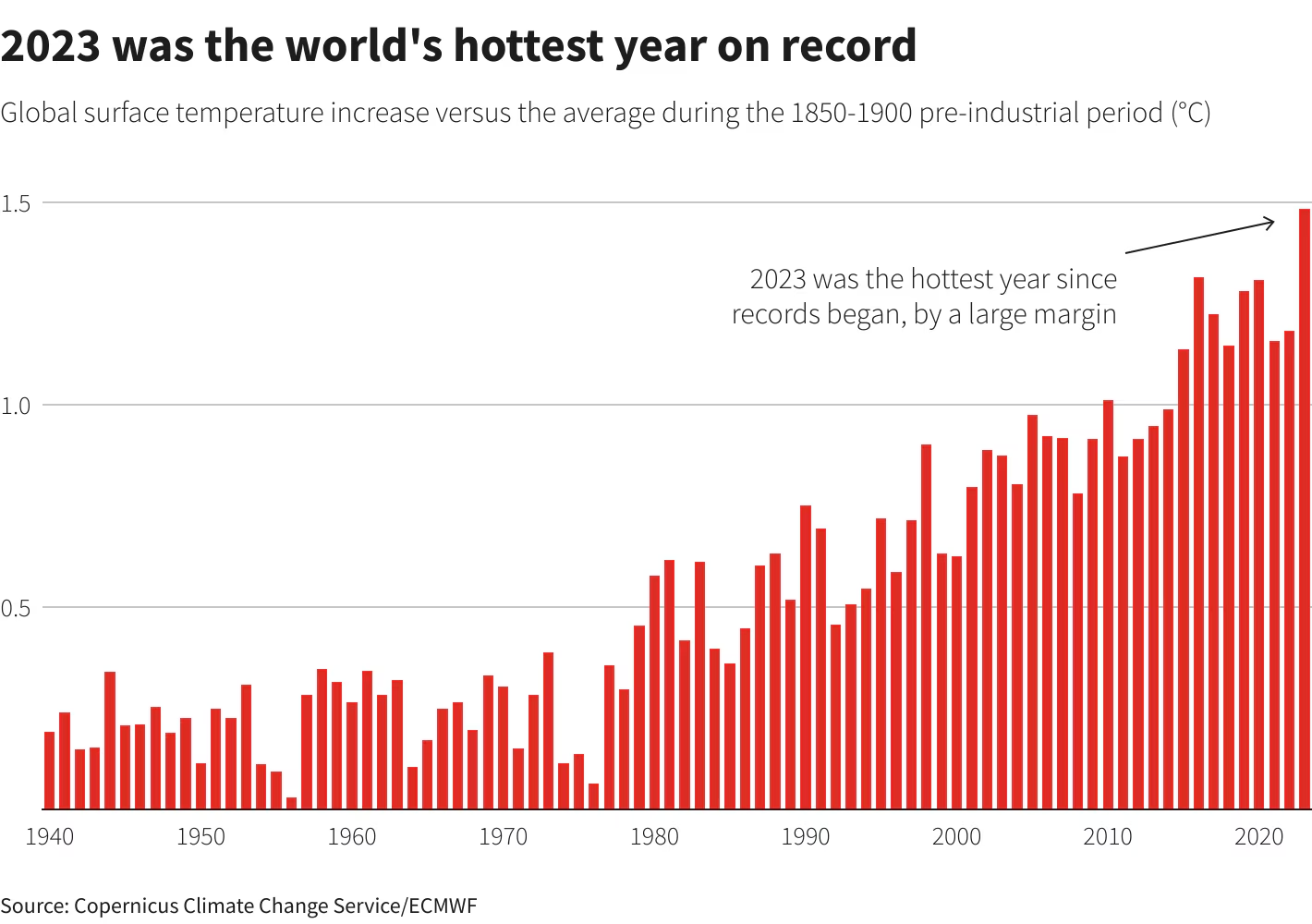 Global temperatures are steadily increasing. Image: Reuters/Copernicus Climate Change Service/ECMWF
2. COP16 biodiversity summit – what you need to know
Discover
How is the World Economic Forum fighting the climate crisis?
Show more
The Global Risks Report 2023 ranked failure to mitigate climate change as one of the most severe threats in the next two years, while climate- and nature- related risks lead the rankings by severity over the long term.
The World Economic Forum’s Centre for Nature and Climate is a multistakeholder platform that seeks to safeguard our global commons and drive systems transformation. It is accelerating action on climate change towards a net-zero, nature-positive future.
Learn more about our impact:
Scaling up green technologies: Through a partnership with the US Special Presidential Envoy for Climate, John Kerry, and over 65 global businesses, the First Movers Coalition has committed $12 billion in purchase commitments for green technologies to decarbonize the cement and concrete industry.1 trillion trees: Over 90 global companies have committed to conserve, restore and grow more than 8 billion trees in 65 countries through the 1t.org initiative – which aims to achieve 1 trillion trees by 2030.Sustainable food production: Our Food Action Alliance is engaging 40 partners who are working on 29 flagship initiatives to provide healthy, nutritious, and safe foods in ways that safeguard our planet. In Vietnam, it supported the upskilling of 2.2 million farmers and aims to provide 20 million farmers with the skills to learn and adapt to new agricultural standards.Eliminating plastic pollution: Our Global Plastic Action Partnership is bringing together governments, businesses and civil society to shape a more sustainable world through the eradication of plastic pollution. In Ghana, more than 2,000 waste pickers are making an impact cleaning up beaches, drains and other sites.Protecting the ocean: Our 2030 Water Resources Group has facilitated almost $1 billion to finance water-related programmes, growing into a network of more than 1,000 partners and operating in 14 countries/states.Circular economy: Our SCALE 360 initiative is reducing the environmental impacts of value chains within the fashion, food, plastics and electronics industries, positively impacting over 100,000 people in 60 circular economy interventions globally.
Want to know more about our centre’s impact or get involved? Contact us.
3. UN warns: ‘Climate crunch time’ is here
Taking urgent action to prevent “catastrophic” spikes in temperature is the subject of a new United Nations (UN) report, which has warned that “countries must start curbing emissions immediately”.
On the release of the report, the UN Environment Programme urged nations to start “right now”, before these pledges are due, to mobilize action at a scale and speed not seen before.
“Climate crunch time is here,” said UNEP Executive Director Inger Andersen, warning that Paris Agreement’s goal to cap rising temperatures at 1.5°C is at critical risk.
Discover
‘Safeguarding the Planet’ at Davos 2025
Show more
How can we catalyse climate and nature action through innovative partnerships, increased financing and the deployment of frontier technologies?
Innovative partnerships and dialogue that enable investments and the deployment of climate and clean technologies will be critical to progress on global climate and nature goals, as well as to address the ‘energy trilemma’ of ensuring an affordable, secure and sustainable energy supply.
According to the International Energy Agency, the technology on the market today can allow us to achieve 66% of the global emissions reductions needed if we are to reach net zero by 2050 – significantly up from two years prior but leaving much work to be done. A scaling up of ambition, governance, partnerships and capital is necessary to accelerate decarbonization efforts to reach net zero, invest in nature-positive transition pathways and ensure the circularity and resilience of resource systems overall.
In this context, it’s crucial for businesses, governments, and civil society to work together to find common solutions and take decisive action. Through its Centres, the World Economic Forum integrates public-private efforts to achieve greater impact. Read more here about this work:
4. News in brief: Other top nature and climate stories this week
More than a third of tree species are facing extinction in the wild, according to new research that says trees are at risk in 192 countries, with land clearance for agriculture, logging, and pests and disease the biggest threats.
Spain has experienced its most powerful flash flood event in recent memory, AP reports. More than 200 people died and many livelihoods were destroyed as more than a year’s worth of rain fell in eight hours near the city of Valencia. Experts said they believed human-caused climate change had made the floods worse.
Finland has started exporting “snow-saving” polystyrene mats, which prevent snow from melting, to ski resorts in countries including Norway and Switzerland, The Guardian reports. The product helps preserve the previous year’s snow for the start of a new ski season, to help tackle increasingly unpredictable snowfall.
5. More from the Forum on the nature and climate crisis
The urgency of the biodiversity crisis is undeniable, but there is a path forward. Our latest film explores how businesses can lead the way to secure a nature-positive future. Watch it below.
The annual biodiversity funding gap to protect nature is estimated at $700 billion. A new report from the World Economic Forum provides businesses with guidance on nature finance, highlighting innovative instruments like biodiversity credits that are gaining traction.
AloJapan.com