
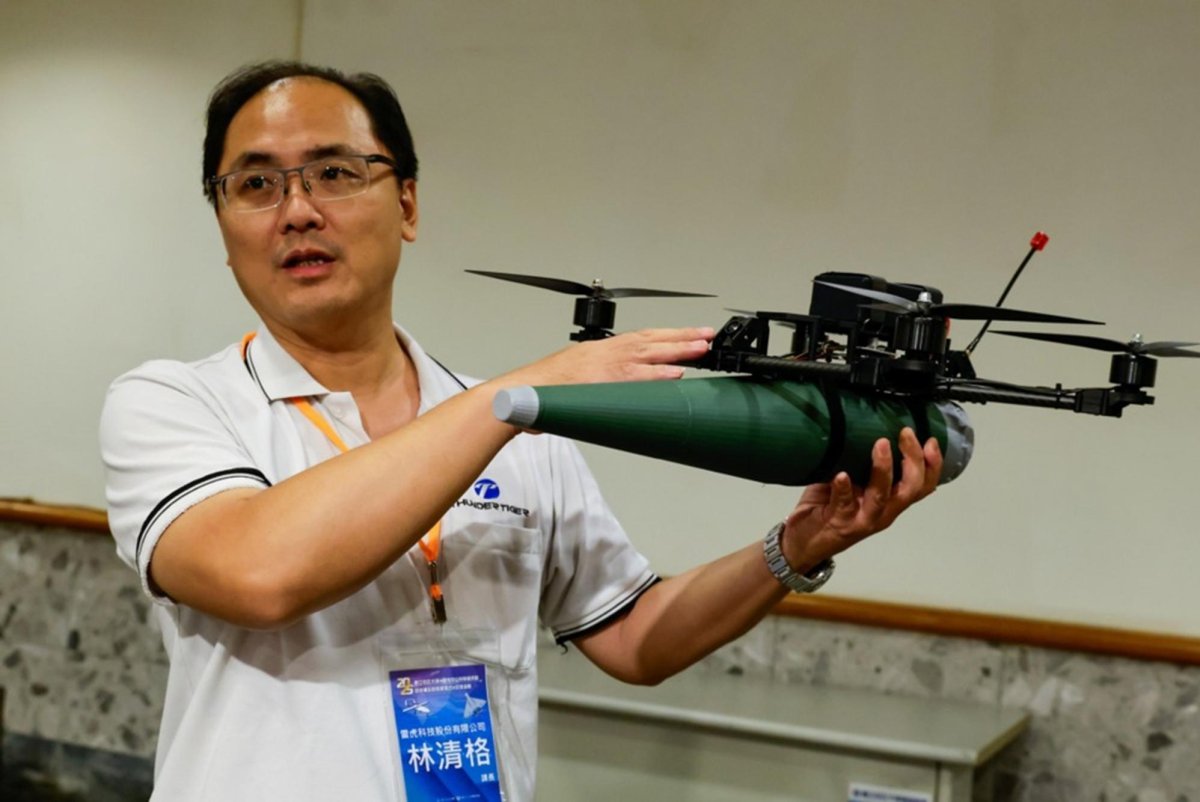
An exhibitor shows a prototype drone with an artillery model attach to it during a media tour inside the National Chung Cheng University in Chiayi, Taiwan. File. RITCHIE B. TONGO / EPA
April 1 (Asia Today) — Japan is considering introducing long-range attack drones with a range exceeding 1,000 kilometers to its Self-Defense Forces, a move aimed at strengthening deterrence against China and North Korea and adapting to changing warfare trends.
According to the Yomiuri Shimbun on Wednesday, the Japanese government and ruling party are reviewing plans to deploy such drones and plan to incorporate them into revised national security documents later this year. The initiative is intended to reinforce Japan’s “counterattack capability,” or the ability to strike enemy bases, adopted in its 2022 security strategy update.
The drones under consideration are expected to include loitering munitions that strike targets directly. Officials are also examining a range of platforms, including systems launched from aircraft and submarines as well as unmanned vehicles operating on or under water.
Japan’s review reflects lessons drawn from recent conflicts, including Russia’s war in Ukraine and U.S. and Israeli military operations involving Iran. In those cases, combined use of drones and missiles has demonstrated the limits of traditional missile-focused defense systems and highlighted the need for more flexible strike options.
Japan has already deployed long-range strike assets such as the Type 25 surface-to-ship guided missile with a range exceeding 1,000 kilometers and is moving to acquire U.S.-made Tomahawk cruise missiles, which can reach beyond 1,600 kilometers. The addition of relatively low-cost drones is expected to create a layered strike capability that is harder to intercept.
A key factor behind the shift is cost efficiency. A single attack drone is estimated to cost about 5.6 million yen, roughly $37,000, compared with about 160 million yen, or approximately $1.06 million, for a Russian Kalibr cruise missile. This cost gap allows for large-scale deployment of drones alongside more expensive missile systems.
Russia has already used Iranian-made Shahed drones in combination with missiles in Ukraine, while the United States has reportedly deployed long-range unmanned systems in operations involving Iran. Japanese officials appear to view these developments as evidence that drone-missile integration is becoming a standard feature of modern warfare.
Analysts say Japan’s potential adoption of long-range drones could reshape the security landscape in Northeast Asia. As China and North Korea continue to develop hypersonic weapons and long-range missiles, the addition of drone-based strike capabilities could accelerate regional military competition.
The Japanese government also sees drones as a tool for sustaining combat operations over extended periods. By relying on lower-cost systems for repeated strikes while reserving high-end missiles for key targets, Japan aims to improve both operational flexibility and deterrence.
The shift underscores a broader evolution in Japan’s defense posture. Long guided by its postwar principle of an exclusively defensive strategy, Japan is increasingly moving toward a model centered on proactive deterrence through integrated strike capabilities.
— Reported by Asia Today; translated by UPI
© Asia Today. Unauthorized reproduction or redistribution prohibited.
Original Korean report: https://www.asiatoday.co.kr/kn/view.php?key=20260401010000115
AloJapan.com