
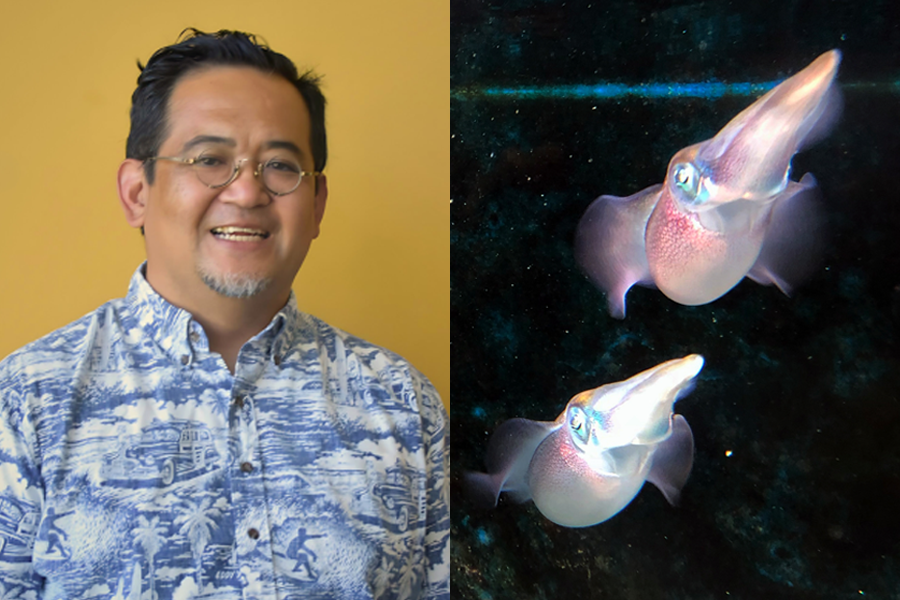
Looking back on his life, Ryuta Nakajima never thought he would be an artist; or a scientist, conservationist and fisheries businessman — but research knows no borders.
Nakajima, professor of contemporary art in the College of Arts, Humanities, and Social Sciences at the University of Minnesota Duluth now lives along Lake Superior, but has always had an affinity for the ocean.
In 2009, he watched a documentary about how cephalopods, such as squid, cuttlefish, and octopuses, can camouflage their body color and texture to match their environment. This made him realize he creates his art in a similar way — by looking at an object and replicating it just like a squid thinks to match the sea floor. This intrigued Nakajima to study cephalopod camouflage as a comparative model for understanding how and why humans produce art.
Ultimately, I want to be able to speak to squid.
Ryuta NakajimaBecoming a behavioral scientist-artist-conservationist
To test his hypothesis, Nakajima traveled to Texas and to Okinawa, Japan, for wet-lab research. He observed cephalopod behavior toward objects in their environment and tested how they camouflage themselves against items outside it, such as modern artworks.
Working with these scientists made him realize how much remained to be discovered about the body pattern behavior of cephalopods for camouflage and communication in science. And while art was his profession, he’d have to immerse himself in science to move forward.
“From that point on, my research has split into both artistic creative output for exhibition purposes, as well as writing scientific papers,” says Nakajima.

Underwater photograph of an oval squid (Sepioteuthis lessoniana) pair at Hedo Point, Okinawa.
Now working with the Okinawa Institute of Science and Technology Graduate University (OIST), he spends his school breaks traveling from Minnesota to Okinawa to study. During his trips to Okinawa over the last 15 years, Nakajima became more aware of issues surrounding the ocean, such as coral bleaching, ocean acidification, overtourism, coastal development and marine debris. As a result, squid populations have declined or migrated to new waters, causing damage to both ocean ecosystems and related human activities.
He founded the Okinawa Seaside Laboratory in 2015 and began conservation work alongside his research, art and teaching in Minnesota. He taught kids and adults alike about the importance of healthy ecosystems and the impacts of plastic pollution, using science and art.
“My research really depends on a healthy ocean. The island of Okinawa economically depends on the ocean, so I wanted to do something to rejuvenate or bring some attention to what’s going on,” says Nakajima.
He is now using business to help work towards a sustainable future. After attracting local and global attention for successfully breeding oval squid for ten consecutive generations, Nakajima launched the first squid aquaculture company in the world, Kwahuu Ocean, in 2024 to convert OIST’s breeding technology into a commercial-based sustainable squid aquaculture.
Currently in research and development, Nakajima aims for this modular, land-based agriculture to supplement a primary food source for many villages, financially support fishermen and give the ocean time to recover.
This circular model of safeguarding animals, people and the planet is a core element of the University’s Elevate Extraordinary 2030 strategic roadmap — driving innovation through a One Health model to promote resilient communities, sustainable food systems and healthy ecosystems.
Minnesota expertise gone global
“Our responsibility in academia is to take risks that other sectors can’t. And that sense of curiosity and desire for discoveries is really the essential part of what we [academics] do,” says Nakajima.

Underwater photograph of an oval squid (Sepioteuthis lessoniana) at Maeda Point, Okinawa.
In the United States, Nakajima led the conservation project “Black Gold” with the University’s Minnesota Sea Grant and Wisconsin Sea Grant. Forty-seven artists drew sturgeon, the project’s symbol, and created a traveling exhibition about Great Lakes water conservation in Michigan, Minnesota and Wisconsin.
In his classroom, Nakajima uses his new knowledge and experience to help students think more deeply about their artistic practice. Their interest in human emotion and landscapes also extends to other fields, and through research and art-making, discoveries can occur.
The interdisciplinarity between the fields is important to Nakajima, and that interconnectedness across the state, nation and world will provide greater benefits to Minnesotans.
“Whether it’s from a cultural experience or scientific discovery, we owe something back to the people of Minnesota.”
Learn more about Najakima’s work.
AloJapan.com