
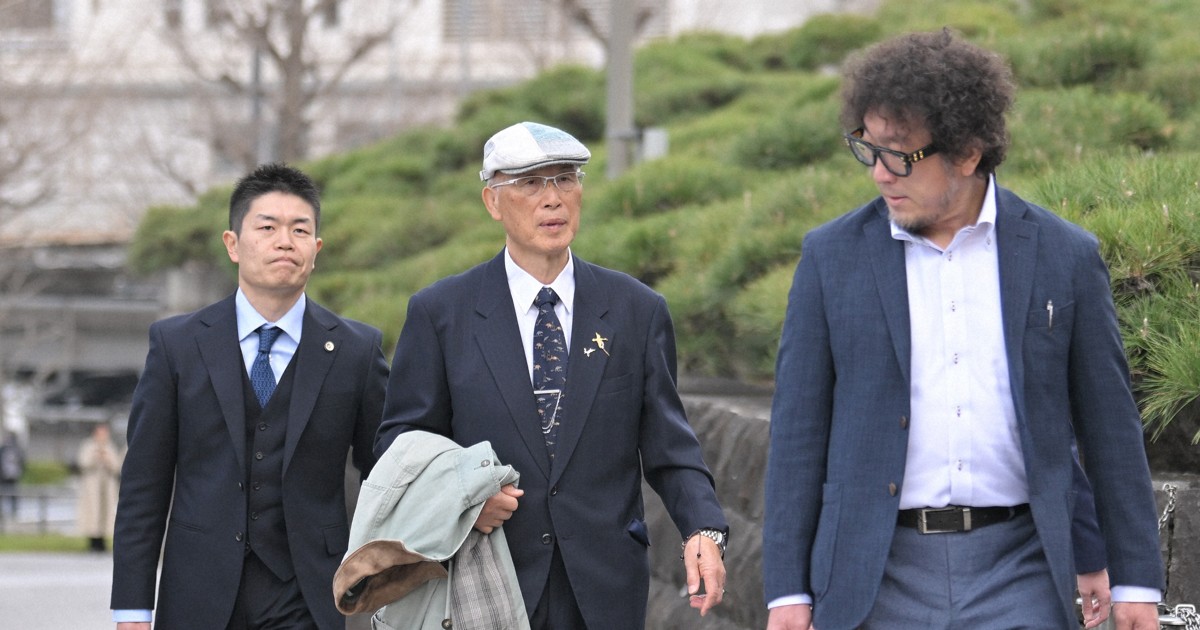
Haruo Ikegami, head of the Sunagawa branch of the Hokkaido hunters’ association, center, heads toward the Supreme Court in Tokyo’s Chiyoda Ward, March 27, 2026. (Mainichi/Koichiro Tezuka)
TOKYO — Japan’s Supreme Court has ruled in favor of a Hokkaido hunter who lost his gun permit after shooting a brown bear at a local city’s request, declaring the prefecture’s decision to revoke his permit illegal and restoring his right to possess a firearm.
In its March 27 decision, the Supreme Court’s Third Petty Bench, presided over by Justice Michiharu Hayashi, overturned a high court ruling, finalizing a reversal victory for 77-year-old hunter Haruo Ikegami. It was the first time for the nation’s top court to rule on the validity of the prefectural public safety commission’s revocation of a hunting rifle permit in connection with shooting a bear.
As bear attacks on people have surged nationwide and become a national issue, the ruling emphasized the public interest of hunting associations, which carry out culls at the request of local governments.
According to earlier district and high court rulings, Ikegami, head of the Sunagawa branch of the Hokkaido hunters’ association, was asked by the Sunagawa Municipal Government in August 2018 to cull a bear, and did so with one shot in the presence of city and police officials. However, since there was a house nearby, the Hokkaido Public Safety Commission in April 2019 revoked Ikegami’s permit to possess a firearm. It ruled he fired toward a building that could be reached by a bullet, as prohibited by the Wildlife Protection, Control, and Hunting Management Act, and that his actions violated the firearms and swords control law.
In December 2021, the Sapporo District Court ruled that Ikegami’s dispatch was for public benefit and, since no bullets struck any buildings, judged the revocation to be illegal. However, the Sapporo High Court reversed that judgment in October 2024, focusing on the possibility of the bullet hitting a rock or another surface and ricocheting off in an unexpected direction, and ruled the revocation legal.
In its Supreme Court appeal, Ikegami’s side argued that bear culling is a public service and that the importance of firing at the request of local governments should be considered. It also argued that the revocation focused excessively on the risk of ricochet and was thus illegal.
The Hokkaido Prefectural Government, on the other hand, had argued that “even when culling bears that threaten public safety, it is unacceptable to underestimate the danger,” maintaining that the revocation was legal.
In response to bear culling issues, the wildlife protection and management act was amended, and from September 2025, an “emergency hunting system” was implemented that allows shots to be fired at bears and other animals in urban areas. As an exception to the general ban on firing toward buildings, hunters can now shoot in urban areas at the discretion of local governments.
(Japanese original by Kentaro Mikami, Tokyo City News Department)
AloJapan.com