
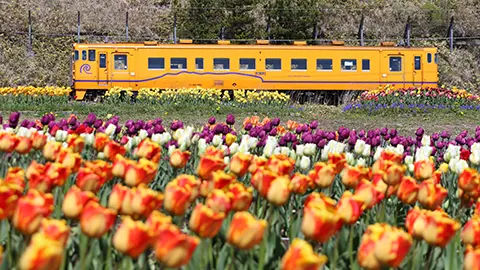
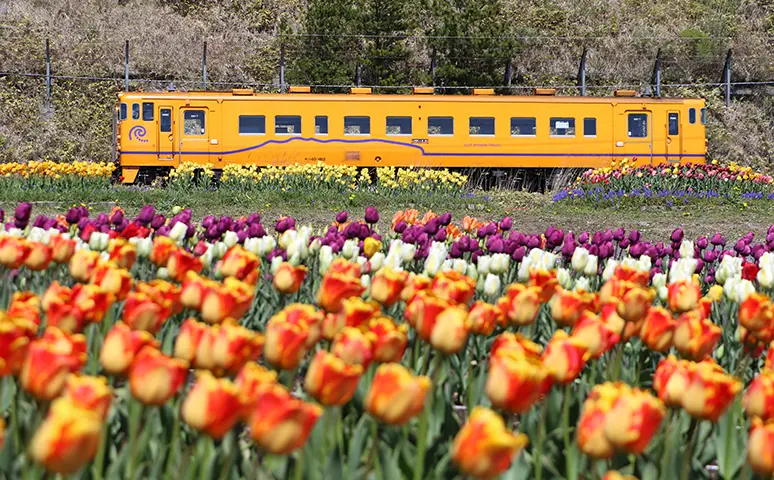
The South Hokkaido Railway and the tulips of Saraki Cape.
Photo: South Hokkaido Railway Company
If you want to experience Japan’s magnificent natural landscapes and enjoy encounters with local residents, why not take a ride on the South Hokkaido Railway (Donan Isaribi Tetsudo), a local railway running through southwestern Hokkaido? We spoke with HARUI Michihiro of South Hokkaido Railway Company’s operation and planning division about ways to enjoy the region’s late-arriving spring and the unique appeal of the railway.
The South Hokkaido Railway is a local railway in southwestern Hokkaido that took over operations of the JR Esashi Line in 2016, following the launch of the Hokkaido Shinkansen, which runs parallel to the route. Stretching 37.8 km, the line runs along the coast from Kikonai Town in Kamiiso District, passes through Hokuto City, and terminates in Hakodate City.
The South Hokkaido Railway’s official starting and terminal stations are Kikonai Station and Goryokaku Station; however, trains actually continue beyond Goryokaku Station onto the JR line to the neighboring Hakodate Station. Hakodate is a core city following Sapporo and Asahikawa, and a historic port city that has played an important role in Hokkaido’s development. On the other hand, Kikonai Station is served by the Hokkaido Shinkansen, providing a direct rail connection to Tokyo Station.
Of the South Hokkaido Railway’s 12 stations, the section between Kikonai Station and Kamiiso Station runs along the Tsugaru Strait. The strait is a body of water linking the Pacific Ocean and the Sea of Japan between Hokkaido and Aomori Prefecture, and from June through December it serves as a rich fishing ground for Japanese flying squid (surume ika), a local specialty of Hakodate. In squid fishing, boats head out to sea at night and use bright lights to attract their catch. The sight of these lights floating in the darkness has long been known as isaribi, or ‘fishing lights,’ and their dreamlike glow has become a seasonal summer feature of Hakodate, giving rise to the name ‘Donan Isaribi Railway.’ Here, Donan refers to the southwestern part of Hokkaido.
In particular, the stretch between Izumisawa Station and Moheji Station offers especially fine views. “It’s an open, scenic section, with spectacular views from the train windows,” says HARUI. Beyond Hakodate Bay, Mount Hakodate comes into view, and under the right weather conditions, passengers can even see the Shimokita Peninsula in Aomori Prefecture.
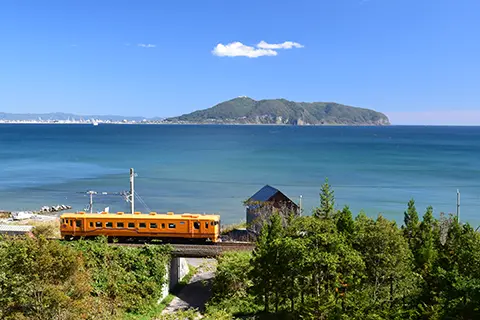
Along the section running beside Hakodate Bay, passengers can enjoy views of Mount Hakodate.
Photo: South Hokkaido Railway Company
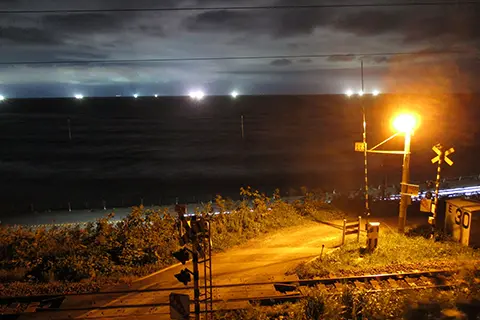
The lights visible on the sea in the background are isaribi, or ‘fishing lights,’ from which the railway takes its name.
Photo: South Hokkaido Railway Company
In spring, the Donan region, centered on Hakodate and served by the South Hokkaido Railway, is transformed by the flowers that bloom along the line, creating colorful vistas throughout the area, according to HARUI.
“In most regions south of Honshu, plum trees bloom first to signal the arrival of spring, followed by cherry blossoms. In southern Hokkaido, however, plum and cherry trees bloom almost simultaneously. In Hakodate, for example, both plum and cherry blossoms begin in late April and are gone by early May, before the start of the Golden Week holidays, a series of national holidays in Japan. From May onward, flowers such as tulips and marigolds come into bloom. In Hokkaido, spring is marked by this dramatic transformation—from the pure white snow of early April to a vibrant, colorful landscape as the flowers gradually appear.”
Notable spring flower spots along the line include the Yae-zakura (double-flowered cherry blossom) trees at Trappist Monastery near Oshima-tobetsu Station, the Shiba-zakura (moss phlox) at the Satsukari Murakami Moss Phlox Garden near Satsukari Station, and the tulip beds at Saraki Cape near Kamaya Station.
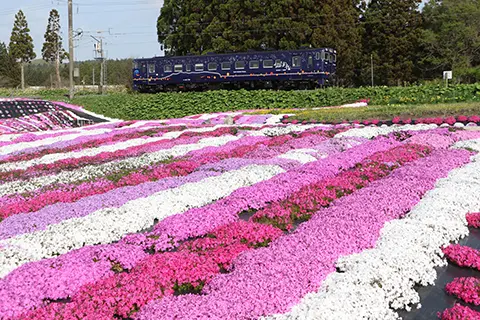
The Nagamare train running along the Satsukari Murakami Moss Phlox Garden, where moss phlox blooms in a vibrant carpet.
Photo: South Hokkaido Railway Company
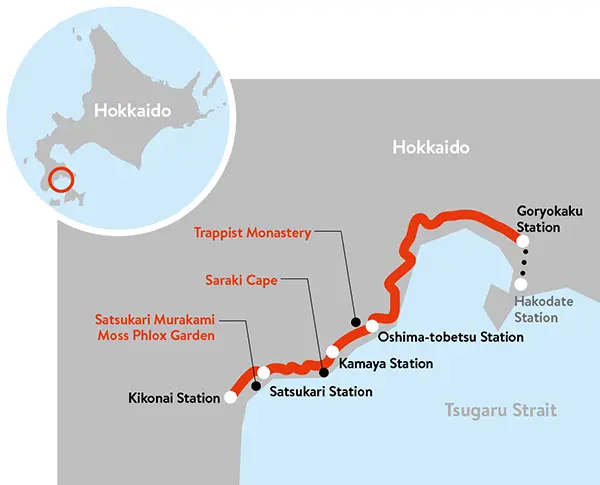
Route map of the South Hokkaido Railway. The dotted section indicates the through-service segment on the JR Line.
In addition to regular trains used by local residents, the South Hokkaido Railway also operates a special sightseeing train called the Nagamare Kaikyo. Nagamare is a term from the local dialect in the Donan region meaning ‘take it easy’ or ‘relax.’ The train runs a round trip between Hakodate Station and Kikonai Station in approximately four hours, even though the journey normally takes about one hour each way. Passengers can enjoy spectacular views of the Tsugaru Strait and meals prepared with local ingredients along the route. At Moheji Station, where the train makes a brief stop, passengers step onto the platform to enjoy fresh seafood grilled at an on-site barbecue.
Such train journeys are made possible with the cooperation of local communities, and the warm, personal hospitality they offer has earned high praise from international tourists. “Going forward, we also want to focus on attracting inbound visitors, including those from Asian countries,” HARUI says, while also expressing his enduring commitment to the local community. “Since opening, our company has worked hand in hand with the local municipalities along the line. In March 2026, we celebrate our 10th anniversary, and we hope to continue initiatives that contribute to the revitalization of the communities along the railway.”
Across Hokkaido’s vast landscapes, late spring is just beginning to arrive. Aboard the South Hokkaido Railway, passengers can enjoy a leisurely ride and experience a spring journey on a local line at a relaxed, unhurried pace.
By TAKADERA Kuriko
Photo: South Hokkaido Railway Company
PREVIOUS
Exploring Japan’s Spring Aboard Local Train Lines
NEXT
Exploring Spectacular Seascapes and a World Heritage Site Along the Gono Line
Feedback and Comments

Thank you for your feedback
Your valuable feedback and commnents will be referenced for our future operations.
Close
AloJapan.com