
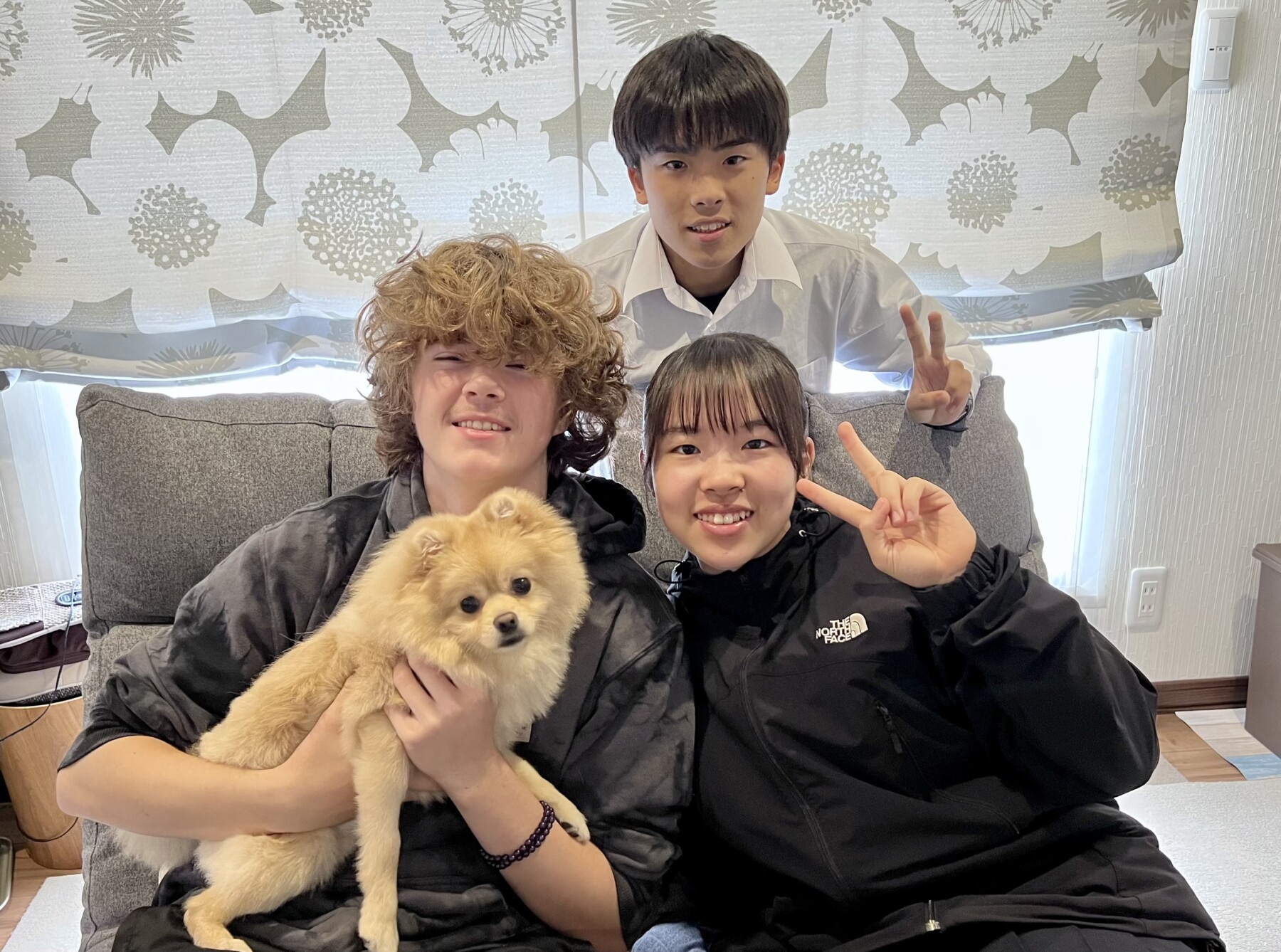
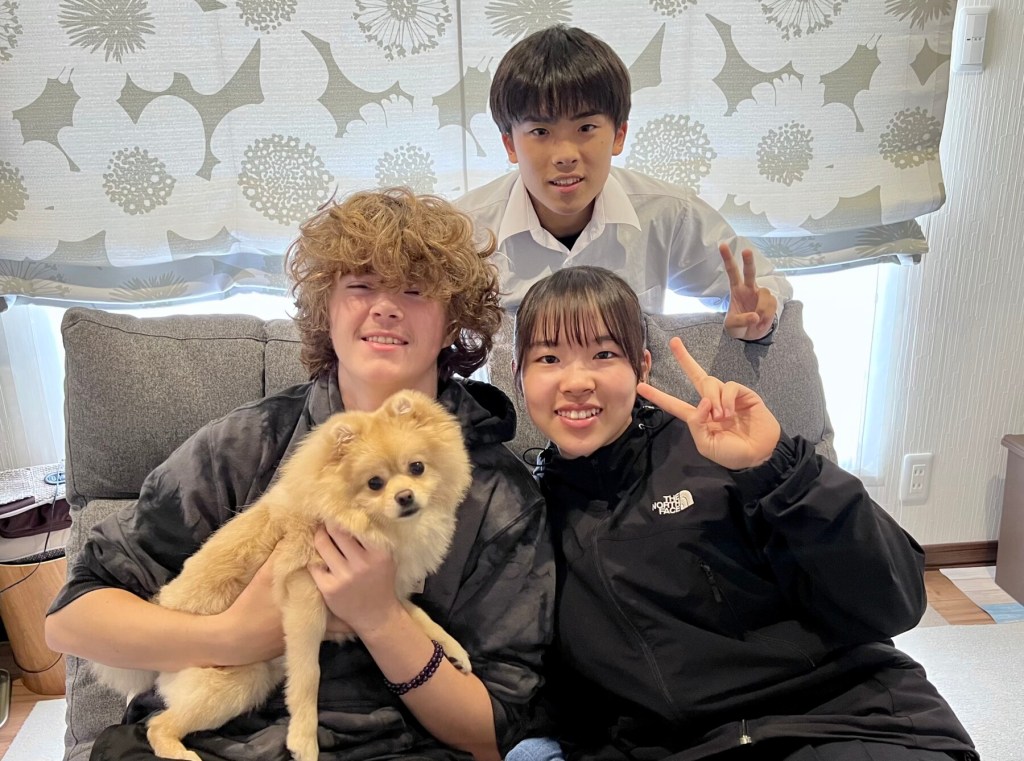
 On the day of his departure from Mombetsu, Nick Crews (left), then a Newport High School sophmore, commemorated his sister cities visit with this portrait of members of his host family, the Watanabes: Aya (next to him), Tomo, and dog, Mugi. Crews, now a University of Oregon freshman, plans a second visit this year. Crews says the Japanese “are the nicest people I’ve ever met.” Photo courtesy: Nick Crews
NEWPORT — Technology in the past 60 years has changed almost beyond imagining, yet some things really don’t change all that much. Take a listen to a snippet of a conversation between Newport officials and their Mombetsu, Japan, counterparts on rotary phones connecting across thousands of miles: “Hello … hello … Are you with me?”
So like those frequently repeated words on a Zoom call: “Can you hear me now?”
The phone conversation took place April 8, 1966, after Newport and Mombetsu (pronounced Mom-bets) officially became sister cities. It’s part of the new exhibit at the Pacific Maritime Heritage Center highlighting the cities’ 60-year relationship. The exhibit, Building Bridges of Friendship Since 1966, will be on display through Sept. 27.
With 24 sister cities in Japan, Oregon has one of the largest numbers of Japanese sister city relationships in the country, said Graham Morris, executive director of the Japan-America Society of Oregon. It also has a sister state relationship with the Toyama Prefecture. Newport’s sister city relationship is the second oldest in the state, following that of Portland and Sapporo, established in 1959.
“One of the great things about Oregon having so many sister city relationships is it is grassroots people-to-people diplomacy, which is super important in making sure the relationship is strong,” Morris said. “This relationship with Newport and Mombetsu is so active and the person-to-person exchange is really great with them.”
The celebration of the relationship between the two cities, both located just below the 45th parallel, will include visits from delegations to and from both, with tours and dinners and gifts. And most importantly, the chance to connect and learn about each other.
“I see it as building the world you want to live in, much like building a neighborhood you want to live in,” said Kaety Jacobson, chairperson of the Newport Sister City Committee. “It requires action by you as a neighbor. I see this as just a very tangible way in the community that I live in to build citizen diplomacy and have connections with people in other places. It’s about realizing that we’re all on this thing called Earth together. I think there’s a lot of learning from a local perspective.”
The sister city relationship grew out of letters from Mombetsu resident Shunichi Kobayachi in 1964 — eight years after President Dwight D. Eisenhower publicly encouraged the international partnership. Kobayachi, a bank clerk, noted the similarities between the cities, including that both are port cities at approximately the same latitude. At the time, Mombetsu had a population of 42,000, Newport approximately 5,400.
Kobayachi wrote, “Main industries of our city are fishery, wood industry, agriculture, and gold mining.” He closed with the information that he was making the application for the cities to become “Sister City” … “as a substitute of people of Mombetsu … and hoping you’ll forgive me for burdening you with such a troublesome request…”
Less than two years later, the proclamation was signed. Over the decades, delegations from the sister cities have visited each other and exchanged gifts — with mixed results. A taxidermied baby seal sent from the mayor of Mombetsu to the mayor of Newport in 1976 in honor of the sister cities’ 10th anniversary was quickly seized by U.S Customs. The seal, named Cecelia, was believed to be a violation of the 1972 Marine Mammal Protection Act. It was later determined that Cecelia was of a different species than that protected under the act and had, in any case, been stuffed before the act was made law.
Newport’s gifts were not always so well thought out either. For the 15th anniversary, Newport had a plaque made for display at City Hall and a second made to send to Mombetsu. “The postage was to be paid by Newport, but Newport couldn’t pay,” said Sachiko Otsuki, curator of the Lincoln County Historical Society. “So, Japan, when they received it, had to pay the shipping fee.”
Gifts from Mombetsu, including Cecelia, are part of the exhibit, which also includes the miniature set of armor displayed at the 1966 reception when the first Newport delegation went to Mombetsu to sign the agreement.
This year, a delegation from Mombetsu is expected on the Oregon Coast in May. Plans include a visit to the wave-testing facility off Seal Rock, a walk along Yachats’ Amanda Trail — named for a blind Coos woman “who suffered injustices during the reservation years in the 1860s” — and a visit to the Rotary Club, which has been instrumental in establishing and maintaining the Sister City program. A student group from Mombetsu will visit Newport separately, and two groups, including students, will visit Mombetsu from Newport.
Nick Crews, a University of Oregon freshman, will make his second visit this year. His first trip to Mombetsu came when he was a sophomore at Newport High School. By then, he’d already traveled a fair amount with his mother, a marine biologist, who encouraged him to go see their sister city.
“Whenever someone asks me what my favorite trip is, one’s Brazil,” Crews said. “The nature there is beautiful. And the tie for first is Japan, the Mombetsu sister city. They are the nicest people I’ve ever met.”
He was particularly struck by the culture. He listed some things Americans wouldn’t think twice about doing — “talking loudly on a subway or wearing shoes inside your house or pouring your own water” — and noted, “all of those are considered impolite or frowned upon in Japan. It’s a different experience.”
Crews, a business major, is planning a career in international business, but should he opt for a different career path, he might consider foreign relations.
“If I were to do anything else, it’d probably be diplomacy,” he said. “This program is something that shows you what it’s about, and I think that’s important, especially now in somewhat of a heavy world where diplomacy is really something that’s important for building a strong future and keeping a strong connection in the present.”
AloJapan.com