
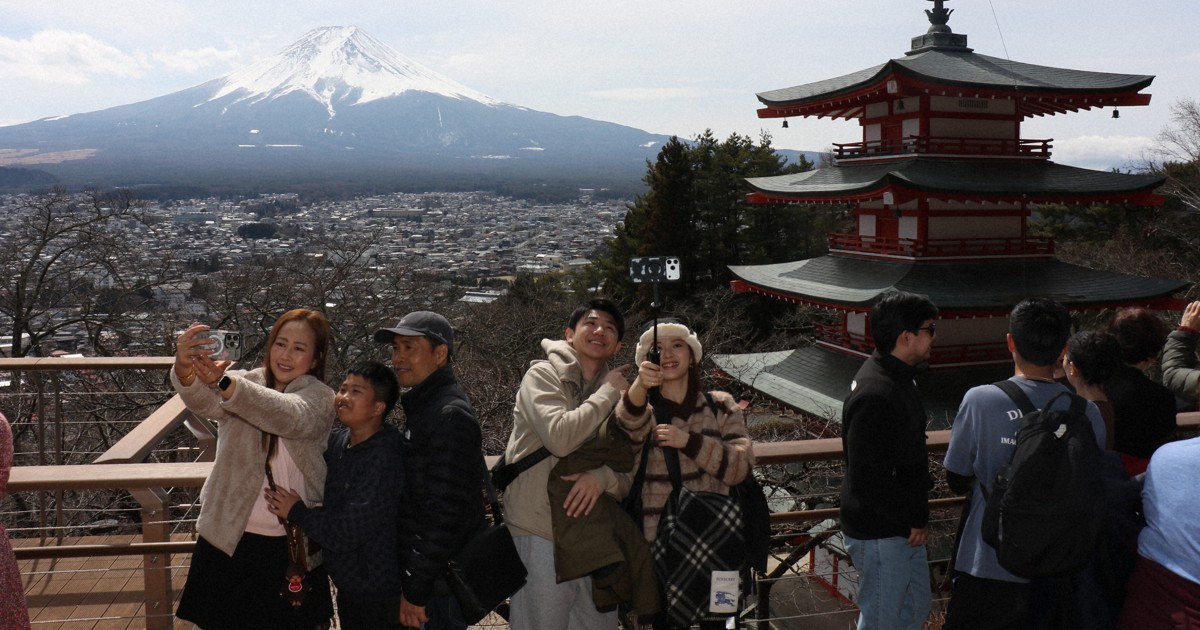
Tourists take photos from the observation deck at Arakurayama Sengen Park in Fujiyoshida, Yamanashi Prefecture, March 18, 2026. (Mainichi/Tatsuki Noda)
FUJIYOSHIDA, Yamanashi — As cherry trees bloom across the country, this east Japan city at the foot of Mount Fuji has decided not to hold its popular sakura festival this spring. The move comes after the volume of tourists overwhelmed the park that serves as the festival site, disrupting daily life for nearby residents.
Even without the festival, the park will remain open, and the Fujiyoshida Municipal Government in Yamanashi Prefecture will step up safety measures, such as traffic restrictions, during the blossom season. Officials say the decision reflects a difficult balancing act between welcoming visitors and preserving residents’ peace of mind.
210,000 visitors in 18 days
Arakurayama Sengen Park sits halfway up 1,180-meter Mount Arakura in Fujiyoshida. A roughly 10-minute climb up steep stone steps leads to the five-story Chureito Pagoda, built to honor local war dead. Behind it lies an observation deck offering a postcard view of Mount Fuji framed by the pagoda and cherry blossoms.
Opened in 1959, the park has become a year-round magnet for overseas visitors. Each spring about 650 Somei Yoshino cherry trees bloom, creating what many call the epitome of “Japanese scenery.” According to the city, 1.58 million people visited in 2025, including 210,583 who came during the sakura festival from April 1 to 18.
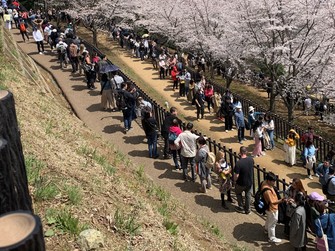
Visitors line up for the observation deck at Arakurayama Sengen Park in Fujiyoshida, Yamanashi Prefecture, in the spring of 2024. The wait was an hour-plus. (Photo courtesy of the Fujiyoshida Municipal Government)
The festival began in 2016, when tourist numbers — both foreign and domestic — started to rise. After the coronavirus pandemic, visitor figures surged again in 2023, and traffic jams in nearby residential streets became routine. Some tourists entered residents’ property or relieved themselves in gardens. A woman in her 70s who lives nearby sighed, “People toss cigarette butts and gum into my yard. The roads are so narrow that cars can barely pass. I’ve given up hoping it’ll improve.”
The city increased security staff during the festival and, starting in 2024, introduced traffic restrictions to ease neighborhood congestion. Last spring it even asked news outlets to refrain from coverage — an unusual step. Yet average daily foot traffic still topped 10,000 for the third straight year.
“We saw what happened last year and realized we’d reached our limit,” said tourism section chief Mika Katsumata at the city’s Mount Fuji division. “We decided we couldn’t hold the full-scale city-sponsored event anymore.”
The municipal government had previously invested heavily in welcoming tourists. Using hometown-tax donations, it expanded the observation deck fivefold in 2022 and opened four paid parking lots, up from one, with space for 180 cars last spring. However, as the costs for security and other operations grew, the city sought a path to coexistence while pursuing the principle of “user pays.” It is now also considering introducing an admission fee.
Taking down the festival banner, not shutting out visitors
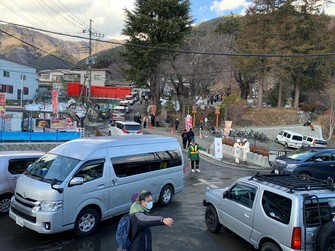
Drivers wait for spaces in the parking lot at the foot of Arakurayama Sengen Park in Fujiyoshida, Yamanashi Prefecture, in February 2024. The road will be blocked and the parking lot closed during the sakura blossom viewing period this year. (Photo courtesy of the Fujiyoshida Municipal Government)
This year Fujiyoshida has “taken down the festival banner” — suspending the formal event — while tightening safety measures and adjusting traffic control. Road restrictions will start earlier, from 7:30 a.m., to match school commuting hours. Parking farther from the site will be cheaper to encourage dispersal.
City officials emphasize they are not trying to end “hanami” — cheery blossom-viewing — itself. After the cancellation announcement, they received multiple calls asking, “Can we still go to see the blossoms?” Katsumata said, “We’re careful that our message doesn’t sound like ‘don’t come,’ but communicating that balance is extremely difficult.” Website traffic to related information pages has already declined.
At a March news conference, Mayor Shigeru Horiuchi said, “We want residents to live calmly while visitors enjoy their stay comfortably. We have no intention of excluding tourists.”
Professor Yoshihiro Sataki of Josai International University, author of books on overtourism, called the cancellation understandable but limited.
“Many foreign travelers visit mainly to take photographs. Stopping the festival alone is unlikely to improve the situation,” he said. In Europe and the United States, he noted, many sightseeing destinations have adopted entry fees and reservation systems, which visitors have come to accept.
“The city is doing what it can under tough conditions,” Sataki said. “The next step may be to consider introducing a reservation system alongside paid admission and begin experimentally limiting the number of visitors.”
(Japanese original by Tatsuki Noda, Kofu Bureau)
AloJapan.com