
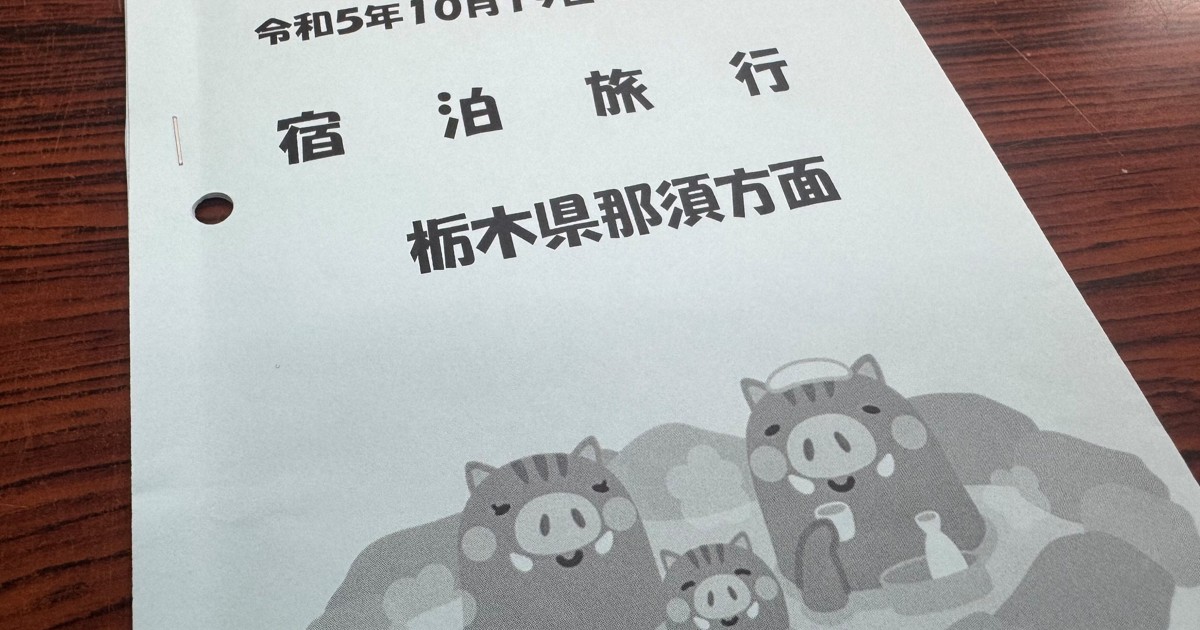
A travel brochure created by “Nonohana,” a disability welfare service center, is seen in Koshigaya, Saitama Prefecture, Jan. 25, 2025. The center chose a different location from the accommodation provider that refused their stay. (Mainichi/Shinji Kurokawa)
Man: “We are a facility for individuals with intellectual disabilities.”
Hotel employee: “We don’t accept reservations from such groups.”
So went an exchange over the phone in June 2023 between a 44-year-old support worker from “Nonohana,” a disability welfare service center in Koshigaya, Saitama Prefecture, and a resort hotel in Nasu, Tochigi Prefecture. The facility had hoped to book rooms for 18 users of the center and eight staff members for an autumn trip. The worker was left speechless and hung up the phone.
A trip meant to broaden horizons
Autumn leaves are seen in Tochigi Prefecture in this photo unrelated to the story. (Mainichi/Seiichi Yuasa)
Nonohana is a day care facility for individuals with severe intellectual disabilities. They had gone on trips once a year, but the outings were paused during the COVID-19 pandemic. The 2023 trip represented a long-awaited restart to the annual event, and both facility users and staff were looking forward to spending time together. For users who typically shuttle between home and the facility, the trip held significant meaning.
“Rather than remaining in a limited world, going where everyone else is going and enjoying the time expands their emotions, their spiritual world and their humanity,” said Yoshie Takano, director of Nonohana’s operator, the Koshigaya-shi Te o Tsunagu Ikusei-kai.
The male staffer had always meticulously inspected accommodation facilities before trips. He would check for large rooms where staff could stay close to users for quick nighttime responses and request the removal of hanging scrolls or vases in rooms in advance. However, this time he was turned away before any such negotiations could begin. “I can’t contain my anger when I think about it,” he reflected.
Hotel apologizes, creates manual
The Mainichi Shimbun contacted this hotel, a popular resort with high ratings on major travel websites, to inquire about its response to the facility, and whether it was appropriate. The hotel responded with a document from the general manager’s office, acknowledging the incident and explaining, “Due to the lack of rules or manuals and only verbal communication, the on-site staff responded based on misinterpretations.” It apologized for the incident.
Three months after the telephone conversation took place, the hotel reportedly developed a response manual. It clarified what was and wasn’t possible, such as making efforts to park buses with wheelchair lifts as close to the entrance as possible while explaining in advance that measures to improve accessibility had not advanced, with stairs and steps remaining. The response stated, “We are striving to gain understanding through constructive dialogue by considering the issues and making proposals within the scope of what is feasible.”
Writing retreat plans blocked
Refusal of accommodation for disabled individuals is occurring elsewhere. Four women in their 30s with hearing disabilities, who are part of a group engaged in creative activities like drawing manga and writing, attempted to book a Japanese-style inn in the Kanto region in April 2024 for an overnight writing session. The inn offered a “manuscript writing plan.”
Using Japan’s “telephone relay service,” which translates sign language or text into voice for people on the other end of the line, they informed the female staff member of the inn that all four were hard of hearing. The staffer responded, “It is difficult to ensure a line of communication and adequately respond in the event of emergencies. We cannot accept guests unless they are accompanied by someone who can hear.”
Recalling the exchange, one member sighed. “I thought, ‘Oh, here we go again.’ When the person responding has little experience interacting with people with disabilities, they often find it troublesome and refuse service.”
This file photo shows a building housing Japan’s Ministry of Health, Labor and Welfare in Tokyo. (Mainichi)
Fearing accusations of ‘customer harassment’
People’s anxiety over refusal of accommodation has been exacerbated by a recent legal amendment. The revised Hotel Business Act, which sets rules for operating accommodations, took effect in December 2023.
The law stipulates that accommodation providers cannot refuse guests except when specific infectious diseases and other such issues are involved. However, the revised law has introduced a provision allowing refusal of unreasonable demands, reflecting the social issue of “customer harassment.”
The Act for Eliminating Discrimination against Persons with Disabilities requires businesses to provide “reasonable accommodation” upon requests by disabled individuals to the extent that the requests do not impose an undue burden.
However, during the process of revising the Hotel Business Act, there were concerns that even legitimate requests could be perceived as “unreasonable demands.”
During the Ministry of Health, Labor and Welfare’s working group discussions for the legal revision, numerous cases of accommodation refusal were reported by organizations for the disabled, raising concerns about the overstretching of “customer harassment” labeling. Consequently, the revised law included a provision to treat cases where individuals with disabilities request reasonable accommodation as exceptions.
Nevertheless, in November 2025, nearly two years after the law came into force, a hearing with organizations for the disabled hosted by the welfare ministry’s Labor Policy Council revealed lingering concerns.
The Japan National Assembly of Disabled Peoples’ International (DPI-Japan), a Tokyo-based group that attended the hearing, mentioned in a written opinion it submitted that the revised law on comprehensive promotion of labor policies, enacted in June 2025, mandates customer harassment countermeasures by companies. They called for guidelines to explicitly state that when people with disabilities request reasonable accommodation or seek apologies for unjust discriminatory treatment, such requests are not to be labeled as customer harassment.
“If things remain as they are, cases of accommodation refusals by businesses with a lack of understanding of the law will increase,” warned Koji Onoue, vice chairperson of DPI-Japan.
The “Nonohana” support worker who faced the refusal of the accommodation request continues to ponder the reasons behind the hotel staff’s response. However, he has yet to find a satisfactory answer.
He commented, “Disabled individuals are seen as undesirable and unwanted. Ultimately, isn’t it that such simple discriminatory attitudes still run deep?”
(Japanese original by Shinji Kurokawa, Yokohama Bureau)
AloJapan.com