
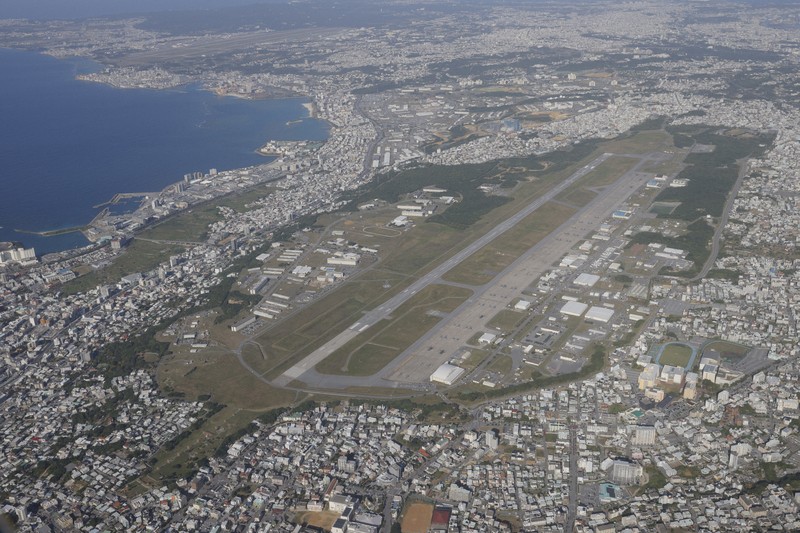
U.S. Marine Corps Air Station Futenma, surrounded by residences, is seen in the Okinawa Prefecture city of Ginowan in this photo taken from the Mainichi Shimbun’s aircraft Kibo on Dec. 8, 2023. (Mainichi)
Does the United States intend to renege on its bilateral agreement with Japan and keep the Futenma base? Such doubts are unavoidable.
The U.S. Department of Defense has raised the possibility of not returning U.S. Marine Corps Air Station Futenma, located in the Okinawa Prefecture city of Ginowan, to Japan, even after its operations are relocated to the Henoko district of the city of Nago in the prefecture. The reason, it says, is that Henoko will lack a runway as long as Futenma’s. The two planned runways are each about 1,800 meters, shorter than Futenma’s approximately 2,700 meters.
Under a plan compiled by Tokyo and Washington in 2013, one condition for the return of Futenma was that in emergencies requiring a longer runway, civilian facilities would be used. The plan assumes that, in a contingency, many aircraft from the Self-Defense Forces, the U.S. military and civilian agencies would use such facilities. However, it does not go as far as stipulating that the civilian runways be specified in advance.
Despite this, the Pentagon told the U.S. Government Accountability Office last year that “Futenma will not be returned” until Japan selects a civilian runway. This is effectively introducing a new condition, and the U.S. position does not stand up to reason.
The Japanese government takes the position that it can address the issue with a system designating a civilian airport for priority use by the Self-Defense Forces and U.S. forces during emergencies. However, Defense Minister Shinjiro Koizumi stated, “It is difficult to specify the details at this point,” and has not clarified which airport would be used.
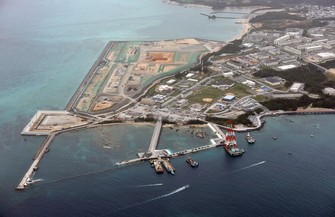
The Henoko area east of Camp Schwab, center, to which the Futenma air base is set to be relocated, is pictured in the Okinawa Prefecture city of Nago on Nov. 28, 2025, in this photo taken from the Mainichi Shimbun’s aircraft Kibo. (Mainichi/Kentaro Ikushima)
On Okinawa’s main island, only Naha Airport has a runway comparable to Futenma’s, but the prefecture opposes allowing the U.S. military to use it in emergencies.
The Futenma base is located in an urban area and has been described as “the world’s most dangerous airfield.” Thirty years have passed since the Japanese and U.S. governments agreed in 1996 on the base’s return to Japan. If the return is not achieved, the danger will become entrenched.
Within the U.S. military, there have been calls for the continued use of Futenma. The security environment in East Asia is deteriorating, but Okinawa Gov. Denny Tamaki has taken issue with such calls, saying, “We absolutely cannot accept the U.S. side’s self-serving narrative.”
The Japanese government has stressed that it aims to alleviate the burden on Okinawa of hosting U.S. military bases and has insisted that relocation of the base to the Henoko area is the only solution. But if there is any possibility that Futenma will remain, the premise of the relocation plan collapses. Tokyo must resolve the differences in perception and press Washington to ensure it fulfills its promise to return the base.
AloJapan.com