
Local artist also raises concerns about damage on Azusa Street.
 Photos by J.K. YAMAMOTO / Rafu Shimpo
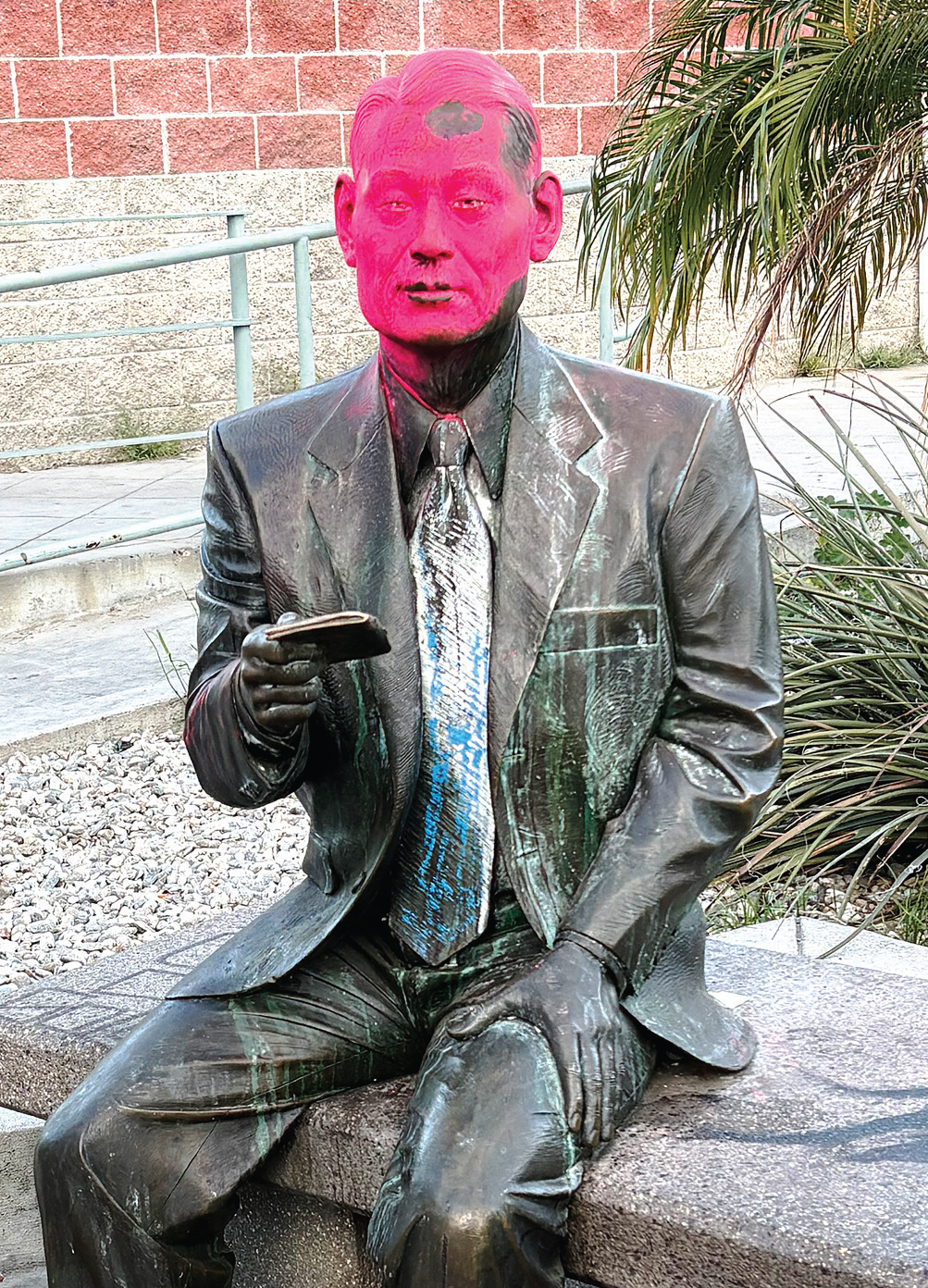
The statue of WWII diplomat Chiune Sugihara was defaced with red paint in early February, but has since been cleaned.
By J.K. YAMAMOTO
RAFU STAFF WRITER
Incidents of graffiti and other forms of vandalism in Little Tokyo have been too numerous to mention, particularly during the ongoing anti-Trump protests Downtown. However, one particular case has drawn international attention.
A statue of Chiune Sugihara (1900-1986), a Japanese diplomat who saved thousands of Jewish refugees from the Holocaust during World War II, stands on the corner of Second Street and Central Avenue near the former locations of Starbucks and Home Depot. Created by sculptor Ramon G. Velasco in 2002, it depicts Sugihara sitting on a bench, holding some of the visas that allowed the refugees to leave Lithuana before the arrival of the Nazis in 1940. A plaque on a boulder next to the statue describes Sugihara’s deeds.
Between Feb. 6 and 7, the statue was vandalized with Sugihara’s head covered in red paint. Local artist Mike Saijo posted a photo of the statue on social media on Feb. 9 with quotes from Sugihara, who disobeyed orders from Tokyo not to get involved: “I could not allow these people to die … I had to follow my conscience … I knew that somebody would surely complain about me in the future. But I myself thought this would be the right thing to do.”
In response, Saijo heard from Madoka Sugihara, who runs a nonprofit in Japan dedicated to preserving her grandfather’s legacy: “A friend in the U.S. informed me of this news. As the granddaughter of Chiune Sugihara, I am deeply saddened to hear about the incident at the statue. However, I believe this is not just an act of vandalism, but an opportunity for us to remember the spirit of ‘humanity’ and ‘courage’ that my grandfather stood for.
“Many of the refugees saved by my grandfather looked to America as a land of freedom, peace, and tolerance. I truly believe that the United States is a great nation of justice and conscience.
“My heart and prayers are with the community in Little Tokyo. I hope that we can move forward with peace and hope.”
Sugihara later provided an update: “I wanted to share some heartening news. Following the incident, Dr. Ted Gover and Rabbi Abraham Cooper from the Simon Wiesenthal Center personally went to the site and worked together to remove the paint. Thanks to their swift efforts, the statue has been restored. It was a moving reminder of the deep friendship between our family and the Jewish community.
“I am reaching out today because Mainichi Shimbun, one of Japan’s major national newspapers, is interested in covering this story. They would like to use your photo to illustrate both the incident and the cleanup efforts by Ted and the rabbi …
“Thank you for your care for the Little Tokyo community.”
Saijo then heard from Orange County resident Kinue Tokudome: “Thank you so much for allowing the Japanese daily Mainichi Shimbun to use your photo of the vandalized Sugihara statue. I just returned from Japan, where I accompanied the family members of the Sugihara survivor and the curator of the Sugihara House museum in Lithuania as they visited Sugihara-related sites in Japan.
“I am also a close friend of Rabbi Abraham Cooper and Dr. Ted Gover, who cleaned the Sugihara statue just a few days ago. My X post reporting on their act has received 1.6 million views so far.
(https://x.com/twitter/status/2024765641723716019) “Again, thank you for caring for this remarkable human being and for making sure that people learn from his courageous act.”
Japan Daily reported on Feb. 26, “While the motive remains unclear, the incident has raised concerns about possible hate-related intent amid rising tensions. Officials say they are continuing to monitor the situation.”
Over the years, people have placed hats or glasses on the statue or written graffiti on its forehead, but the latest incident was the most extensive vandalism in recent memory.
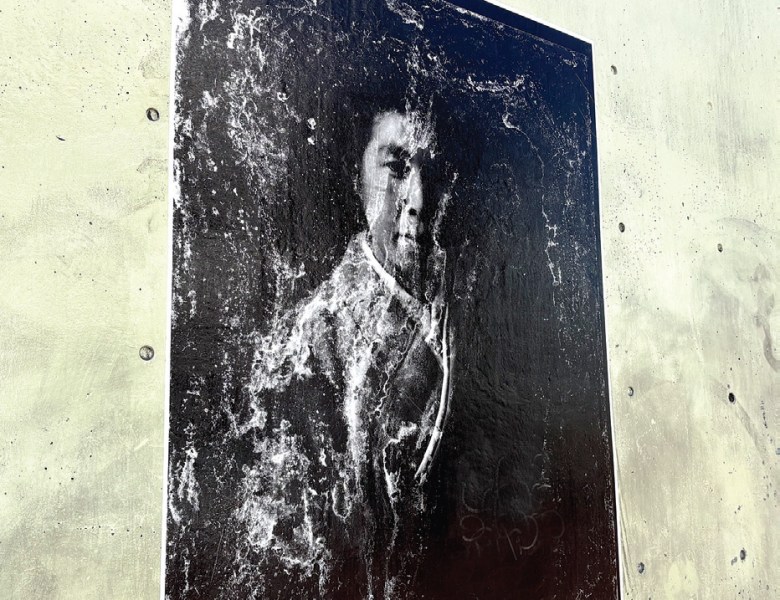 In January, historical photographs that are part of a mural near the Japanese American Cultural & Community Center were damaged or defaced.
Little Tokyo Mural Defaced
Saijo also used social media to alert the community about more extensive damage done to a mural on Azusa Street off San Pedro Street, near the Japanese American Cultural & Community Center’s Noguchi Plaza and Frances K. Hashimoto Plaza. Historical photographs were covered with paint or partially blotted out with some kind of corrosive chemical.
“Would you consider this a hate crime or erasure of history?” Saijo wrote on Jan. 4. “Last night someone tagged over the Chikashi Tanaka photos on the historic Azusa Street in Little Tokyo, and someone deliberately painted over the faces. Few days ago someone else had tagged over some photos in blue but it wasn’t over the faces like this.”
The artist has tried to clean up the graffiti, but much more work needs to be done.
“In conjunction with a photographic exhibition titled ‘Glowing Earth’ at the L.A. Center for Photography, we installed a large-scale photographic series on Azusa Street by Chikashi Tanaka from circa 1914, honoring the early Japanese American community,” Saijo said. “Seeing these historic images vandalized after recent protests was thought-provoking — watching history itself being erased or disregarded. I asked myself: What’s driving this?
“Vandalism stands in direct opposition to the cultural preservation work we are trying to accomplish. From the vandal’s perspective, tagging over an image may be a way to claim ownership, gain visibility, or project a political or personal message. But for the community, it represents a loss — an attack on shared memory, identity, and cultural assets.
“Unfortunately, vandalism in Little Tokyo has increased significantly over the past decade and will likely continue unless we collectively address it by enforcing laws and reinforcing community values that protect our neighborhood.”
Following a recent attack on a local shop owner, Saijo organized a petition drive that gathered 100 community signatures calling for security cameras and signage in the area between the JACCC and Second Street, across from Japanese Village Plaza.
“Community members have even offered financial support, and we are currently exploring community-monitored security camera options,” Saijo said. “These efforts are not just about deterrence — they are about stewardship, safety, and ensuring that the stories embedded in Little Tokyo’s spaces are preserved for future generations.”
“We are saddened and disgusted by the damage to the Sugihara statue and ‘Azusa Street Revival’ mural,” stated David Ikegami, president of the Little Tokyo Business Association. “These works of art represent historically significant periods in history and deserve to be revered and respected.”
Ikegami added that a program addressing graffiti and other forms of vandalism is in the planning stages and due to be implemented in the coming weeks by LTBA’s newly formed Little Tokyo Property and Business Improvement District (BID).
Articles for you
AloJapan.com