
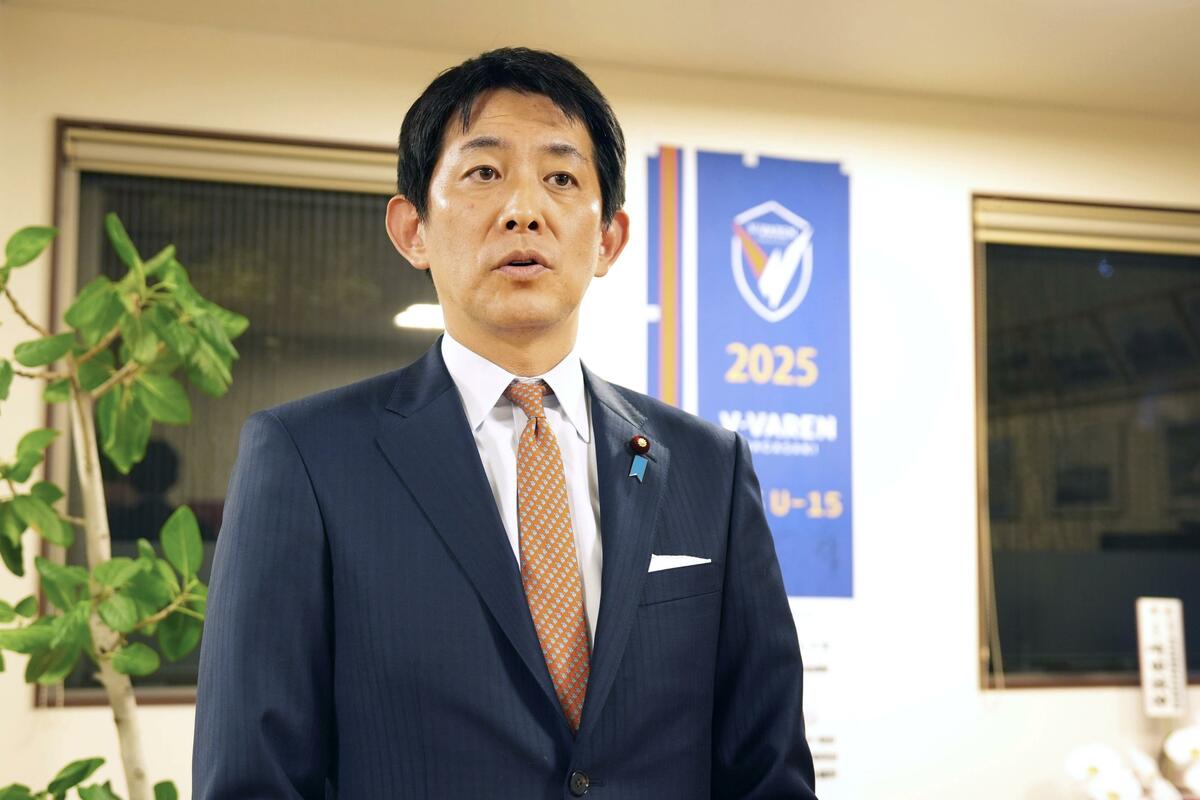
TOKYO – A senior Japanese ruling party official on Sunday called for a “careful” decision regarding the deployment of Self-Defense Forces to the conflict-stricken Middle East for the escort of ships to ensure safe passage.
Liberal Democratic Party policy chief Takayuki Kobayashi said during a TV program that he will “not exclude the possibility (of escorting) from a legal standpoint,” but the deployment would be “an extremely high hurdle.”
Under the Self-Defense Forces Act, the government can order the SDF members to accompany Japan-related ships for protection as a maritime security operation, permitting their use of weapons.
SDF activities overseas have been restricted under Japan’s war-renouncing Constitution. The government has expanded the role of the SDF abroad through security legislation that took effect in 2016, but sending troops to areas where they could get embroiled in fighting remains controversial.
Mitsunari Okamoto, policy chief of major opposition party Centrist Reform Alliance, said on the same TV program that Prime Minister Sanae Takaichi should not make a “rash promise” even if U.S. President Donald Trump asks for SDF activities in the Middle East during their planned meeting in the United States on Thursday.
Trump said Saturday on social media that he wants Japan among other nations to send warships to the Strait of Hormuz to ensure the safety of the vital energy shipping route, which Iran has effectively blocked in response to attacks by the United States and Israel.
During an interview with NBC News, Trump was quoted as saying that it is not clear whether Iran has dropped mines into the strait, but noted, “We’re going to sweep the Strait of Hormuz very strongly, and we believe we’ll be joined by other countries that are somewhat impeded from getting oil.”
The SDF can be dispatched overseas to aid the United States and other friendly nations under armed attack if the situation is deemed threatening to Japan’s survival, even if Japan itself is not under attack. This is known as exercising the right to collective self-defense.
In a situation that is deemed to have significant impact on Japan’s peace and security, the SDF can engage in logistical support for the activities of U.S. military and those of other countries.
So far, the government has determined conditions have not been met in the current situation to allow the SDF to be dispatched in those two scenarios.
During parliamentary deliberations over Japan’s security legislation in 2015, then Prime Minister Shinzo Abe cited the dispatch of the SDF for minesweeping operations in the event of a closure of the Strait of Hormuz, saying such a blockade could have a devastating impact on the public.
Japan depends on the Middle East for over 90 percent of its crude oil and 11 percent of its liquefied natural gas.
AloJapan.com