
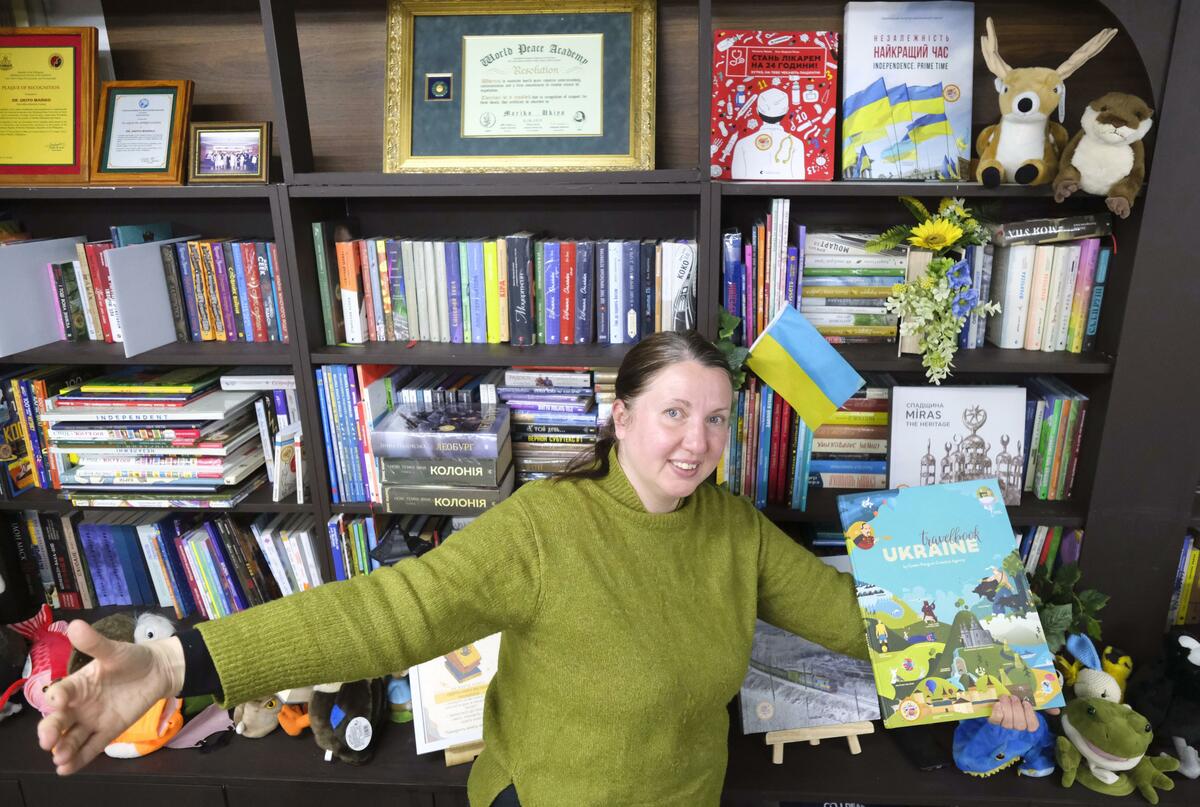
TOKYO – A small library of Ukrainian-language books in Tokyo’s Shibuya area is serving as an emotional anchor for people who have fled to Japan from Ukraine since Russia’s full-scale invasion of the country in 2022.
The library was opened that year by Daria Murakami, a Ukrainian woman who married a Japanese man, with a strong resolve to protect Ukrainian culture.
What began as a modest effort has steadily grown. It now holds nearly 1,000 picture books, novels and manga filling bookshelves that line the walls of a room in the building, creating a quiet space where visitors can browse and reconnect with the language and stories of their homeland.
Daria came to Japan in 2014, when Russia fomented conflict in the eastern region of Ukraine. Determined to build a life in her new country, she studied Japanese and eventually married her husband. While raising their 7-year-old daughter, she teaches English to children at a kindergarten.
There are nearly 2,000 Ukrainians in Japan, including many mothers with small children. For many of them, daily life is filled with uncertainty and worry.
Raising children in unfamiliar environments while constantly checking news about the war in their home country is immeasurably stressful. Daria’s initiative was intended to provide a place where Ukrainians can relax and feel at home.
Following the 2022 Russian full-scale invasion of Ukraine, the Japanese Organization of Mental Health and Educational Agencies, a group of counselors that provides mental care primarily for people in disaster-hit areas in Japan, decided to extend its support to Ukrainian refugees.
Mariko Ukiyo, head of the organization, began looking for someone who could serve as a bridge for the new project. “We have know-how for mental care but knew nothing about Ukraine,” she said.
Ukiyo soon found that person in Daria because of her familiarity with both the Ukrainian and Japanese languages and cultures, as well as her personal understanding of what displaced Ukrainians were going through.
Ukiyo immediately accepted Daria’s proposal to place books in the organization’s office for Ukrainian refugee support because, she recalled, “reading eases loneliness.”
Daria brought about 50 books and displayed them on a small bookshelf in a corner of the office. Visitors quickly began picking them.
Mothers’ facial expressions softened as they read the books to their children, sharing stories that reminded them of home. For people asking for books from distant places such as Okinawa, Daria sends them at her own expense.
Daria also received an immediate response when she asked friends and others in Ukraine for support. A bookstore employee solicited donations of books from customers, while authors willingly sent their writings.
A publisher continues to send newly released books despite difficult wartime business conditions, including the fact that it can use electricity for only three hours per day.
Some people now visit the library frequently, saying the space makes them feel as if they have briefly returned home. One of them is Olha Kobylianska, 26, who has been living in Japan for almost four years.
When she found a favorite book she used to read in Ukraine, she spoke in a choked voice. “It brings back memories of happy times I spent with my family and friends,” she said.
Watching videos of Russian soldiers setting books on fire is heartbreaking, she said. “Books here don’t get damaged at all. That’s why I want to collect as many books as possible.”
AloJapan.com