
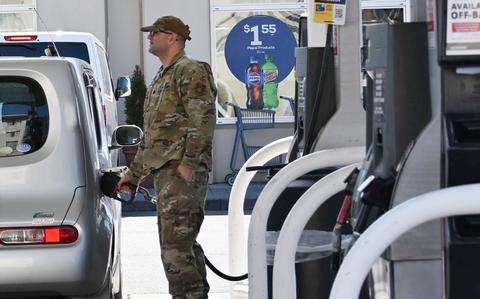
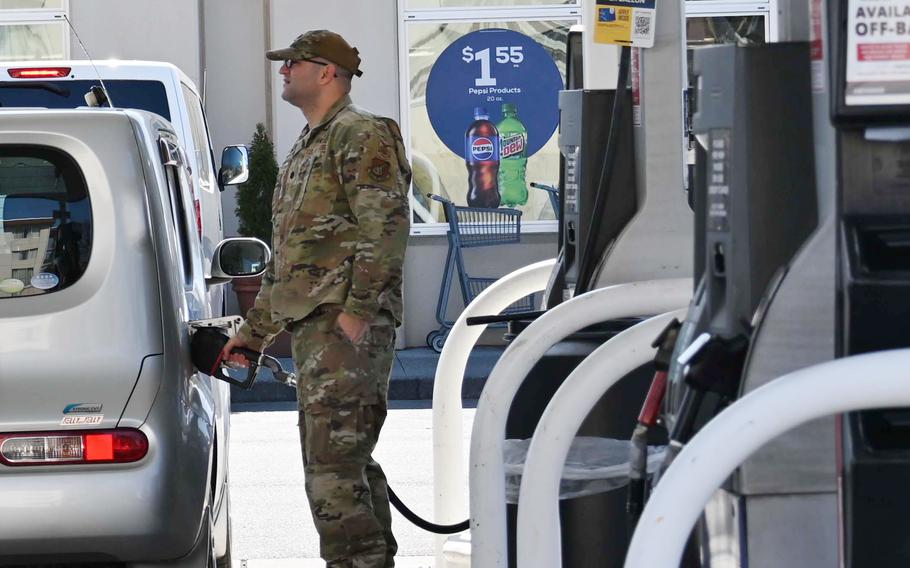
A service member fills his tank at an Army and Air Force Exchange Service gas station on Yokota Air Base in western Tokyo, March 12, 2026. (Seth Robson/Stars and Stripes)
YOKOTA AIR BASE, Japan — Gasoline prices at U.S. military bases across the Pacific will jump by nearly 50 cents this weekend as rising tensions in the Middle East push global oil prices higher.
A price list released Thursday by the Army and Air Force Exchange Service shows the increase will take effect Saturday at bases in Japan, South Korea and Guam.
The hikes come amid concerns about energy supplies after Iranian attacks on shipping in the Strait of Hormuz, a key route for global oil exports. Iranian forces struck three cargo ships attempting to transit the waterway Wednesday as crude oil futures approached $100 per barrel, according to a report that day by The Wall Street Journal.
At U.S. bases across mainland Japan and Okinawa, a gallon of regular gasoline will rise to $3.559.
Drivers at Yokota — the home of U.S. Forces Japan in western Tokyo — have been paying $3.069 per gallon for regular, while prices stand at $3.349 on Misawa Air Base in northeastern Japan and $3.309 at Okinawa bases.
Regular gasoline on bases in South Korea will increase from $3.099 to $3.589 per gallon. On Guam, the price will rise from $3.129 to $3.619, according to exchange data.
Premium fuel prices will also rise. At Yokota and other bases in main island Japan and Okinawa, a gallon of premium will increase from $4.039 to $4.509.
Exchange customers in South Korea will pay $4.539 per gallon for premium, up from $4.069. On Guam, premium will increase from $4.099 to $4.569.
Diesel prices will rise even more sharply. In Japan, including Okinawa, it will increase from $3.959 to $4.919 per gallon, while in South Korea it will climb from $3.989 to $4.949.
At Yokota on Thursday, Air Force Staff Sgt. Alex West was filling up his Subaru Legacy at an exchange service station.
“It’s not great,” he said of the approaching price hike, adding that he experienced high fuel prices while living in California. He said he rode a scooter at his last duty station, Incirlik Air Base, Turkey.
The exchange sets overseas fuel prices based on the Department of Energy weekly average for gasoline in the continental United States, along with additional costs tied to operating fuel stations overseas.
Those costs include labor, infrastructure depreciation and other expenses associated with supplying fuel to authorized drivers at overseas bases, according to the exchange.
AloJapan.com