
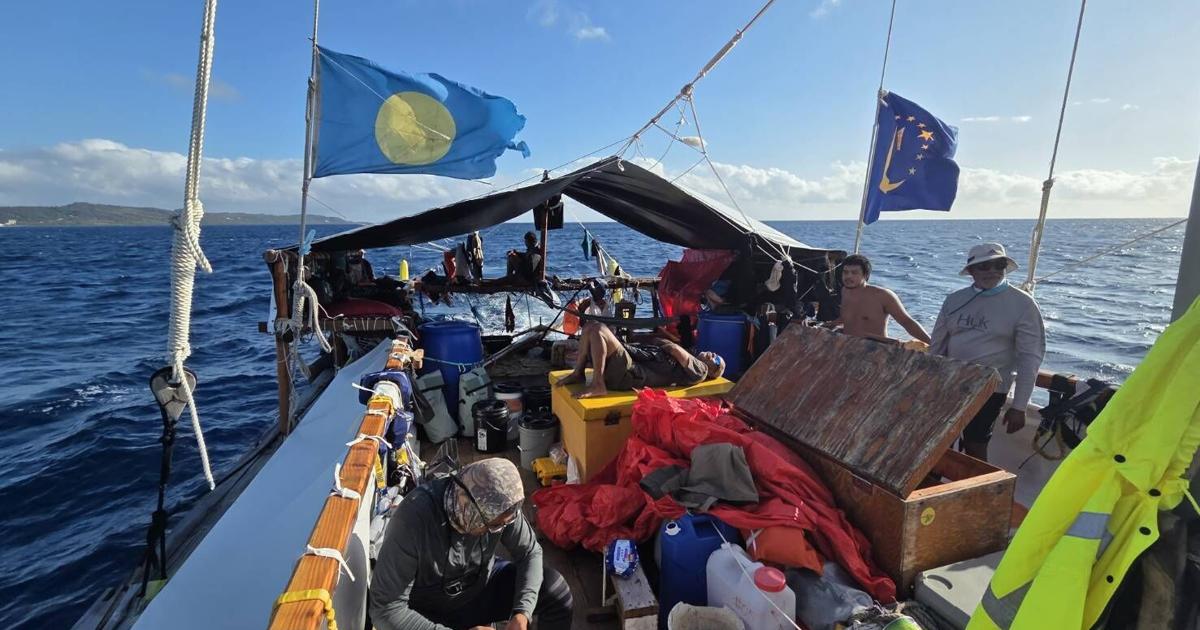
For Guampedia Managing Director Rita Pangelinan Nauta, the traditional voyaging canoe Alingano Maisu is not just crossing the Pacific – it is carrying her daughter into the pages of Pacific history.
Nauta, a CHamoru historian, chronologist and cultural perpetuator, said the voyage has taken on a deeply personal meaning because her daughter, Zea Nauta is part of the crew. Zea turned 30 on March 12.
“She’s my daughter first,” Nauta said, acknowledging that even as she celebrates the historic voyage, she also watches it unfold through the eyes of a concerned mother.
Zea Nauta is serving as the educational coordinator for the expedition, which began in Palau on Feb. 15 and will cover about 6,200 nautical miles across the Pacific over roughly 100 days.
The canoe reached Kaohsiung, Taiwan, earlier this month and departed again March 12 for the island’s east coast. The crew is expected to arrive in Taitung around March 15, continuing a voyage that blends traditional navigation, cultural exchange and modern education.
Nauta said she flew from Guam to Taiwan after learning the canoe would arrive about a week earlier than initially expected, wanting to be there as the crew reached port.
Although Pacific Islanders’ ancestors may have sailed similar routes between Palau and Taiwan centuries ago, Nauta said it still takes time to process the reality that her daughter is now part of that living history. Indeed, with every nautical mile, she becomes not only part of Guam’s history, but also part of the history of every place they land.
The first leg of the voyage was challenging. Nauta said the crew endured eight straight days of rain, sailing without seeing the sun until the ninth day of the journey.
The voyage is being led by Grandmaster Navigator Sesario Sewralur aboard the Alingano Maisu, a traditional canoe originally built in Hawai‘i as a gift to his father, legendary Micronesian navigator Pius “Mau” Piailug, whose teachings helped revive traditional Polynesian and Micronesian wayfinding.
Today, Sewralur and a new generation of navigators continue that legacy, training 13 younger sailors in celestial navigation, weather reading, sail handling and decision-making at sea.
The expedition vessel doubles as a floating classroom. In partnership with Palau Community College and supported by the Micronesian Voyaging Society, the canoe serves as a platform for education programs, youth mentorship and marine science activities, including environmental observation and data collection along the route.
At each stop, the crew plans to engage with schools, universities and community leaders, sharing knowledge about traditional navigation, ocean stewardship and cultural heritage.
The voyage schedule includes extended cultural exchange visits along the way.
After Taitung, the canoe is expected to depart March 22, arriving in Hualien, Taiwan on March 24 before setting sail again March 30 for Okinawa, Japan where it is projected to arrive between April 10 and April 12, depending on weather and sea conditions.
From Okinawa, the canoe will continue south across the Pacific, arriving in Guam on May 1 before continuing to Saipan, Satawal, Yap and Palau, where the voyage is scheduled to conclude May 30 with an arrival ceremony.
In total, the expedition is expected to include about 54 to 58 sailing days, with another 44 to 48 days devoted to cultural programs and educational exchanges in ports across Taiwan, Japan and Micronesia.
Among the younger crew members is Landon Moss Sewralur, 22, a trained Paiurourou navigator, and two new crew members from Palau, Metukr Columbus, 22 and champion paddler Elilai Sugiyama, 32. Others hail from from Micronesia, Hawai‘i and Japan.
For Rita Nauta, the voyage underscores how traditional knowledge continues to shape the present.
The Pacific Ocean, she said, has always been a path rather than an obstacle – validated today by sailors now guiding the Alingano Maisu across the same paths their ancestors once navigated by stars, winds and waves.
AloJapan.com