
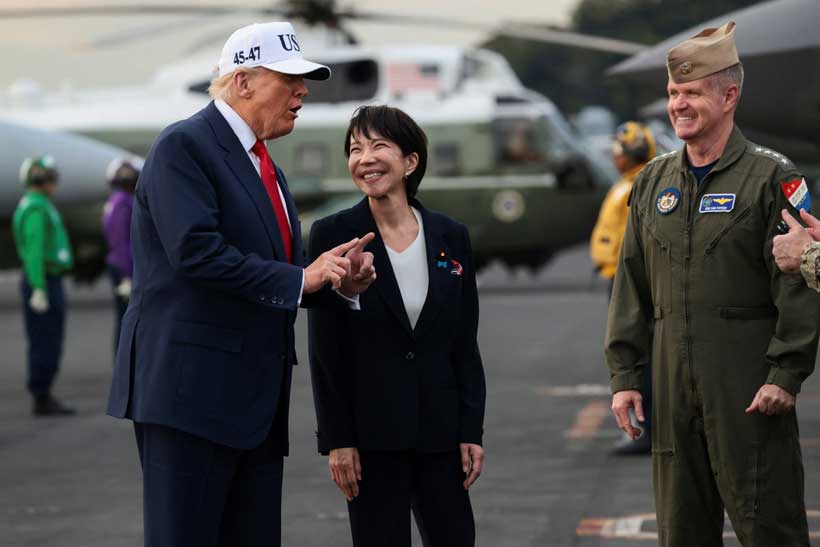
Japan plans to inform the United States next week that it intends to join the “Golden Dome” missile defence initiative proposed by Donald Trump, according to sources familiar with the discussions.
Japanese Prime Minister Sanae Takaichi is expected to announce the plan during a leaders’ summit with Trump in Washington on March 19.
The initiative comes as conflicts in the Middle East and Europe are putting pressure on U.S. missile inventories and reshaping global defence cooperation.
What the Golden Dome project is
The Golden Dome initiative was unveiled last year as an ambitious missile defence system with a target completion date of 2028.
The plan seeks to expand existing ground based missile defence networks while incorporating more advanced and experimental technologies, including space based systems capable of detecting, tracking and potentially countering incoming missiles from orbit.
While the concept has drawn attention among defence planners, the project has so far shown limited visible progress, and details about how allies such as Japan would participate remain unclear.
Japan’s motivations
Japan views participation in the project partly as a way to strengthen its protection against emerging missile threats.
According to reports from the Yomiuri Shimbun, Tokyo hopes the system could eventually help defend the country against hypersonic glide weapons being developed by China and Russia.
Such weapons travel at extremely high speeds and follow unpredictable flight paths, making them far more difficult for conventional missile defence systems to intercept.
Japan has increasingly prioritised missile defence as regional tensions rise, particularly due to the military expansion of China and the nuclear weapons programme of North Korea.
Possible missile production requests
Japanese officials also expect that Washington could ask Tokyo to help produce or co develop missiles.
The request would be aimed at replenishing U.S. munitions stockpiles that have been depleted by ongoing conflicts, including support for Ukraine following the Russian invasion of Ukraine and the ongoing war between the United States, Israel and Iran.
Officials in Tokyo are still assessing how they might respond if such a request is formally made.
Japan’s changing defence policy
Japan has already taken steps that indicate a shift in its traditional defence posture.
Late last year, Tokyo exported a batch of interceptor missiles from the Patriot missile system to the United States. The missiles were produced in Japan under licence and the transfer marked a historic departure from Japan’s long standing restrictions on exporting lethal weapons.
The move reflects growing security concerns in the region and closer military coordination between Japan and the United States.
Strategic implications
Missile defence systems like the Patriot have played a crucial role in recent conflicts.
Patriot interceptors have been widely used to defend against Iranian missiles and drones launched toward Gulf countries since the United States and Israel began air strikes on Iran earlier this month.
Ukraine has also relied heavily on the system to protect energy infrastructure and military facilities from Russian missile attacks.
Analysis
Japan’s potential participation in the Golden Dome initiative highlights the expanding role of U.S. allies in global missile defence networks.
For Washington, cooperation with partners like Japan could help ease the strain on American defence manufacturing capacity at a time when multiple conflicts are drawing heavily on missile stockpiles.
For Tokyo, the project represents both an opportunity and a challenge. Participation could significantly strengthen Japan’s defensive capabilities against advanced missile threats, particularly from China and North Korea.
At the same time, deeper involvement in U.S. missile defence efforts could provoke criticism from Beijing and further complicate security dynamics in the Asia Pacific region.
The summit between Trump and Takaichi may therefore mark an important step in shaping the next phase of U.S. Japan defence cooperation amid a rapidly changing global security environment.
With information from Reuters.
AloJapan.com