
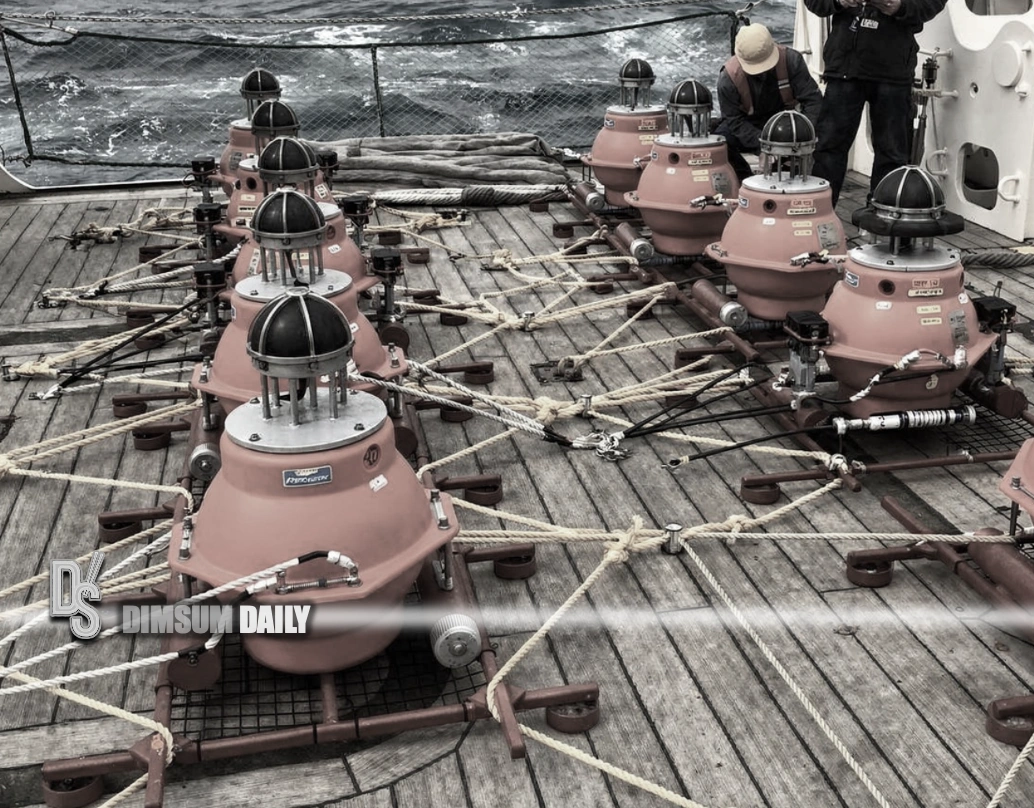
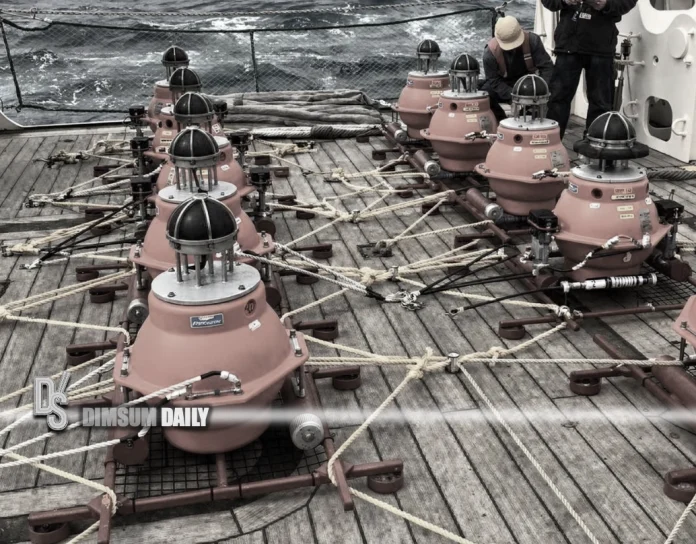
 Equipment used to gather acoustic data from the ocean floor is pictured on board a research vessel in an image released by Tohoku University, Hokkaido University and the Japan Agency for Marine-Earth Science and Technology Picture credit: JAMSTEC
12th March 2026 – (Sapporo) Fifteen years after the 2011 Great East Japan Earthquake, new research points to a dangerous build‑up of tectonic strain along the Kuril Trench off Hokkaido’s Pacific coast. Scientists from Hokkaido University and Tohoku University report that energy comparable to that which drove the 2011 disaster has accumulated in zones off Tokachi and Nemuro, capable of generating a magnitude‑9 earthquake and tsunami waves exceeding 20 metres. In a worst‑case winter scenario, when snow and freezing temperatures would hamper evacuation, experts warn casualties could reach as high as 100,000.
Between 2019 and 2024, teams from Tohoku University, Hokkaido University and JAMSTEC deployed seabed instruments at three sites along the trench. Acoustic geodetic measurements show two offshore points moving landward at roughly 8 centimetres per year and a third at about 4 centimetres. Crucially, motion at offshore stations closely matches that on land, indicating the subducting Pacific Plate is strongly locked to the overriding plate and efficiently storing strain—particularly in the outer‑trench region. Researchers highlight a long‑recognised “seismic gap” from off Tokachi to off Nemuro, where major quakes have been scarce, consistent with ongoing energy accumulation.
Historical evidence suggests great earthquakes occur in this segment roughly every 400 years. The last event, estimated at around magnitude 8.8 sometime between 1611 and 1637, likely displaced the plate boundary by about 25 metres. Current estimates put total strain at roughly 20.5 to 30 metres of potential slip, implying the fault may already hold energy on par with that earlier rupture. With Hokkaido’s eastern Pacific coast most exposed to extreme tsunami heights, researchers urge residents and authorities to update evacuation planning and preparedness without delay.
AloJapan.com