
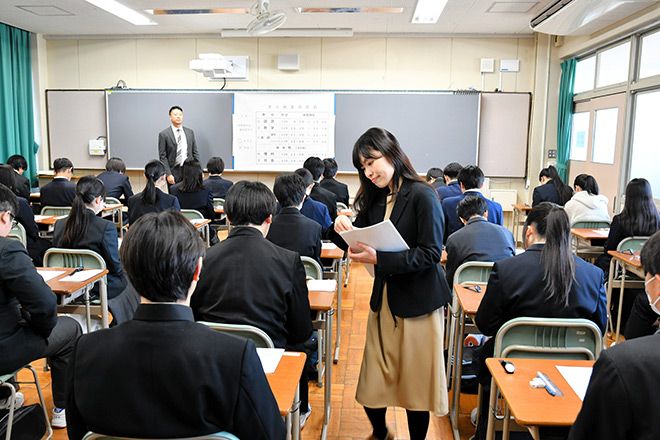
A special high school entrance exam in Osaka for students from overseas was overwhelmed this spring after the number of applicants doubled, leaving more than 100 students without a slot.
The Osaka Prefectural school system, long considered nationally progressive, is facing its own test from the post-pandemic surge of foreign student applicants.
The demand is pushing the system to the breaking point, forcing the prefecture to multiply its support budget eightfold as educators and civic groups call for urgent government action.
Osaka Prefecture opens its “Entrance exam for foreign students requiring Japanese language instruction” to students who arrived in Japan while in the fourth grade of elementary school or later.
The exam consists only of English, mathematics and an essay portion that can be written in the student’s native language.
The prefecture started the program in 2001 at two prefectural high schools to accommodate the descendants of Japanese war orphans returning from China.
To keep pace with the growing number of students from abroad, the program expanded to eight schools by 2022, each with an enrollment capacity of 16 to 20 students.
DEMAND EXPLODES
On March 2, results were announced for the special exam. For a total of 132 spots across the eight schools, 340 students took the exam—1.8 times the number from last year.
While some were accepted through a “rolling pass” system to fill vacancies at other schools, 111 applicants were still rejected.
In the past three years, the number of rejected applicants hovered between 20 and 30.
The eight schools participating in the special exam offer extensive Japanese language instruction and native language support after enrollment.
FRONT LINES BUCKLE
At Osaka Wakaba High School in Osaka’s Ikuno Ward, one of the eight institutions, 43 students vied for 20 slots. Ultimately, 32 were accepted, including those through the rolling pass system.
As a result, the school will have about 150 students requiring Japanese language support when the new academic year opens in April.
“Every year, we have more incoming students than we have spots for, and it is difficult to adequately prepare, such as by securing teachers for Japanese language instruction,” said Principal Shoichi Takashina.
At his school, Japanese language teachers are primarily responsible for instructing these students.
“I would like the prefecture to consider hiring teachers who specialize in Japanese as a second language,” Takashina added.
Applicants who are not accepted in the special exam must then compete for spots in the general selection or second-round selection exams in mid-to-late March.
Across all Osaka prefectural high schools, about 800 students who require Japanese language instruction are enrolled in around 45 schools.
This trend of foreign students being scattered in small numbers is expected to continue, but many of these high schools lack a sufficient support system.
FUNDING THE FIX
In response, the Osaka prefectural board of education has allocated 130 million yen ($817,500) for support in the new fiscal year—an eightfold increase.
The plan includes designating Osaka Wakaba High School as a “Japanese language instruction hub” to assist other schools within two years and expanding the dispatch of “education supporters” who help students in their native languages.
The goal is to increase the number of dispatches to about 6,000, nearly seven times the fiscal 2025 level, but with students’ native languages numbering over 25, securing qualified personnel is a challenge.
In Osaka city, the number of elementary and junior high school students needing Japanese language instruction has increased 3.5-fold over the past three years to exceed 3,000.
With that, applicants for the special high school exam are expected to rise further from the spring of 2027 onward.
NO SAFETY NET
In addition, there has been a sharp increase in “direct applicants”—students who graduated from a junior high school in their home countries and are taking the exam without having attended a Japanese school.
Lacking local exam guidance, they often rely on private organizations for assistance.
Kodomo Hiroba, a civic group in the city’s Tennoji Ward that has provided support for 20 years, assisted 33 such applicants in the 2025 school year.
However, due to the overwhelming increase, the group had to stop accepting new students for the first time last fall.
Kiyoko Ukai, the group’s secretary-general, said they have received several inquiries from rejected applicants even after the special exam.
“More and more children are falling through the cracks of the school system, unable to get enough information about continuing their education,” Ukai said. “There are disparities between municipalities, and the government should address this to guarantee the right to an education.”
PRIVATE SCHOOLS STEP UP
Private high schools in Osaka Prefecture have also begun accepting foreign students.
Osaka Kunei Jogakuin Senior High School in Settsu established a new entrance exam track for them this spring, consisting of Japanese, math and English tests, and an interview.
Sixteen students from China took the exam, and all passed.
Principal Hajime Tanaka previously served as head of the entrance exam system at the prefectural board of education.
“I’ve seen children with nowhere to go because the number of spots is limited,” he said. “I thought a private school, which can act independently, could take this on.”
The school has established individual classes for Japanese language and after-school tutoring sessions.
“We want to become a private hub school for accepting these students,” Tanaka said.
YMCA Gakuin High School in Osaka’s Tennoji Ward established a “translingual course” six years ago, in which about 30 percent of classes are related to the Japanese language.
The move was prompted by having to turn away an applicant from overseas the previous year.
To date, 35 students of 14 nationalities have enrolled. This spring, 31 students took the exam, more than double last year’s number.
“Hiring new staff and creating multilingual materials is costly, and the reality is that we have no choice but to reflect that in the tuition fees,” said Rika Shibahara, a teacher in charge of the course. “I wish there were public financial support and multilingual consultation systems for private high schools that accept foreign students.”
A DEEPER PROBLEM
Professor Yukari Enoi of Aino University, who researches the prefecture’s entrance exam system, said it was “established so that no child would be left without a place to go.”
“Ideally, all high schools would be able to accommodate foreign students who have recently arrived, but the actual system is not set up that way,” she said, noting the eight designated schools can no longer handle the inflow.
Enoi said the backdrop to the problem is that the central government has promoted the acceptance of immigrant workers while neglecting family integration and the education of their children.
“There are many teachers working hard on the front lines, but there are limits to what individual efforts can achieve,” she said. “Similar issues are being seen nationwide, and what is needed most of all is for the central government to introduce policies that support coexistence in schools, if only to build a consensus in the field of education first.”
(This article was written by Taro Tamaki, Satoshi Maeda and Shoko Matsuura.)
AloJapan.com