
Breadcrumb Trail Links
TravelTravel GuideTravel International
Kyushu invites guests to visit a quieter side of the country
Published Mar 10, 2026 • Last updated 2 hours ago • 6 minute read
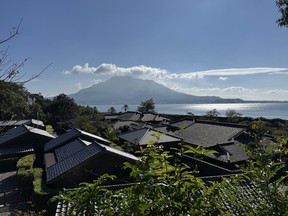 A view of the the Sakurajima volcano for Sengan-en, a historic residence that was once home to the Shimadzu family. Photo by Aleesha Harris/PostmediaArticle content
Reviews and recommendations are unbiased and products are independently selected. Postmedia may earn an affiliate commission from purchases made through links on this page.
As I walked toward the Fujisaki Hachiman-gu Shrine, one of the most famous in Kumamoto City, I was struck by the quiet sense of calm. Across the stone-laden courtyard leading to the bright, orange-and-white shrine, there was only one other visitor — a man engaged in the rituals of prayer.
Advertisement 2
This advertisement has not loaded yet, but your article continues below.
Article content
It was one of several moments during my recent trip to the island of Kyushu where I found myself almost entirely alone. Even while wandering downtown streets in search of tourist destinations, there was an unrushed opportunity to explore what the southern island of Japan had to offer at my own pace.
Article content
Article content
It was a strange, and slightly wonderful experience, especially following the tight clusters of crowds I’d encountered during previous visits to some of the country’s most popular destinations in Tokyo and Kyoto.
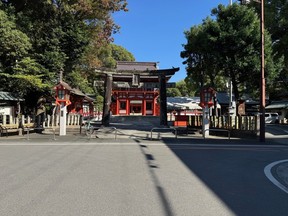 The Fujisaki Hachiman-gu Shrine is one of the most famous in Kumamoto City. Photo by Aleesha Harris /POSTMEDIATourism boom
Japan has seen a massive jump in tourism in recent years. According to the Japan National Tourism Organization, the country welcomed roughly 42.7 million inbound travellers in 2025, a 16 per cent increase from 2024 and a new all-time high. More than 688,000 of those visitors were Canadian, up 18 per cent from the year before.
Advertisement 3
This advertisement has not loaded yet, but your article continues below.
Article content
International interest spurred by a weakened yen, combined with the ease of direct flights from both Toronto and Vancouver on airlines such as Air Canada, have helped to boost the number of Canadians looking to visit the country, exponentially.
Given the influx of tourists, the Japanese government has decided to triple the country’s departure tax from 1,000 to 3,000 yen (C$26 per person) starting July 2026. The International Tourist Tax applies to travellers age two and up and is automatically applied to airline and ferry tickets.
As overtourism pressures mount in popular hot spots and tourist fees rise, savvy travellers are seeking out quieter, lesser-known destinations to explore.
Off the beaten path
A quick two-hour flight from Tokyo’s Haneda Airport to Kagoshima takes you to the ‘gateway to Japan.’ The country’s third-largest island, Kyushu is a place of historic importance for the country.
Advertisement 4
This advertisement has not loaded yet, but your article continues below.
Article content
Kyushu harbours a deep history of trade, temples and samurai. (Saigō Takamori, better known as The Last Samurai, was born, lived and died on the island.)
But it’s not just about the past.
Kyushu’s highlights include Oita, the onsen (Japanese hot springs) capital of the world; Fukuoka, a major foodie destination; Mount Sakurajima, an urban volcano in Kagoshima; and Kumamoto, a rapidly evolving city that’s home to the now world-famous Kumamon cartoon. Kyushu offers a vibrant glimpse of Japan — without the busy crowds of the more oft-travelled tourist destinations.
A taste of history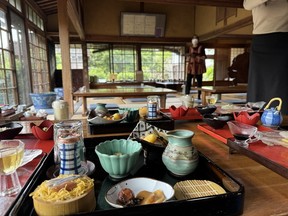 A traditional feudal lord’s meal at Taki’an in Kagoshima prefecture. Photo by Aleesha Harris/Postmedia
My fall trip to Kyushu started in Kagoshima prefecture, one of 47 jurisdictions in Japan, where we first stopped to visit the Chiran Fumoto district, home of classic Samurai houses and standout gardens.
Advertisement 5
This advertisement has not loaded yet, but your article continues below.
Article content
While there, we had a taste of history with a traditional feudal lord’s meal at a local restaurant called Taki’an. A colourful mix of eclectic bowls held dishes such as satsuma-age (fried fish cake) and torishashi (thinly sliced chicken sashimi. Yes, raw chicken). The restaurant, with its tatami mats, traditional dishes, and views from the paned windows of the Edo-period gardens and structures beyond, created the impression that we’d somehow travelled back in time.
One thing struck me in many of the smaller towns and villages of Kyushu (beyond the beauty, of course): the English language is much less common than in larger cities such as Tokyo or Osaka (a particularly tricky point when you have a severe shellfish allergy like I do). So, translating apps and tour guides can provide helpful communication support for tourists visiting the area.
Advertisement 6
This advertisement has not loaded yet, but your article continues below.
Article content
Craftsmanship is at the heart of Kyushu, whether it’s premium green teas sourced from the family–run Chiran Tea operation (Did you know green tea production takes more than 16 steps, from harvest to final packaging?), to historic Satsuma-ware pottery at the 420-year-old Chin Jukan Kiln, to painstakingly perfect silk kimonos at Oose Shouten.
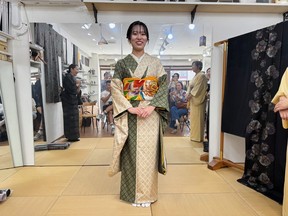 A model wears a full traditional kimono at Oose Shoten. Photo by Aleesha Harris/Postmedia
My appreciation for the traditional Japanese garment, not to mention the wonder for the intricate steps required to properly put one on, were taken to an entirely new level after visiting the silk-weaving factory and showroom. The small factory space is considered to be one of the last artisan outposts making Oshima Tsumugi silk, a slow and meticulous process using hand-operated looms. Just one bolt of the fabric can take several months to make.
Advertisement 7
This advertisement has not loaded yet, but your article continues below.
Article content
A living volcano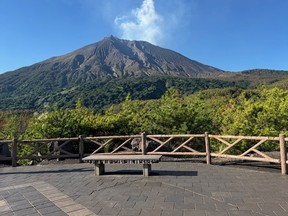 A view of the Sakurajima volcano from the Arimura Lava Observatory. Photo by Aleesha Harris/Postmedia
Our next stop was the Sengan-en house, which was home to the Shimadzu family, a prominent warrior clan. After walking through the abode, I stood in the expansive gardens surrounding the historic house and stared, in awe, at the active volcano that loomed a mere four-kilometre expanse of water away.
Called Sakurajima, the active stratovolcano was once located on an island. But its solitary land status changed after an eruption in 1914 created a peninsula. A visit to the Arimura Lava Observatory, a short hike from a nearby parking lot, afforded a better view of the volcano. It is one of the country’s most active, erupting with smoke or ash almost daily.
Visiting Kumamoto
While it was fairly quiet on the day of our visit, I’ll admit that I was somewhat relieved when the volcano was at our backs on the return ferry to Kagoshima city. There’s something unsettling about standing so close to an unpredictable force of nature.
Advertisement 8
This advertisement has not loaded yet, but your article continues below.
Article content
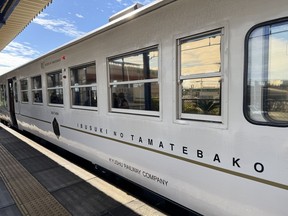 A ride on the Ibusuki no Tamatebako train takes you from Ibusuki Station to Kagoshima-Chuo Station. Photo by Aleesha Harris/Postmedia
After a few days in Kagoshima, it was time to board the Shinkansen bullet train to the city of Kumamoto. While you may have never heard of the urban destination, there’s a good chance you’ve seen its mascot: Kumamon.
The friendly looking cartoon black bear with round red circles for its blushing cheeks, has become an international symbol of the city since its creation. A mascot dreamt up by the prefecture’s government in 2010 to draw visitors via the then-new Kyushu Shinkansen high-speed train line, the bear can now be seen all over Japan.
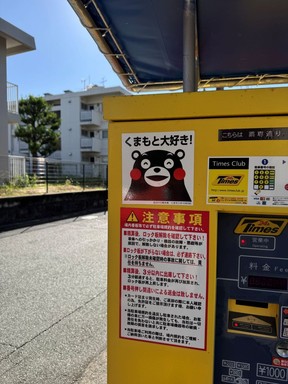 Kumamoto’s mascot, Kumamon, can be spotted all around the city. Photo by ALEESHA HARRIS/POSTMEDIA
Beyond the now-famous bear, the city is what I imagine some of Japan’s larger cities might have been like, say, 10 years ago, before my first visit to Japan in 2018.
Kumamoto felt similar to Kyoto and Osaka, but without the swarms of tourists. A visit to the grand Kumamoto Castle, located in the heart of the city’s downtown core, required no wait time.
Advertisement 9
This advertisement has not loaded yet, but your article continues below.
Article content
The structure, considered to be one of Japan’s three ‘premier’ castles, is an impressive sight — as is the city view afforded from the castle’s top viewing floor.
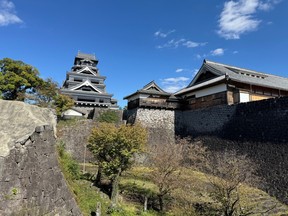 Kumamoto Castle, constructed in 1607, is considered to be among Japan’s three premier castles. Photo by Aleesha Harris/Postmedia
My two days in the city were filled with wonderful wanderings — discovering charming cafés and restaurants, searching for vintage treasures in the expansive shopping arcades, and taking in the latest exhibition at the Contemporary Art Museum. For fans of artist Yayoi Kusama, there is a small, almost hidden version of her famous Infinity Mirrored Room under the museum’s stairs.
Garden serenity
Three things in Japan are best enjoyed in generous quantities while visiting: sashimi, sake and spectacular gardens.
Kumamoto is home to one of the most wonderful examples of the latter enjoyment. Located toward the outskirts of the downtown core, Suizenji Jojuen Garden dates back to 1671, and remains much the same as it was then.
Advertisement 10
This advertisement has not loaded yet, but your article continues below.
Article content
On the last day of my trip, I enjoyed a slow, quiet morning in the garden, strolling the pebbled paths before stopping to sit on a bench to enjoy my breakfast of a fresh red bean bun and iced coffee — all while taking in the serene surroundings.
With its many monuments, manicured trees — and miniature Mt. Fuji — the garden offered an enchanting finale to my volcanic island adventure. I went in search of a side of Japan that was free of the crowds and discovered a destination rich in history, hot springs and a rumbling volcano.
Read More
More Canadians are visiting Japan as country boasts record year for tourism

These travel hacks could save you money on your next trip
Article content
Share this article in your social network
AloJapan.com