
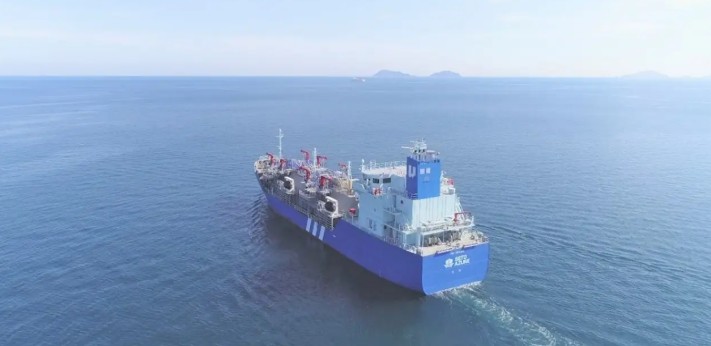
According to a statement by Osaka Gas, Shitanoe Shipbuilding held a naming ceremony for the 3,610-cbm LNG bunkering vessel in Usuki on March 5.
Shitanoe built the 82.29-meter-long vessel for Osaka Bay LNG Shipping, in which Osaka Gas International Transport, a wholly-owned subsidiary of Osaka Gas, has invested.
Other partners include NS United Coastal Tanker Kaisha (NSUT) and Kobe-Osaka International Port Corporation (HPC).
Osaka Gas announced this joint venture back in 2023.
The vessel features a type C independent tank and LNG/fuel oil dual-fuel engine.
“Named after the beauty of the Seto Inland Sea—one of the locations where the
company’s STS bunkering business will take place—the bunkering vessel is scheduled to
commence operations upon its launch in April 2026,” Osaka Gas said.
With Osaka Gas selling and providing LNG, Seto Azure will supply LNG to LNG-fueled ships, including capsize bulkers operated by MOL, K LINE, and NYK.
The introduction of the STS bunkering method complements Osaka Gas’s existing bunkering
operations, which currently utilize the truck-to-ship and port-to-ship methods.
LNG fuel on the rise
Osaka Gas noted that an increasing number of LNG-fueled vessels have come into operation in recent years, driven by the global trend of marine fuel decarbonization and the target set by the IMO to reduce greenhouse gas emissions.
The company said that LNG-fueled vessels can reduce carbon dioxide emissions compared to the traditional use of heavy oil as marine fuel.
However, the shortage of LNG fuel facilities across Japan poses a challenge to this effort, it said.
According to DNV’s data, 30 LNG dual-fuel vessels have been ordered in the first two months of the year, compared to 54 in the first two months of 2025.
A further two orders were also placed for LNG bunkering vessels in February, continuing the steady expansion of the LNG bunkering orderbook, in line with the growing LNG-fueled fleet.
DNV’s Alternative Fuels Insight (AFI) platform shows that there are now 873 LNG-powered ships in operation and 653 LNG-fueled vessels on order.
These statistics do not include smaller inland vessels or dual-fuel LNG carriers.
AloJapan.com