
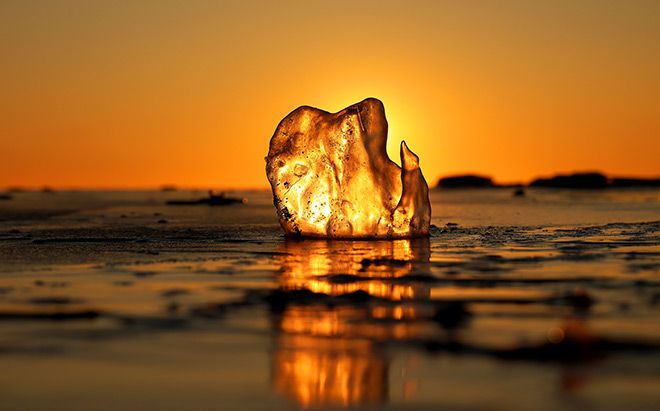
TOYOKORO, Hokkaido–A bounty of riches originates as the waters of the Tokachigawa river freezes in the extreme cold of midwinter, allowing the resulting ice floes to drift downstream.
These frozen masses eventually reach the Pacific and are washed ashore as crystal-like chunks, after their edges are smoothed by rough waves.
As those chunks of ice form when the river water slowly freezes over time, the consequent lumps are characterized by their low impurity content and high transparency, unlike the cloudy white ice floating in the sea.
The product of nature from Tokachigawa was given the name “jewelry ice” in 2012 by the town’s tourism ambassador, Hisashi Urashima.
The Otsu coast has since come under the global spotlight as a high-profile photo spot, drawing a plethora of photographers and spectators from Japan and abroad.
Toyokoro officials have rolled out the red carpet for these sightseers from all over the world and set up a rest area and a parking lot. The town government has similarly installed a sign to warn visitors not to make too much noise.
However, whether one can encounter the maritime gems depends on the weather conditions. Unlucky travelers might ultimately come up empty-handed.
Though rumors circulate that there is a particularly limited amount of ice this year, Urashima, 73, noted that it is too early to give up entirely.
“Tokachigawa is currently covered by ice sheets, so future visitors still have plenty of opportunity to see the jewelry if they are washed ashore in the coming days,” Urashima said.
Located at the southeastern tip of the Tokachi region in Hokkaido, Toyokoro is a vast agricultural and fishing town with a population of 2,800.
Toyokoro is likewise noted for a Japanese elm estimated to be 160 years old. The tree, as a popular tourist spot, stands along the Tokachigawa river and attracts hordes of sightseers.
The waters of the Tokachigawa nourishes the fertile Tokachi Plain so delicacies of Hokkaido, inclusive of potatoes and cheese, can be produced there.
The river originates on Mount Tokachidake in the Daisetsuzan mountain range, gathers tributaries and flows into the Pacific Ocean at Otsu beach in Toyokoro.
Standing on the water’s edge at the beach and gazing into the distant scenery, visitors may notice the shiny crystals suddenly appear at their feet.
The horizon stretches as far as the eye can see beneath the clear, beautiful sky known as Tokachi Blue.
A 1- to 2-kilometer walk along the beach toward the river mouth in early February led to the discovery of numerous ice chunks ranging from fist-size pieces to those large enough to hold in one’s arms.
Small yet perfectly round masses, alongside glittering blocks with countless bumps, could be seen tossed about by thundering waves. Visitors may gradually begin to recognize their own preferred shapes during such a stroll.
Observed during the day, the icy gemstones are stunning due to their exceptional transparency but they lack vivid coloring like true jewels.
Photographing them at sunrise, for example, can add an orange hue from the sun to those natural artworks.
Positioning the camera very close to the ground on a super compact tripod causes sunlight to shine through a tiny ice cube. This approach also makes it possible to fully capture the effects of light reflecting off the crashing waves.
The only drawback of the method is that the tripod may be submerged in seawater and end up completely covered in ice following the photo session.
According to Ryo Takizawa, 37, a Toyokoro town official, the ice jewelry can be found from mid-January through early March every year, whereas it may be difficult to spot under certain climate conditions.
“Floes are particularly beautiful in the morning,” Takizawa said. “But one can enjoy a variety of expressions, as their color gradually changes in the sunlight throughout the day and evening.”
Those seeking to spot their favorite jewels are urged to take extensive precautions against the cold, since temperatures around the coast can at times drop to minus 20 degrees or much lower.
(This article was written by Seiichiro Kuchiki and Takeo Kato.)
AloJapan.com