
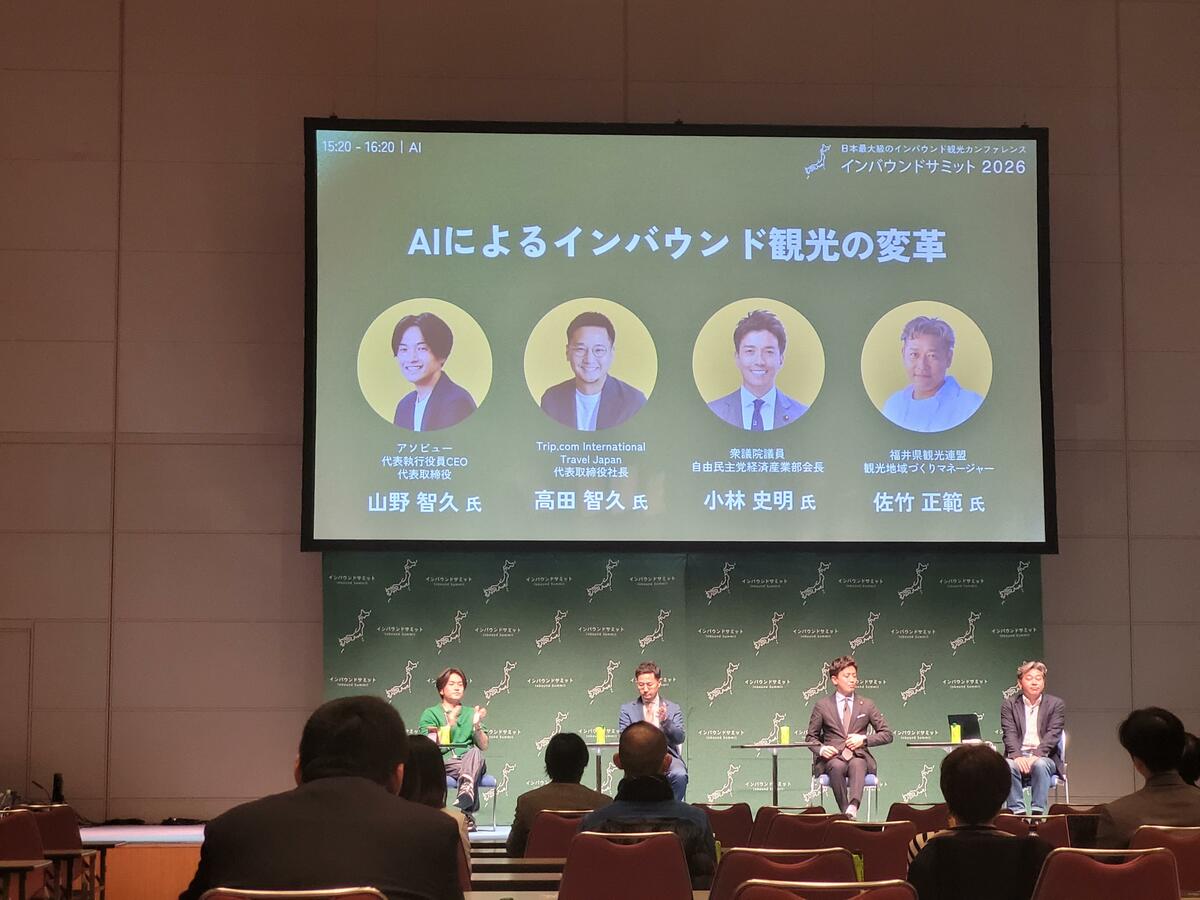
TOKYO – Although artificial intelligence has huge potential for Japan’s tourism industry, industry leaders argue that the first step to laying the foundation is establishing stronger emotional connections with local businesses.
Building the sufficient data infrastructure that is needed for the effective use of AI “requires collaboration between the public and private sectors,” said Fumiaki Kobayashi, chairman of the ruling Liberal Democratic Party’s economy, trade and industry division.
Speaking during a session at the Inbound Summit held in Tokyo on Wednesday, Kobayashi noted that Japan’s AI utilization rate remains low and encouraged businesses to “just start using it.”
Masanori Satake, a manager at the Fukui Prefectural Tourism Federation, said that building trust was the real challenge in gathering data for its tourism analysis system, not technology.
Back in March 2022, the prefecture launched FTAS, the Fukui Tourism data Analyzing System, a comprehensive tool to promote “profitable” regional tourism through data-driven decision-making.
Satake pointed out, however, that his organization had to repeatedly persuade the local ryokan association in Awara Onsen to share their data. They had to “go back again and again and again” to address concerns before the association agreed.
“There are many things that will become automated. But the creation of connections rooted in the local foundation of a region, those ties can only be created by the people who live there,” Satake said.
FTAS allows users to visualize accommodation occupancy rates up to 90 days in advance by integrating diverse data sources, resulting in benefits such as improved pricing strategies for hotels and optimized inventory of products and promotions for local businesses.
AI is currently being utilized to make data analysis more efficient and generate reports. Data includes everything from bookings for the Fukui Prefectural Dinosaur Museum, to page views of the prefecture’s official tourism site.
With Japan’s working-age population expected to shrink to around 80 percent of its current level by 2040, the LDP’s Kobayashi stressed that boosting productivity and using AI to add value to experiences is vital to tourism policy.
“Until recently, the focus was on volume — aiming for 40 or 50 million visitors. Now, the policy emphasis is shifting toward quality,” said Kobayashi, who added that AI could help generate suggestions to guide travelers toward regional destinations and optimize dynamic pricing.
Tomohisa Yamano, the representative executive officer and CEO of Asoview, Inc., who moderated the AI session, said that physical communication and human networks unlock the potential of regions.
“In reality, what it ultimately comes down to is effort — plain, old-fashioned legwork and sales. Whether or not you put in that effort determines whether AI can actually be utilized in a region,” said Yamano.
AloJapan.com