
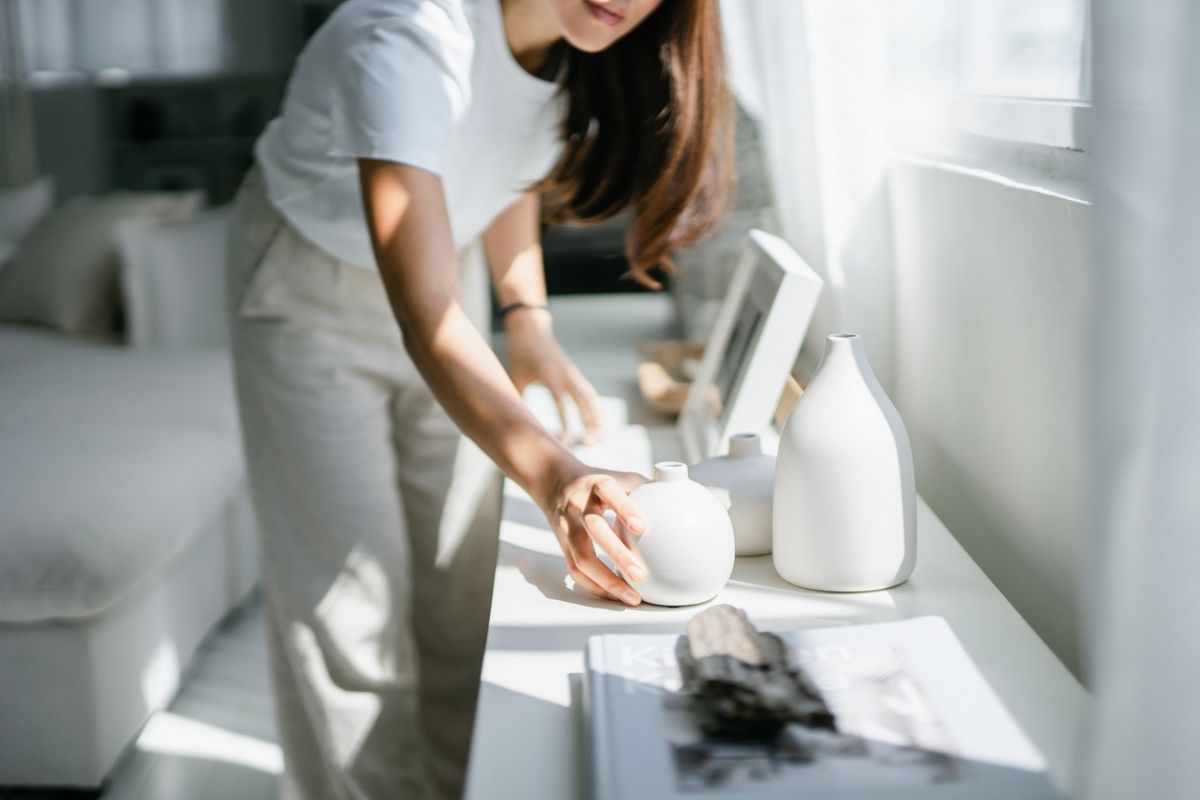
The concept of oosouji dates to at least the Edo period (1603–1868), when Buddhist temples performed end of year purification rites that eventually spread into domestic life. Today the practice is observed on December 28 in many Japanese households and public institutions, including the Imperial Palace. But a growing number of practitioners and a handful of researchers, are making the case that the underlying logic applies year round, in ten minute increments.
A 2010 study published in Personality and Social Psychology Bulletin by UCLA researchers Darby Saxbe and Rena Repetti found that women who described their homes as cluttered or unfinished showed elevated cortisol levels throughout the day. Comparatively, not a pattern in women who described their homes as restful or restorative. A separate 2011 study by researchers at Princeton University’s Neuroscience Institute found that visual clutter competes for neural resources, reducing the brain’s capacity to focus and process information.
Oosouji doesn’t ask for a full overhaul. The method sets a fixed window (ten minutes) and a fixed scope: one surface, one corner, one drawer. The timer matters. Without a hard stop, cleaning tends to expand into an hours long project that most people avoid starting. With one, it becomes manageable enough to repeat daily.
How the method works
The practice follows a simple sequence: set a timer for ten minutes. Pick a single, contained area; a kitchen counter, an entryway shelf, a desk surface. Remove anything broken, expired, or no longer in use and wipe the surface. Return items to their designated spots, or create a temporary holding area for things that need a decision.
The emphasis on specificity, one area, not “the living room”, reflects what behavioral researchers call implementation intentions, a strategy shown to significantly increase follow-through on tasks. A 2001 meta analysis by Peter Gollwitzer and Paschal Sheeran in the journal Advances in Experimental Social Psychology reviewed 94 studies and found that people who specified exactly when, where, and how they would act were two to three times more likely to complete a goal than those with only a general intention.
Applied to oosouji, that means saying “I will clear the kitchen counter for ten minutes after dinner” produces measurably better results than “I want to keep the house cleaner.”
What accumulates besides dust
In Japanese cultural practice, the end of year oosouji carries explicit emotional significance. Discarding objects associated with past difficulties is understood as preparation for a fresh start, not metaphorically, but practically. Psychologists studying material attachment have found that people often delay disposing of objects tied to unresolved decisions or past relationships, a phenomenon the researchers Elizabeth Dunn and Michael Norton describe in their work on the psychology of ownership.
The ten minute daily version of oosouji sidesteps that paralysis by keeping the scope small. Rather than confronting the entire house and everything it represents, practitioners clear one surface at a time, a pace that makes the emotional weight manageable.
The consistency variable
What distinguishes oosouji from the average cleaning blitz is repetition. A single session won’t transform a home. Daily or weekly practice, accumulated over months, does. That accumulation also changes how practitioners relate to acquiring new objects, a downstream effect documented in Marie Kondo’s work, though Kondo’s KonMari method differs from oosouji in both scale and philosophy.
Kondo’s approach asks for a wholesale sorting of all possessions at once. Oosouji, by contrast, is incremental and ongoing, closer in spirit to a maintenance habit than a one time reset. For households where large scale decluttering feels prohibitive, that distinction is practical.
The Princeton neuroscience study found that organized environments enhanced focus and information processing. Sustained focus, it turns out, is easier to protect than it is to recover once lost.
AloJapan.com