
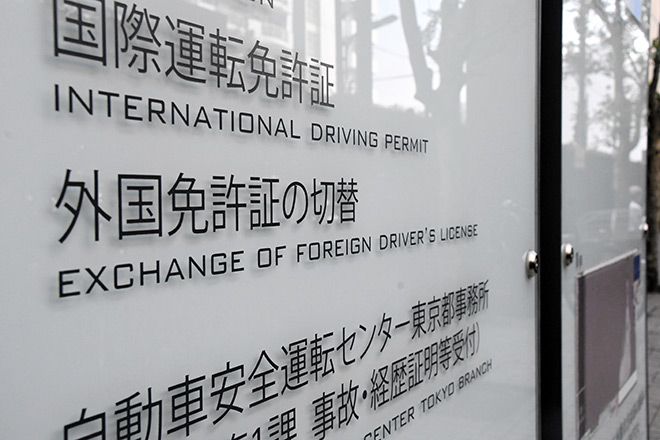
Stricter rules for converting foreign driver’s licenses to Japanese ones that took effect in October have slashed pass rates for knowledge and skills tests to less than half of the previous year’s levels.
The pass rate for the written knowledge test dropped to 42.8 percent between October and December, down from 92.5 percent recorded for all of 2024.
The pass rate for the practical skills test, which added new tasks such as negotiating railway crossings and passing through pedestrian crosswalks, also fell to 13.1 percent from 30.4 percent the previous year.
The National Police Agency in October tightened procedures for the foreign license conversion system to ensure that foreign nationals properly learn Japanese traffic rules and driving skills.
The knowledge test, for example, previously consisted of 10 true‑or‑false questions using illustrations and required at least seven correct answers to pass.
Under the revised rules, illustrations were eliminated. The number of questions was increased to 50, and the passing standard was also raised to a score of 90 percent or higher.
Under the revisions, applicants’ addresses are confirmed with a copy of their residence certificates, in principle, whereas temporary accommodations such as hotels had been previously accepted as an “address” at the time of acquiring the license.
The NPA said it will continue to ensure that applicants’ knowledge of traffic rules and driving skills are thoroughly checked.
Last year, there were 587 traffic accidents involving vehicles driven by foreign nationals that resulted in death or serious injury, the second‑highest number since recordkeeping began in 2006, according to the NPA.
The breakdown was 52 fatal accidents and 535 causing serious injuries.
Accidents caused by drivers who obtained Japanese licenses through the foreign license conversion system totaled 158, accounting for one‑quarter of the total.
Of all fatal and serious-injury traffic accidents, those caused by foreign drivers represented 2.3 percent, up from 1.4 percent five years earlier.
In 2024, 68,623 foreign nationals obtained Japanese driver’s licenses via the conversion system, a 2.4‑fold increase over the past 10 years.
A factor behind the increase is believed to be the benefit that, once a Japanese license is obtained and an international driving permit is issued, holders can drive in about 100 member countries of the Geneva Convention on Road Traffic.
As driver’s license testing centers became crowded with the growing number of conversion applicants, police in 46 prefectures have introduced appointment systems.
In Nara and Hyogo prefectures, devices that automatically translate conversations using artificial intelligence and display them on transparent panels have also been adopted.
During the last three months of last year, 7,479 foreign nationals obtained Japanese licenses through the conversion system.
By country or region of the original license, South Korea was the most common at 14.6 percent, followed by China at 13.8 percent, Taiwan at 11.7 percent, Vietnam at 10.6 percent and the United States at 9.7 percent.
AloJapan.com