
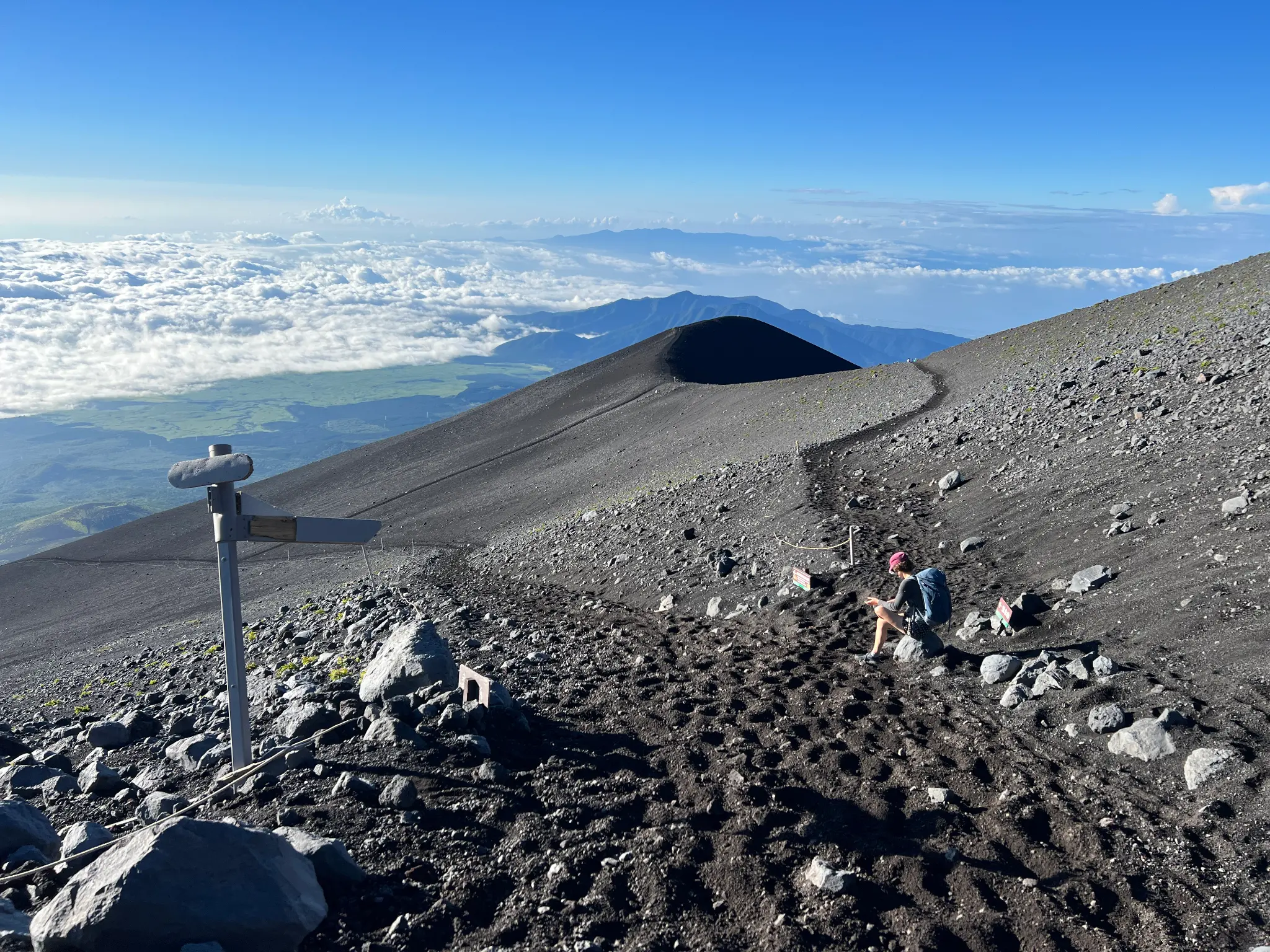
From the bus stop at Fujinomiya 5th Station, go up the well-signposted Fujinomiya Trail past a parking lot and an information point with national park rangers; shortly afterwards, you pass the sign with the altitude “2,400m.” At the 6th Station, where the Fujinomiya Trail makes a steep turn behind the Hoei Sanso hut, we leave it and follow the signs to Mount Hoei on a roughly flat, clearly visible path. We quickly pass the wide crater of Mount Hoei, as this is where rockfall is most likely. Then it goes strenuous up a steep path with a few switchbacks to the summit of Mount Hoei, which is only five minutes off the direct ascent and is a good spot for a first break.
From here, continue a few degrees counterclockwise around the round Mount Fuji. We cross the descent path of the Gotemba Trail, which goes straight down the mountain through deep gravel. Be careful here to stay on the correct path (signposted)! The ascent path of the Gotemba Trail lies 200 meters further and leads in small switchbacks to the 7th Station. From the ruin of a mountain hut upwards, the ascent and descent routes unite. At nearly 3,100 meters elevation, the Waraji-kan and Sunabashiri-kan mountain huts are reached; they are located about a hundred meters apart and offer accommodations. Those who started early in the morning can store luggage here and still ascend to the summit in the afternoon—dinner is served from 5:00 to 5:30 p.m.!
The further ascent becomes rockier and steeper, and at nearly 3,300 meters elevation the Akaiwahachigo-kan hut is reached. The path continues steeply upward; just below the crater rim, there is again a risk of rockfall in a fairly scree-filled gully. Then the crater rim at the Gotemba Trail 10th Station is reached. Here, keep left to first reach a large shrine at the end of the Fujinomiya Trail (here, there are toilets, souvenirs can be purchased, walking sticks branded, or postcards sent). Continuing clockwise around the crater, you soon reach the highest point at 3,776 meters, Kengamine Peak, with a monument and weather station. The crater can now be circled along the roughly 3-kilometer-long Ohachimeguri Trail, also passing the end of the Yoshida Trail—with a shrine—which is chosen by 70% of mountain climbers. Alternatively, you can take the same, shorter return path to the 10th Station of the Gotemba Trail. The descent down to one of the three huts on the Gotemba Trail is now known and quite short.
From the huts, there is a common ascent and descent path down to the 7th Station at nearly 3,000 meters; here, however, caution, because the path splits! The Long Sand Run begins, which in a straight line first leads toward Mount Hoei, then just left past its summit and subsequently very steeply down to nearly 1,900 meters. This section can be covered very quickly and is a lot of fun, resembling skiing. Then you reach a junction with the ascent route, which until here was on the left side during descent but now shifts to the right side of the straight descent path. The ground becomes harder and less steep, and soon the Oishi-Chaya hut at 1,500 meters is reached, where food, drinks, and souvenirs are available. Ten minutes further is the large parking area with the national park ranger information stand, free toilets, and the bus stop, marking the end of this route.
AloJapan.com