
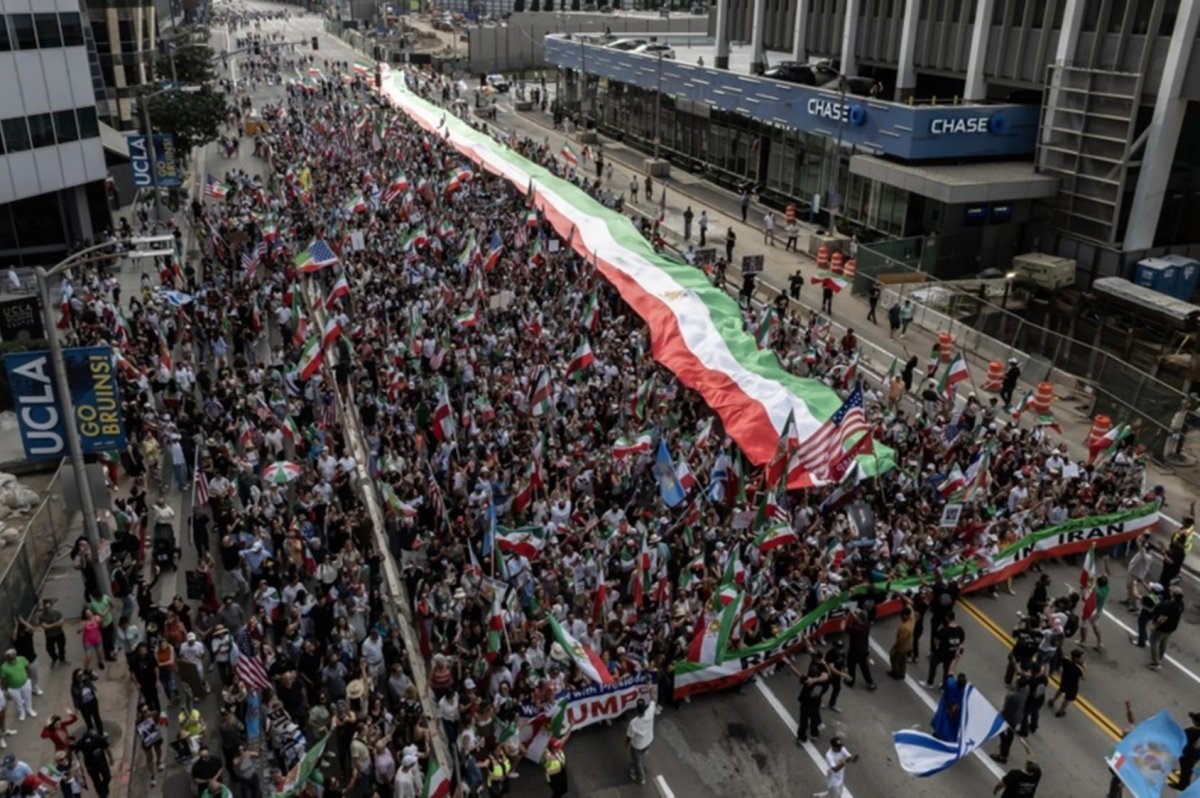
An aerial view taken with a drone shows a crowd holding a flag during a march and rally in support of regime change in Iran outside the federal building in Westwood in Los Angeles, California, USA, 01 March 2026. Iran officially confirmed on 01 March that Iranian Supreme Leader Ali Khamenei was killed in a joint US-Israeli military operation conducted on 28 February 2026. PHoto byTED SOQUI/ EPA
March 2 (Asia Today) — Iranians living in Japan gathered outside Iran’s Embassy in Tokyo on Sunday, welcoming recent U.S. and Israeli strikes on Iran as a potential turning point for political change in their homeland.
According to the Sankei Shimbun, demonstrators assembled in Tokyo’s Minato Ward waving flags associated with the former Pahlavi monarchy and holding portraits of Reza Pahlavi, the exiled crown prince. Participants chanted “freedom” and called for an end to Iran’s current political system.
Some said that while it might appear contradictory to welcome attacks on their own country, they saw no alternative path toward freedom. The newspaper reported that the rally was organized shortly after news spread of the death of Iran’s Supreme Leader, Ali Khamenei.
The Tokyo rally drew attention against the backdrop of years of unrest inside Iran. A major flashpoint came in 2022 after the death of Mahsa Amini, which sparked nationwide protests. Rights groups, including Iran Human Rights and HRANA, have reported that at least 500 people, including minors, were killed in the ensuing crackdown, with tens of thousands detained.
Although large-scale nationwide demonstrations have subsided since 2022, smaller protests, university gatherings, women’s movements opposing mandatory hijab rules and labor strikes have continued intermittently. Authorities have responded with internet restrictions and mass arrests.
Observers say the Tokyo gathering reflects the perspective of parts of the Iranian diaspora who view external pressure as a catalyst for change in a political environment they see as closed domestically. Participants reportedly acknowledged civilian casualties but maintained that systemic political change was necessary.
The rally also coincided with remarks by Donald Trump urging the Iranian people to act, language that some analysts interpret as invoking a “regime change” framework. Reuters reported that Trump called on Iranians to rise up while signaling a willingness to continue military operations.
Diplomats say references to regime change can serve both as a signal of intensified pressure on Tehran’s leadership and as a political message framing military action in terms of freedom and human rights. Whether such change could occur – and how civilian harm and regional escalation might be managed – remains uncertain.
The events in Tokyo underscore that international debate over the strikes now encompasses not only questions of military action and nuclear nonproliferation, but also human rights and Iran’s political future.
— Reported by Asia Today; translated by UPI
© Asia Today. Unauthorized reproduction or redistribution prohibited.
Original Korean report: https://www.asiatoday.co.kr/kn/view.php?key=20260302010000299
AloJapan.com