
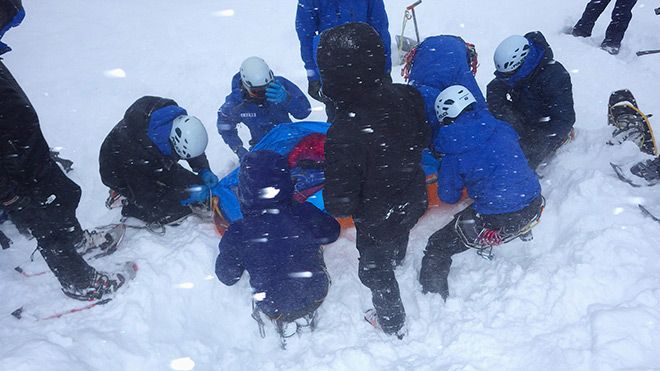
Police have struggled to curtail the growing number of mountain accidents across Japan and are warning climbers that rescue operations are not always possible.
Law enforcement authorities are again calling on mountain climbers to compile detailed hiking plans and procure proper mountaineering gear in advance.
“We recommend that citizens act with utmost care,” said Captain Takayuki Sakuta, 46, a veteran with 20 years of rescue experience, from the mountain relief division of the Hokkaido police department.
“They should not only prepare exhaustive mountaineering plans and equipment but also take part in drills to survive avalanches.”
On the afternoon of Jan. 15, seven French nationals went missing on Mount Furano-Nishidake in Hokkaido’s Furano city. They were later discovered by the mountain life-saving unit just after 2 a.m. the following morning. Their injuries were not life-threatening.
They reportedly got lost after venturing outside a ski resort’s controlled area for backcountry travel.
Sakuta said his mountain emergency response unit trains constantly and is always ready for life-saving requests that may come at any time.
In one training session, Sakuta marched across a mountain for more than 10 hours with almost no rest while carrying a heavy load on his back.
On his days off, Sakuta climbs the 531-meter Mount Moiwayama in Sapporo, descends to the other side, and then makes a round trip.
“It is never enough, no matter how hard I work out,” Sakuta said, referring to a rescue mission that took 19 hours to complete.
Police received a report in autumn 2021 from the companion of a man “stranded due to the worsening of his chronic illness” at an altitude of 1,800 meters on 2,013-meter Mount Nipesotsuyama in the northern part of Hokkaido’s Tokachi region.
The stranded man weighed more than 100 kilograms.
Captain Sakuta rushed to the scene with a dozen of rescuers in his team and found the victim in a critical, every-second-counts situation. The rescuers had to take into account that he might have organ damage.
Transporting him by helicopter did not appear feasible because of the unfavorable weather conditions. The only option was to take the man down from the summit on a stretcher along a trail. The route for skilled hikers had steep ups and downs, and any slip could have worsened the man’s condition.
The rescuers took turns carrying the victim down the mountain over a 19-hour period.
According to statistics from the community safety planning department of the National Police Agency, 3,357 individuals were lost or stranded in 2,946 mountain accidents nationwide in 2024. Of this figure, at least 300 died or were not found.
The largest number of accidents, 321, were recorded in Nagano Prefecture, followed by Hokkaido at 189 and Tokyo and Kanagawa Prefecture at 183 each.
Specifically in Hokkaido, 77 incidents at higher elevations occurred during the winter mountain season through March 2025, the most in the past five years.
Emergency operations at high altitudes are particularly challenging during winter.
In recent years, a series of accidents have involved people who requested rescue after entering snow-blanketed mountains with insufficient preparation.
The decision to dispatch personnel to those scenes is based largely on a comprehensive assessment of the urgency of the situation, including the weather and the victim’s physical state.
Searches could occasionally be forcibly terminated because of darkness or avalanche hazards.
AloJapan.com