
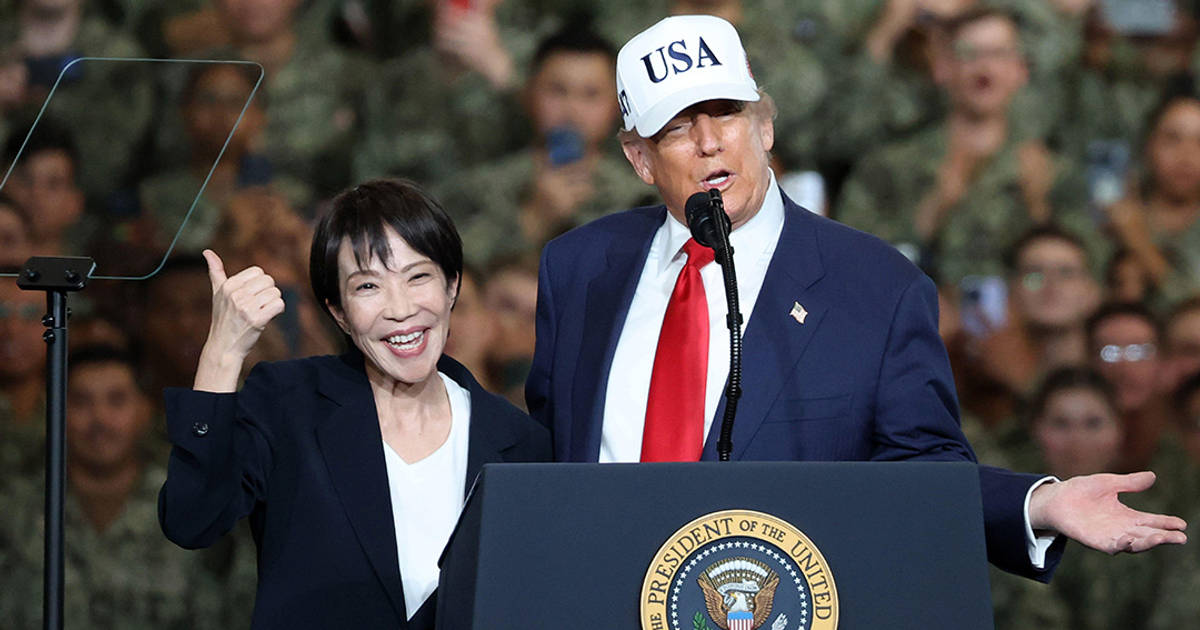
On security, the Yokosuka appearance and joint statement reaffirmed the Free and Open Indo-Pacific (FOIP) vision, stability across the Taiwan Strait, and the complete denuclearisation of North Korea. The two leaders also met families of abductees taken by Pyongyang – a deeply symbolic gesture for Japanese audiences.
Overall, the visit was less about treaty-level commitments and more about clarifying political signals and consolidating bilateral stability – a pragmatic showcase of diplomacy rather than grand strategy.
Governing in Motion: Takaichi’s Domestic Balancing Act
Takaichi’s leadership has been defined by speed and decisiveness. Her immediate priority has been curbing inflation and wage stagnation. Within weeks, she moved to abolish the ‘temporary’ gasoline tax surcharge, tabling a bill and securing cross-party agreement for year-end repeal, introduced energy subsidies, and rolled out targeted support for small businesses and households.
Her governing formula – ‘short-term relief, medium-term investment, long-term fiscal discipline’ – balances populist responsiveness with technocratic control. While the Bank of Japan’s independence is formally maintained, fiscal expansion has clearly regained primacy.
On defence, Takaichi is accelerating Japan’s build up to 2% of GDP ahead of schedule, emphasising domestic production, advanced capabilities (cyber, space, long-range strike), and a 2026 revision of the National Security Strategy to reflect ‘new modes of warfare.’ Her industrial and technology policies mirror this logic: strategic investments in AI, semiconductors, quantum, biotechnology, shipbuilding and cyber. The Technology Prosperity MOC functions as the international extension of this agenda.
In energy, she has prioritised nuclear restarts, next-generation reactors, and fusion R&D – framed as both green-growth and national-security imperatives.
Politically, she governs from a fragile minority. After the LDP’s decades-long alliance with Komeito collapsed, she forged a confidence-and-supply agreement with the Japan Innovation Party (Ishin), leaving her just short of a lower-house majority. This configuration forces issue-by-issue negotiation with opposition blocs, making the supplementary budget the key test of her authority.
For now, her method is pragmatic – adopting workable proposals from outside her party. Her cabinet is unmistakably conservative. Yet three women stand at its forefront—Prime Minister Takaichi herself, Finance Minister Satsuki Katayama (the first woman ever in that post) and Economic Security Minister Kimi Onoda. The mix of experience and youth gave the line-up both gravitas and momentum, and markets read it as stable and execution-oriented, with equity indices edging modestly higher in response.
Three women now define the face of Japan’s new government – Prime Minister Sanae Takaichi, Finance Minister Satsuki Katayama and Economic Security Minister Kimi Onoda. The symbolism is striking: generational and ideological diversity wrapped in disciplined execution. Markets read the message quickly – stability with momentum – and equity indices edged higher in response.
AloJapan.com