
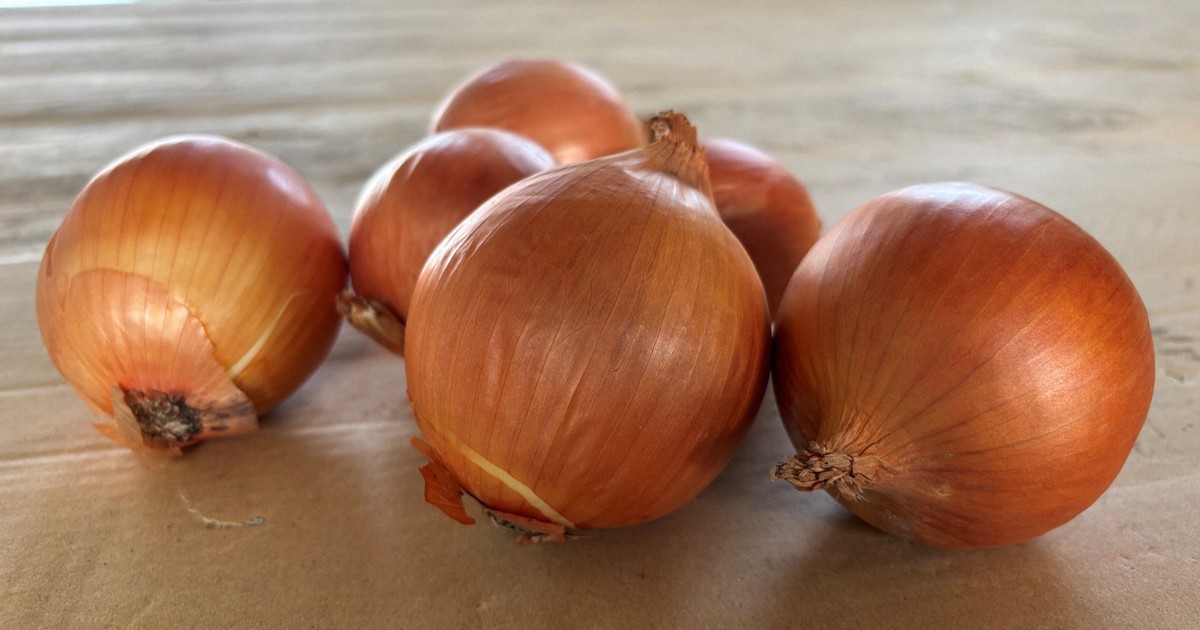
Smile Ball onions that don’t cause eye irritations when cut are seen in Kuriyama, Hokkaido, on Feb. 4, 2026. (Mainichi/Haruka Ito)
KURIYAMA, Hokkaido — Onions that don’t cause tears when cut, lack pungency even when eaten raw, and can be used in salads without soaking in water are now being cultivated in Hokkaido.
Developed by a major Tokyo-based food company during research into onion discoloration, the variety is steadily gaining ground in Hokkaido. Popular since its 2015 launch, production is planned to reach approximately 1,000 metric tons by 2029, over five times the current sales volume.
Ig Nobel Prize winner
The new onion variety, “Smile Ball,” was developed in 2012by House Foods Group Inc. The idea originated in the 1990s. During the process of making retort curry, onions and garlic sometimes turned green when sauteed together. To understand the chemical reaction causing the discoloration, the components of each were analyzed. During this process, an enzyme responsible for producing the pungent compounds in onions was newly discovered. The research findings were published in the British scientific journal Nature in 2002.
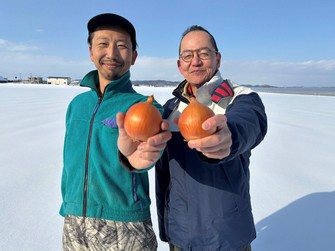
Noriya Masamura, right, from House Foods Group Inc., and producer Tamotsu Nishino stand in an onion field covered with snow in Kuriyama, Hokkaido, on Feb. 4, 2026. (Mainichi/Haruka Ito)
The research moved forward, and the mechanism of the enzymatic reaction involved producing the pungent compounds in onions also became clear. The team hypothesized that preventing this reaction could lead to creating a nonpungent onion. They began developing a new variety and succeeded in 2012. In 2013, research on this onion earned the Ig Nobel Prize in chemistry.
Try eating them thickly sliced and raw
According to House Foods Group, Smile Ball onions do not require soaking in water to remove pungency. This makes them particularly valued by establishments such as restaurants and salad specialty shops in the dell section of department stores, where they’re considered useful for being “easy to prepare.” Additionally, they retain water-soluble nutrients that would otherwise be lost through soaking.
Their sweetness is comparable to that of regular onions, and when sauteed, they become jamlike. At home, the onions are apparently also appreciated for not leaving a lingering onion odor on cutting boards, knives or hands.

This photo provided by House Foods Group Inc. shows a field of Smile Ball onions just before harvest season.
Noriya Masamura, 61, a section chief of the agribusiness promotion department at House Foods Group, who has been involved in the development of the Smile Ball onions for over 20 years, said, “Roughly chop them into pieces about 5 to 7 millimeters thick, toss with a little salt, dried herbs and olive oil, and you’ll taste their sweetness and they’ll pair perfectly with white wine. I highly recommend that people try eating thick slices of raw onions.”
Since current Smile Ball onions can only be cultivated north of 41 degrees north latitude, Hokkaido has become their primary production area. House Foods Group has contracts with onion farmers in the town of Kuriyama and elsewhere, selling 48 tons in fiscal 2023 and 124 tons in fiscal 2024. In recent years, the company and growers have focused on creating fields that maintain yields even in high temperatures and droughts, as well as on further varietal improvements, aiming for a gradual increase in production from 180 tons this fiscal year.
Tamotsu Nishino, 43, an onion farmer in Kuriyama who has been producing Smile Ball onions since 2015, said, “Hearing consumers say they want to buy them again or want more is encouraging. Masamura and his team provide detailed data on growing conditions and offer advice, which has broadened my knowledge.”
This year’s expected retail price for Smile Ball onions is 278 to 298 yen (roughly $2) for two L-size bulbs, available in supermarkets in Hokkaido and the Tokyo metropolitan area.
(Japanese original by Haruka Ito, Hokkaido News Department)
AloJapan.com