
 Save
Save
You have reached your maximum number of saved items.
Remove items from your saved list to add more.
Save this article for later
Add articles to your saved list and come back to them anytime.
Got it
AAA
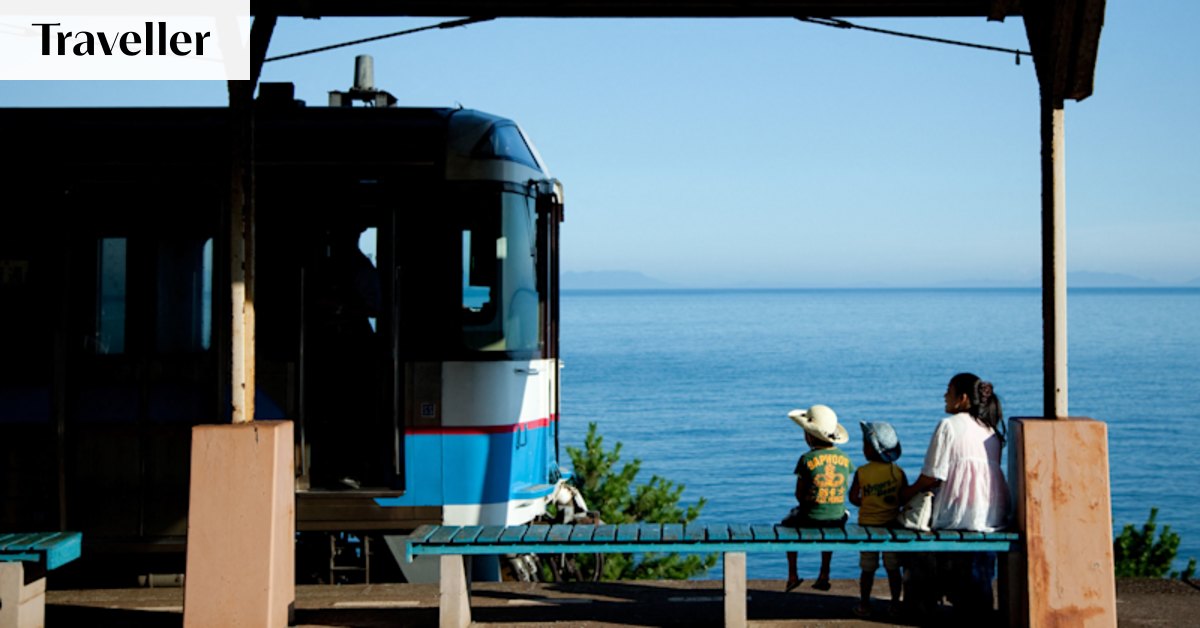
When arriving for a train at Shimonada station here in a remote corner of Japan it’s not uncommon, as you could safely expect, to be met by what appears to be a scattering of intending commuters. But the majority of these seeming passengers, while actually waiting for the arrival of a train, have absolutely no intention of boarding it.
You see, the assembled Japanese, along with the occasional interloping gaijin (foreigners like me), are here for the Instagram yen shot of the next train that pauses and then passes through the platform of this most accidental of Japanese tourist attractions.
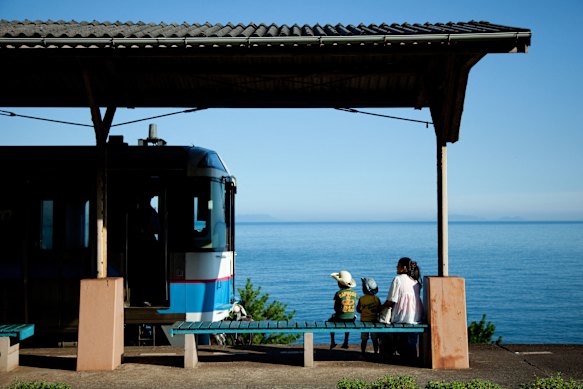 Waiting for a train at Japan’s Shimonada station, which overlooks the calm waters of the Seto Inland Sea.Alamy
The explanation? Forget Tokyo’s mammoth, frenzied Shinjuku station or even Kyoto’s behemoth main rail terminal: Japan’s most photographed, and perhaps filmed, railway station is this one.
It faces the western expanse of Japan’s impossibly scenic Seto Inland Sea in the lesser-visited prefecture of Ehime tucked into the north-west coast of Shikoku, the country’s fourth-largest island.
Shimonada station is a favourite location for Japanese film and TV commercial producers, and it’s not difficult to see why. Its captivating position is immediately by the seashore, and it has an unmanned weatherboard station building, plastered with faded photographs of the station from over the years, that serves as a waiting room in adverse weather.
Sign up for the Traveller Deals newsletter
Get exclusive travel deals delivered straight to your inbox. Sign up now.
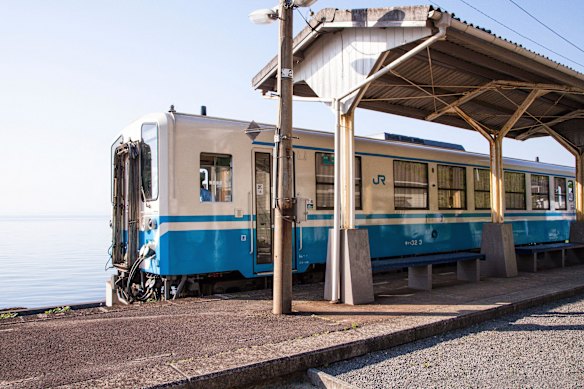 Against the scenic backdrop of the Seto Inland Sea, a Japan Rail train pauses at Shimonada station.Alamy
Both it and its sheltered platform with timber benches deliver a superlative, full-frontal view of the Iyo-nada Sea, a subsection of the greater Seto Inland Sea. The nearest city, Iyo, is known for its production of bonito flakes (aromatic dried, smoked and fermented shavings of tuna).
I’ve come here not by train but by road on a nearly week-long tour of Ehime’s main attractions, travelling from the southern castle city of Ozu. I’m en route to the easy-going prefectural capital of Matsuyama to the north, with a small diversion necessary along the way to visit Shimonada station.
While I’m a lifelong train travel fancier, Shikoku, being the least populous of Japan’s four main islands, is one of only a few places where foreigners can confidently opt for their own rental vehicle.
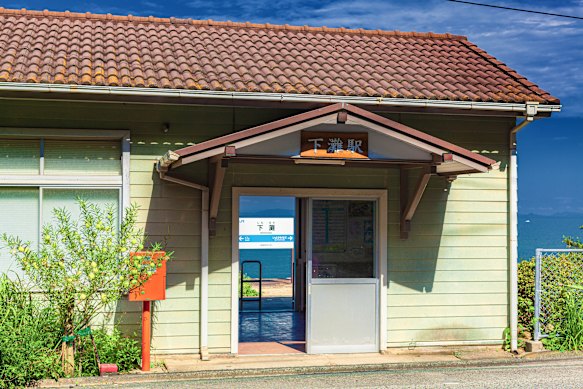 Shimonada station’s modest waiting room building features snaps of some of the thousands of trains that have passed along its tracks.iStock
Whichever form of transport you choose, these days only about 10 trains a day pass through Shimonada station, including, when running, the “retro-modern” Iyonada Monogatari tourist train, which routinely pauses to allow sightseeing passengers to alight and take photos.
There is even a regular passenger train which is intentionally scheduled to arrive at sunset as the view of the sea at dusk from the station platform is sublime.
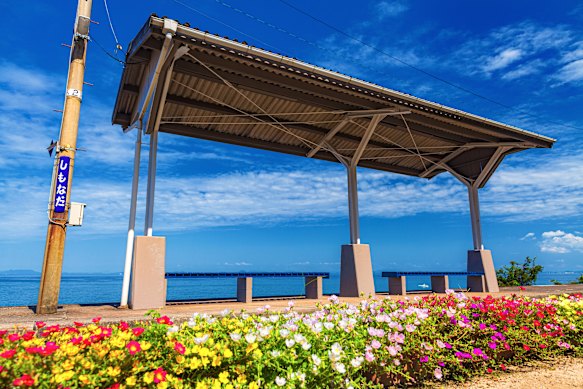 On a clear day, you can make out distant islands.iStock
From Shimonada station, on a cloudless day such as the one with which I’ve been blessed for this visit, you can easily make out in the distance some of the hundreds, if not thousands, of islands, many uninhabited, that look like puffs of steel wool flecking the brilliantly blue Seto Inland Sea.
In a country known for its fearsome waves, it’s an expanse of water renowned for its relative crystalline-like serenity and which connects the Pacific Ocean to the Sea of Japan.
The beauty of the Seto Inland Sea extends even further north beyond Matsuyama to the Shimanami Kaido, a 70-kilometre cycling route that runs, in part, across nine connecting bridges built atop a chain of islands, from the city of Imabari on Shikoku to Onomichi on the main island of Honshu.
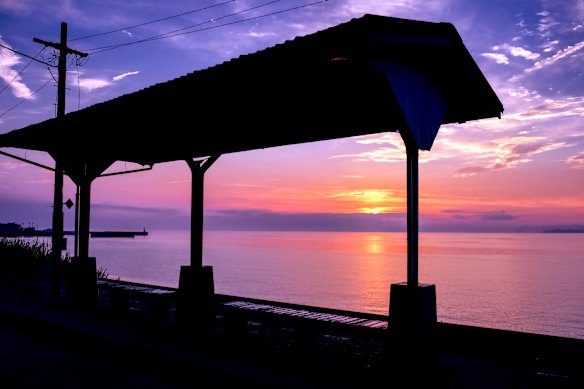 Dusk at the station is a favoured visiting time for passengers, sightseers and Instagrammers.iStock
While the route, which includes dedicated cycling lanes, is mostly flat, rented e-bikes at either end will smooth out what inclines that do exist along the way.
Back at Shimonada station, it’s not only the ocean views that attract sightseers, but also memories it evokes of scenes from Spirited Away, the cult 2001 Japanese anime feature film that earned nearly $US500 million at the global box office.
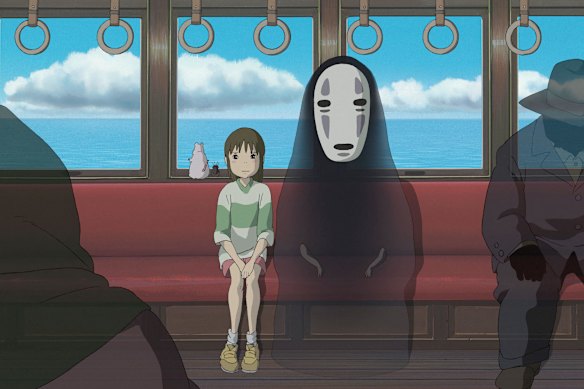 A scene from the Japanese anime film “Spirited Away” featuring characters aboard an imaginary sea-going train.Alamy
One of the most memorable elements of a movie full of them is a fantastical recurring passenger train that miraculously speeds across the sea, a little like the scene here, if you employ some imagination.
When a train is finally spotted by the gathered Instagrammers and no doubt trainspotters, those among the patiently waiting folk, me included, scurry to secure the shot.
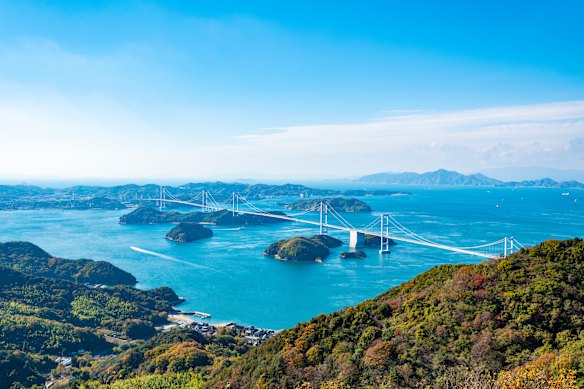 The road and rail bridges across Japan’s spectacular Seto Inland Sea also serve as the platform for a major cycling route.Getty
Typically, if not a little hilariously, the puttering two-carriage train is completely decorated with the kiddie character Reccha-kun, a “train fairy mascot” unique to the JR Shikoku Railway Company.
What could easily appear moderately infantile, or at best twee, in other countries, is perfectly normal in Japan: similarly decorated trains can be found elsewhere in this, the ancestral land of cuteness.
However, little or nothing lasts forever. It was announced last year that the livery on the iconic Hello Kitty-emblazoned bullet train, or Shinkansen, engines and carriages would be removed by mid-May this year, after eight years of display on the Sanyo trunk line between Osaka and Hakata.
But, if you hurry, you can catch a Super Mario-themed and adorned Shinkansen, part of a campaign run by JR Kyushu (named after Japan’s third-biggest island, to the south of here), until June 30. You’ve gotta love, if not also be charmed and befuddled by, the Japanese.
Back on track, or at least beside it at Shimonada station, once you secure that Instagram photo or video, or both, most people are ready to move on, continuing the coast-hugging journey on to Matsuyama or inland to Ozu.
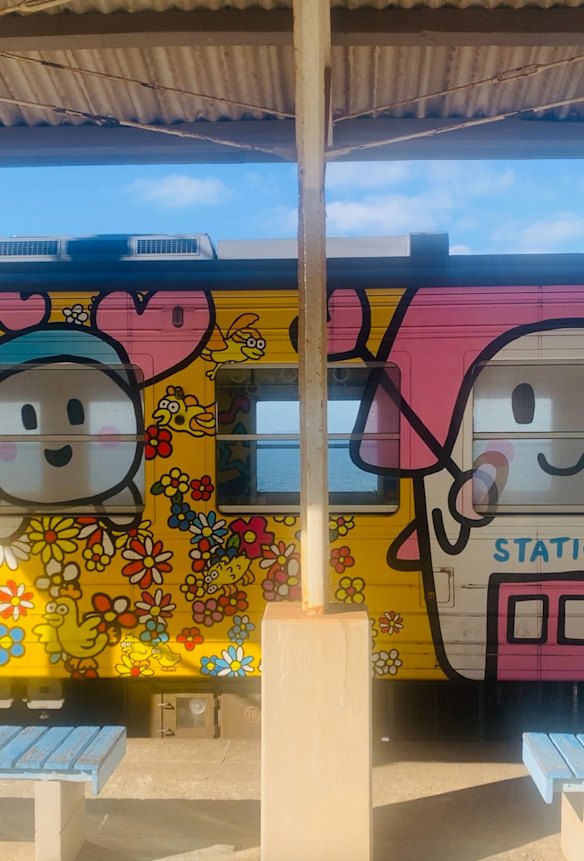 Reccha-kun, a “train fairy mascot” decorates railway carriages at Shimonada station.Anthony Dennis
Yet, it pays to linger a while because across the road from the platform and weatherboard JR station building is a small and rather cute caravan where you can buy coffee, snacks and the fresh citrus fruits for which Ehime prefecture is renowned.
Related Article
But don’t expect an espresso-style coffee as it’s strictly Japanese drip-style, which can take an agonisingly long time to be brewed and served at this one-man operation.
But, really, in this unrushed part of an otherwise rush, rush, rush Japan, there’s no need at all to spirit yourself away too soon.
THE DETAILS
VISIT
Shimonada station is about an hour from both the regional castle city of Ozu to the south and the Ehime capital of Matsuyama to the north. See visitehimejapan.com/en/
FLY
Jetstar operates regular flights from Sydney and Melbourne to Osaka’s Kansai Airport. From there, take a connecting one to 1½-hour domestic flight to Matsuyama Airport. Alternatively, fly a different airline to one of Tokyo’s airports and connect to Matsuyama with a similar flight duration to that from Kansai. See jetstar.com
TRAIN
An alternative to a connecting flight to Shikoku is to take a train to Matsuyama from one of the main cities on neighbouring Honshu such as Osaka, Okayama or Hiroshima. The three to 3½-hour trip is rewardingly scenic as the train traverses the network of bridges over the Seto Island Sea and then traces a route between the Ehime coastline and mountains to Matsuyama. See westjr.co.jp; jr-eki.com
The writer travelled as a guest of Visit Ehime.
Save
You have reached your maximum number of saved items.
Remove items from your saved list to add more.
 Anthony Dennis is the editor of Traveller at The Sydney Morning Herald and The Age.Traveller GuidesFrom our partners
AloJapan.com