
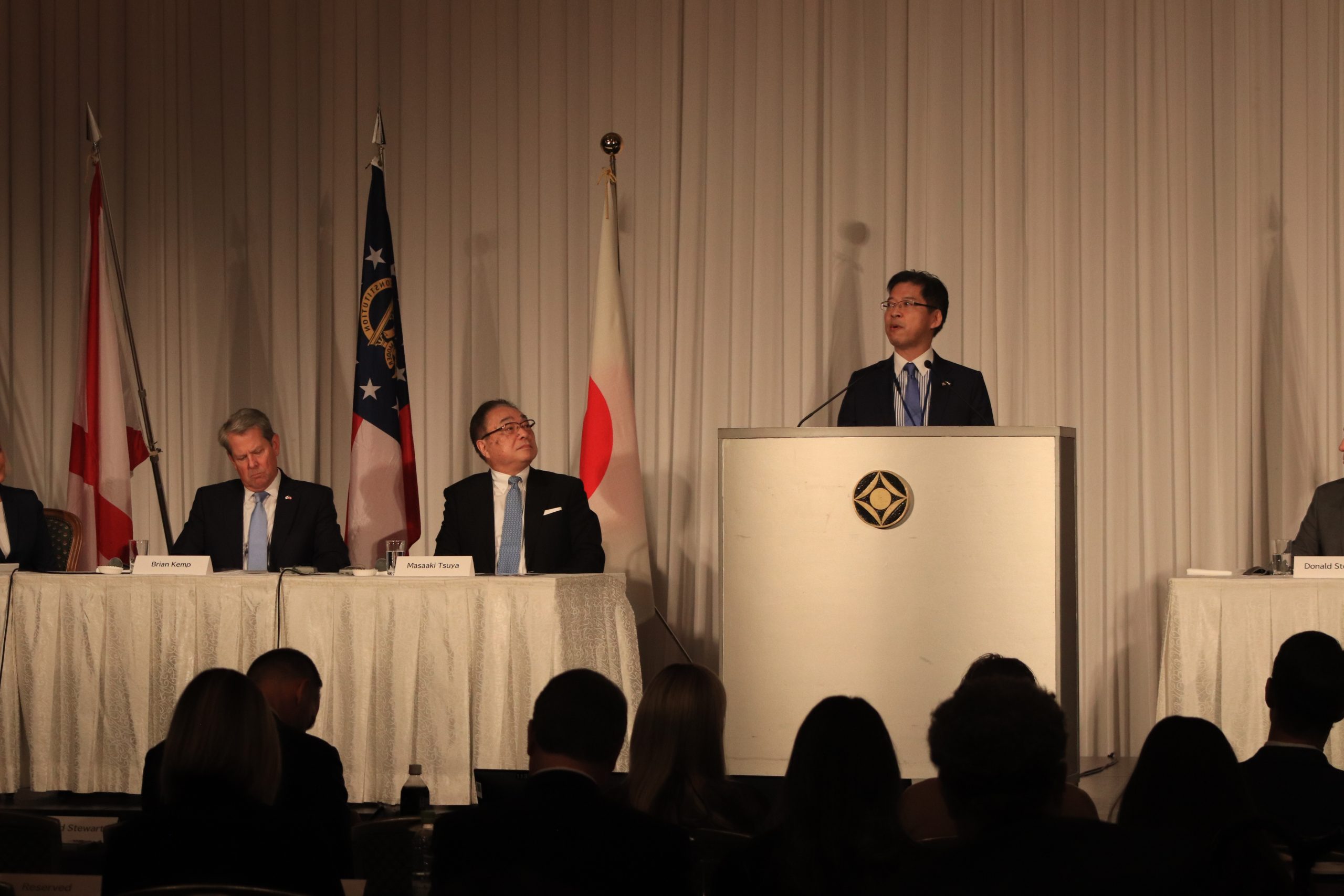
With his prime minister set to visit Washington next month and a recent trade deal facing an uncertain future, Japan’s consul general in the Southeast U.S. hasn’t slowed down since landing in Atlanta four months ago.
And neither has Japanese investment in the surrounding states, Consul General Kenichi Matsuda said during a celebration of Emperor Naruhito’s 66th birthday at his residence in Buckhead Wednesday.
Mr. Matsuda has adopted a breakneck pace since taking up the post, reflecting the flurry of activity in the Japan-U.S. commercial relationship as the two sides work to make good on a trade arrangement last year amid Trump tariffs that hit car makers and other Japanese manufacturers in the South hard.
Already, Mr. Matsuda has accompanied new ambassador to the United States, Shigeo Yamada, to all four states in his jurisdiction.
As he’s settled in, Mr. Matsuda expressed pride in uncovering the extent of Japan’s influence in his new home. At last count, the consulate counted 1,577 Japanese-owned facilities (some operated by the same company) in the four states, the largest in any territory covered by Japan’s 14 diplomatic missions in the U.S. It’s also the only region to have two state legislative caucuses — for Georgia, which has a 50-year presence in Tokyo, and Alabama, which also announced the opening of a Tokyo trade office last fall.
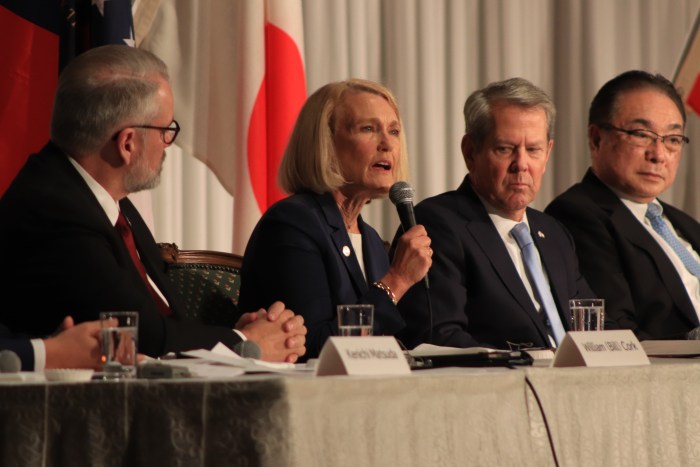 During the SEUS-Japan conference in Tokyo last October, Alabama Commerce Secretary Ellen McNair announces a new Tokyo trade office for Alabama as Georgia Gov. Brian Kemp looks on. The two states both have legislative caucuses celebrating Japan.
This is evidence that the kizuna, or friendship bonds, between Japan and Southeastern states are not just a 20th-century relic.
“This remarkable investment is a clear sign of the confidence Japanese companies have in the Southeast region. We often hear about the impressive expansion of Japanese businesses decades ago, but what is truly exciting is that we are witnessing this growth right now,” Mr. Matsuda said.
Further underscoring this trend, he said, is the first tranche of three Japan-funded projects announced under the $550 billion investment framework President Donald Trump formalized with Prime Minister Sanae Takaichi in late October.
While the bulk of the $36 billion will come in the form of a power plant ($33 billion) and liquefied natural gas export terminal ($2.1 billion) in Ohio and Texas, respectively, one $600 million project is slated to land in Georgia: an industrial diamond dust factory slated to be operated by Element Six, a British company within the DeBeers group. (See the fact sheet from the first three investments here)
Details are scant on the Georgia project, which the U.S. Commerce Department announced Feb. 17, saying the “synthetic diamond grit” made at the plant would be sufficient to completely onshore production of this “essential material.”
As announced, the project wouldn’t be a Japanese investment in Georgia per se, but reports indicate that the funding in the form of loans or guarantees would come from Japanese development banks or capital instruments.
“Japan is providing the capital. The infrastructure is being built in the United States. The proceeds are structured so Japan earns its return, and America gains strategic assets, expanded industrial capacity, and strengthened energy dominance,” Mr. Lutnick said in a news release.
The state of Georgia hasn’t commented on the specifics of the project, but a spokesperson said the state is set to play a role in reducing American reliance on imported critical minerals:
“Georgia is a major hub for innovation and R&D, including when it comes to the critical mineral supply chain needed to keep America safe and economically strong.
“In this industry, as in all others, the Georgia Department of Economic Development welcomes the creation of good jobs for Georgians and stands ready to support that growth whenever and wherever we can be beneficial.”
It’s unclear whether the October trade deal, which Japan struck to lower its tariff rate to 15 percent, will stick now that the Supreme Court has ruled unlawful the tariffs Mr. Trump used as leverage to bring trading partners to the table.
Analysts have noted that the the timing of the investment announcement, just before Ms. Takaichi’s March visit to Washington, may have been calibrated to show progress on the deal, especially as others have stalled.
The president has now imposed a 10 percent across-the-board tariff under an authority known as Section 122 and has warned partners against scuttling their deals in the wake of the Feb. 24 court ruling.
While Japanese companies have endured tariff harm, many operate on business plans that span more than a generation, sometimes rendering them less apt to react rashly to swings in policy.
“Japanese companies in Georgia are an essential part of the fabric of our local communities, and we share deep cultural cultural ties and friendship that span generations,” said Mary Waters, chief administrative officer and chief of protocol at the department, in remarks at the birthday celebration. “We build things together, we work together to solve common challenges, and we create economic opportunity and a better future for our families.”
Just before giving a toast, Toyo Tire North America Manufacturing Inc. President Patrick Lenz said his company is a testament to that ethos of cooperation, having expanded seven times since landing in White, Ga., 20 years ago. Reports indicate that the company is planning another $200 million expansion in response to tariffs, though Global Atlanta has not independently confirmed that deal or its driving factors.
The Emperor’s Birthday celebration, an annual soiree, included a lavish dinner and displays of Japanese products made in Georgia, a format similar to the recent Japan Day at the Capitol, which celebrated the 52nd anniversary of the consulate’s presence in Atlanta and culminated in a proclamation in the state legislature recognizing the importance of Japanese investment in the state.
Mr. Matsuda was there, soaking in yet more of the Southern hospitality that has attended the arrival of the consul general and his wife, Yoko, whom he praised in the speech for her support during the transition to Atlanta.
“I must confess that those first couple of weeks passed in a flurry of events, and frankly, my days consisted of trying my very best to remembering the many faces at one space,” he told an assemblage of guests from the consular corps, business and government. “When the pace settled, what struck me most was the warmth and hospitality I received from all of you. From my very first days, I felt not just welcomed, but genuinely embraced, and in that moment, I understood why Japanese companies, students and family choose to invest study and live in the Southeast.”
From the archive:
AloJapan.com