
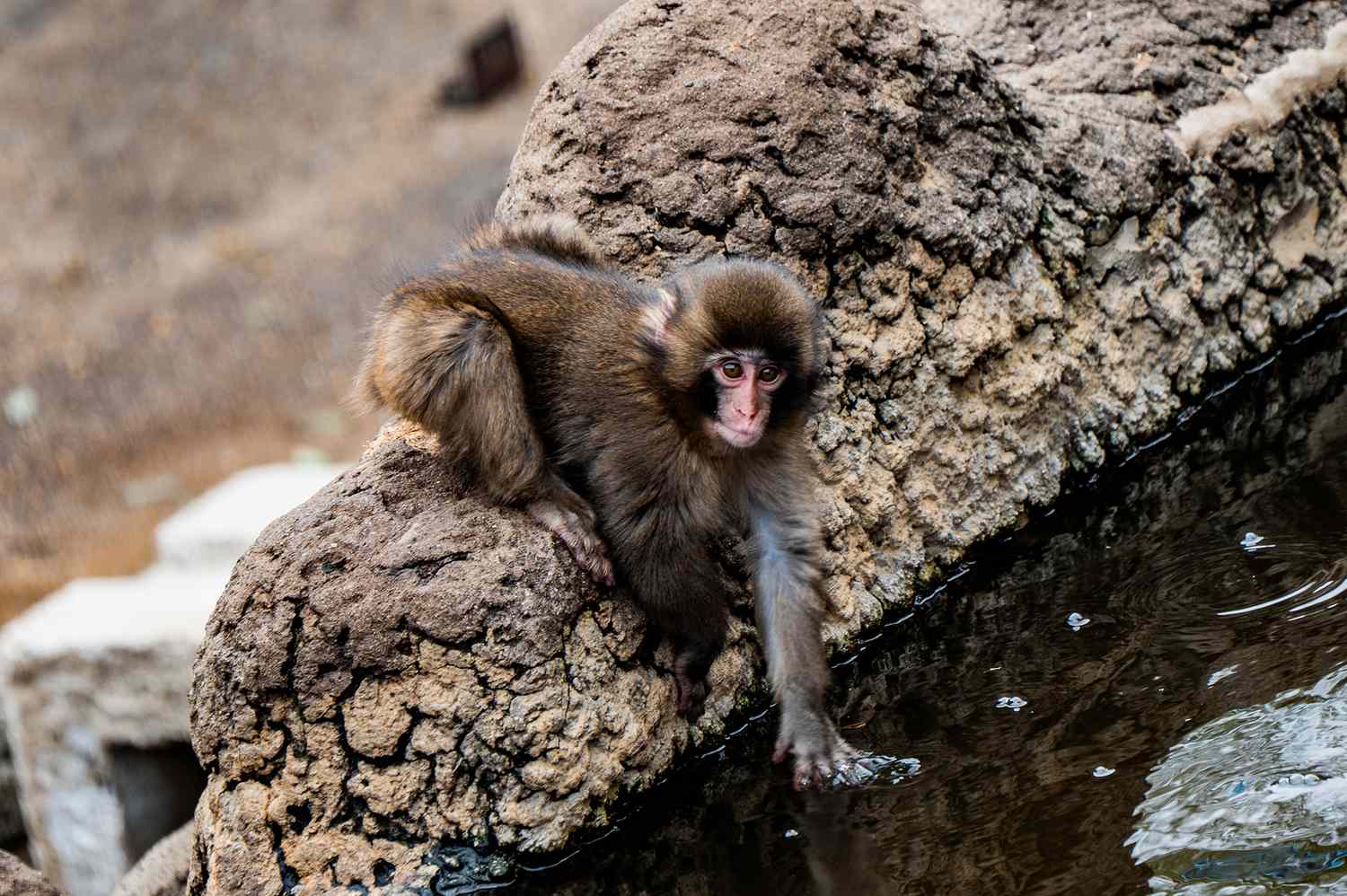
In the past week, Punch—the baby Japanese snow monkey who was reportedly abandoned by his mother and was being raised by zoo staff—has become an unlikely international celebrity. The tiny macaque, born on July 26, is often spotted clutching a plush toy from IKEA and has melted hearts across the internet, inspiring a wave of comments from fans half-joking about booking flights to Japan to check on him.
I didn’t just joke about it. I went.
I was headed to Japan for the World Baseball Classic, but on my very first morning in Tokyo, I made a detour to neighboring Chiba Prefecture to visit Punch at Ichikawa City Zoo in Ichikawa, Japan.
After weekend reports of thousands of visitors and hours-long waits at the small community zoo, I devised a strategy: beat the crowds. Running on jet lag, I woke at 4 a.m. to catch a 5 a.m. train from Shinjuku. I rode the Oedo Line to Daimon, transferred to the Asakusa Line bound for the Omachi Station, and watched the sunrise spill across the Tokyo skyline. From there, it was a 25-minute walk to the zoo entrance. Door to gate, the journey took just about two hours.
As cars streamed past me toward the parking lot, I braced for a long queue. Instead, I found myself alone at the ticket gate—so early that arriving zookeepers glanced at their watches, puzzled. About 30 minutes later, another early bird traveler appeared: a young woman from Singapore, who had flown in just to see Punch.
By the time the gates opened at 9:30 a.m., a few hundred people had gathered behind us. My two-hour wait at the entrance felt like a worthwhile trade-off. (Pro-tip: If you’re planning a visit, be sure to check the zoo’s latest rules and updates. As of Feb. 23, the zoo reported averaging 5,200 visitors per day—a surge that has prompted admission restrictions and even a temporary closure on Feb. 24.)
When the turnstiles clicked open, I headed straight for Monkey Mountain, the rock enclosure where Punch lives with his troop. At first, I couldn’t find him. On this particular morning, there was no stuffed orangutan in sight—no obvious signifier of viral fame. Instead, a small monkey darted between rocks, trailing older members of the troop.
Punch being hugged by one of the older Japanese macaque.
Joshua Mellin
Japanese snow monkeys, formally known as Japanese macaques (Macaca fuscata), are native to Japan and are the northernmost-living nonhuman primates in the world. Famous for bathing in hot springs during winter, they are highly social animals that live in large troops and thrive in environments ranging from subtropical forests to snowy mountain regions.
It took me a few minutes to realize that the baby was blending seamlessly into the group was Punch himself. The internet’s shy celebrity has already begun to look like any other young macaque, scrambling, observing, and learning. (On Feb. 23, Ichikawa City Zoo posted on X that Punch has been spotted socializing with other baby monkeys and eating independently, marking a positive step forward in his development. “He’s continuing to do well!” the zoo shared.)
For nearly an hour, I watched him stick close to older monkeys, mirroring their movements and cautiously navigating his place within the group. Behind me, the crowd thickened. Within a couple of hours, Monkey Mountain was ringed several rows deep with visitors, camera phones raised high and news photographers angling for a clear shot. The monkeys seemed unfazed by the spectacle. I, on the other hand, was grateful for my early start.
The rest of the zoo was modest but charming, the kind of place where you can sense the staff’s hands-on care. A red panda dozed in a tree, a giant tortoise ambled across its enclosure, and one of the largest cows I’ve ever seen grazed calmly in a nearby pen. The facilities may be small, but the attention to the animals is evident. If Punch’s fame brings additional resources and long-term support, it could be a meaningful silver lining.
When I left in the early afternoon, a line of roughly 200 people still stretched from the entrance, though staff were managing the flow efficiently; the wait appeared to be about an hour.
There was something unexpectedly joyful about beginning a Japan trip with a visit to a viral sensation. But beyond that, what stayed with me was simple: Punch is in good hands and thriving.
AloJapan.com