
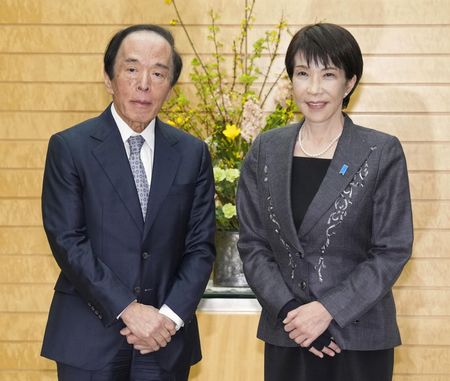
Japanese Prime Minister Sanae Takaichi has nominated two academics who favor low interest rates to the Bank of Japan’s board, signaling her opposition to rate increases. The appointments surprised markets and weakened the yen, raising concerns about political interference in monetary policy.
Japanese Prime Minister Sanae Takaichi has made her stance on interest rates crystal clear by selecting two academics who strongly favor keeping borrowing costs low to serve on the Bank of Japan’s governing board.
The Wednesday announcement of nominations for professors Toichiro Asada and Ayano Sato caught financial markets off guard, as many expected Takaichi’s administration would choose more centrist candidates. The yen dropped following the news.
According to two sources with knowledge of the situation, Takaichi kept her selections secret even from the Finance Ministry, which traditionally plays a role in vetting potential board members.
Though the central bank may continue raising rates in the near term, these appointments could have lasting effects on monetary policy battles that may stretch across years or even decades.
Market experts warn that Takaichi’s direct involvement in monetary policy decisions increases the likelihood she’ll appoint more stimulus-friendly members when two rate-hike supporters finish their terms next year.
Should the dovish prime minister remain in office long enough, she would also control the selection of new Bank of Japan leadership when Governor Kazuo Ueda and his deputies’ terms conclude in 2028 — potentially pressuring an institution that has faced political meddling previously.
“If the government tries to politicise the Bank of Japan then the same thing we’ve seen in the U.S. could happen in Japan, which is bond selling as well as currency selling,” warned Yusuke Miyairi, a foreign exchange strategist at Nomura Securities in London.
“I wouldn’t say BOJ independence is threatened at the moment, but the government is trying to have more power in the BOJ’s policy decisions,” Miyairi added, noting the selections reveal more about Takaichi’s monetary policy philosophy.
Both parliamentary chambers must approve the nominations before they take effect. While Takaichi’s ruling coalition controls the lower house, it needs opposition support in the upper chamber where it lacks a majority.
Asada, a scholar famous for championing massive economic stimulus measures, will replace dovish board member Asahi Noguchi at the end of March.
Sato, also an academic, has promoted the advantages of expansionary government spending and loose monetary policy. She’ll take over in June when Junko Nakagawa, viewed as neutral to slightly hawkish on rates, steps down.
Both candidates belong to a circle of economists who have pushed for the expansionary fiscal and monetary approaches now embraced by Takaichi, and maintain connections with dovish former Bank of Japan officials including former deputy governor Masazumi Wakatabe.
The new appointments won’t immediately impact the central bank’s short-term policy choices. Neither nominee will participate in March’s policy meeting.
As a newcomer, Asada likely won’t make waves at his first meeting on April 27-28, while Sato’s initial opportunity to vote will come during July’s rate review.
Former Bank of Japan official Nobuyasu Atago suggested the newcomers’ perspectives may evolve once they confront the realities of policy-making amid market volatility, economic uncertainty and unexpected crises.
“Once they join, the board members shed their ideologies and become more practical,” explained Atago, who worked as staff for a board member during his central bank tenure.
“BOJ staff would barrage them with briefings, which could be overwhelming for newcomer academics,” he noted. “I think yen moves matter far more than the Takaichi nominations.”
Board member Noguchi exemplifies this transformation — he joined as a strong advocate for aggressive monetary easing but changed course and supported the Bank of Japan’s last two rate increases.
Nevertheless, the new members will likely influence policy discussions by altering the board’s makeup, which has increasingly favored near-term rate hikes as the yen’s decline keeps food inflation persistently elevated.
Noguchi represents the final member of the once-powerful stimulus advocates who gained influence by providing theoretical support for former premier Shinzo Abe’s “Abenomics” economic policies.
Two hawkish board members, Naoki Tamura and Hajime Takata, have actively pushed for additional rate increases in the near future, with Takata unsuccessfully proposing rate hikes at January’s meeting for the second consecutive time.
While uncertainty remains about how the newcomers will position themselves, analysts believe the most significant impact stems from Takaichi’s clear dovish signal through these nominations.
The Nikkei newspaper reported, without identifying sources, that Takaichi expressed dissatisfaction with the Bank of Japan’s December rate increase to her associates, worrying about effects on home loan rates and business investment.
Given the substantial political momentum Takaichi gained from her party’s overwhelming election victory earlier this month, analysts suggest the central bank would struggle to implement rate hikes without administration approval.
“Up till now, the Takaichi administration didn’t send clear communication on its view on monetary policy,” observed Takahiro Otsuka, senior fixed income strategist at Mitsubishi UFJ Morgan Stanley Securities in Tokyo.
“This nomination is a message it is pursuing a high-pressure economy,” he said, emphasizing efforts to stimulate growth through inflation.
AloJapan.com