
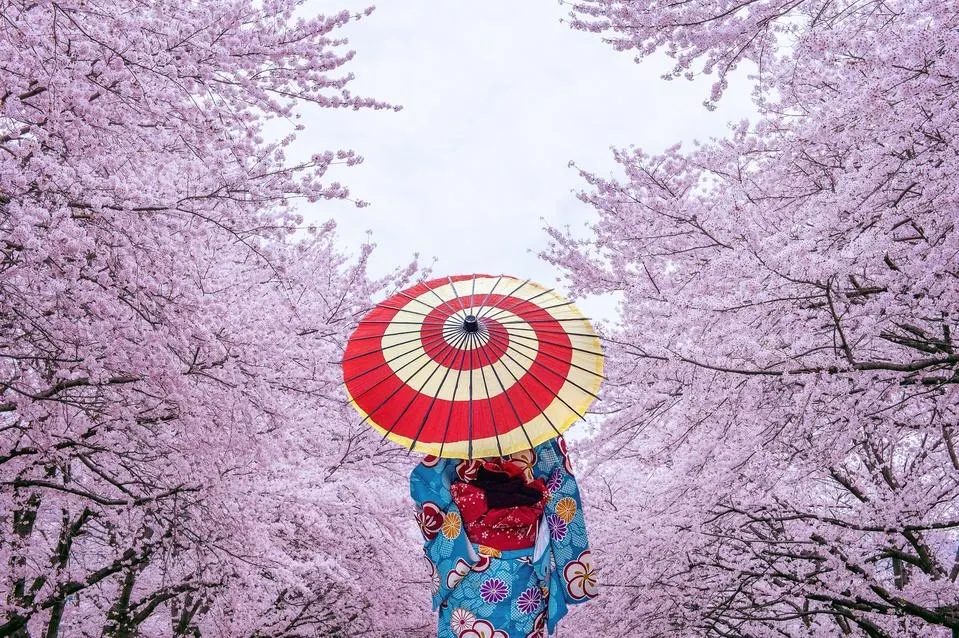
Asian woman wearing japanese traditional kimono and cherry blossom in spring, Japan.
getty
Japan’s cherry blossom season has become a victim of its own popularity. On February 3, 2026, Fujiyoshida canceled its popular Cherry Blossom Festival at Arakurayama Sengen Park, which draws about 200,000 visitors each year to a city of about 46,000 to 47,000 residents. Officials cited overtourism as the main reason for the decision.
When Crowd Controls Stop Working
When asked in an email interview whether this cancellation was an outlier or an early example of how destinations may respond when crowd-management tools stop working, Takao Nishina, a Tokyo-born local expert who leads experiences in Japan for GetYourGuide, replied that Fujiyoshida is a clear example of what happens when everyone converges on one spot at once, and even well-planned crowd controls are overwhelmed.
Sam Bruce, co-founder of Much Better Adventures, agreed that the cancellation is a sign of what happens when tourism isn’t designed with local communities in mind.
“Tourism should, first and foremost, work for the people who live in a place,” he said. When everyday life starts to break down under visitor pressure, authorities may have little choice but to stop promoting the surge and reset.
Fujiyoshida, Japan at Chureito Pagoda in Arakurayama Sengen Park during spring cherry blossom season.
getty
Dana Yao, who lived in Japan and now splits time between Japan and the U.S. while running a Japan-focused travel community, says in an email interview that the cancellation aligns with what she has seen build over the past few years. “In smaller cities, it does not take much for crowds to crowd the streets, transit, and basic services and they cannot handle it all at once,” she says.
Ben Julius, founder of Tourist Japan, points out that “It’s also important to note that this is not the first time severe measures have been taken in Japan to stop the overwhelming crowds in their tracks before they have a chance to take over. Everyone has heard about the closure of the famous Lawson Mt. Fuji photo point or the recent spike in lodging tourism taxes.”
A worker installs a barrier to block the sight of Japan’s Mount Fuji emerging from behind a convenience store to deter badly behaved tourists, in the town of Fujikawaguchiko, Yamanashi prefecture on May 21, 2024.
AFP via Getty ImagesCancelling The Festival Does Not Cancel The Blossoms
Not everyone agrees that the cancellation necessarily marks a wider shift. Catherine Heald, CEO and co-founder of luxury tour operator Remote Lands, argues the cancellation is largely symbolic because it doesn’t remove the underlying draw. She warns that people will not stop coming because the cherry blossoms will be there regardless.
“I think Fujiyoshida is an outlier and other festivals won’t be cancelled – although they will be crowded, especially in places like Ueno Park in Tokyo,” she said in an email interview.
Ladies pose for portraits under the cherry blossoms trees at Ueno park in Tokyo, Japan during cherry blossom season.
Getty Images
Nishina from GetYourGuide agrees that “closing the site completely isn’t a realistic fix.” He recommends that a better approach would have been to improve transportation and facilities, work with local businesses and create programs that draw visitors to other neighborhoods.
“The goal shouldn’t be to slash visitor numbers but to guide them more evenly so residents and visitors both win,” he reasons.
From Two Weeks To A Full Season
“Seasonal travel built around natural moments like cherry blossoms will always be powerful,” Nishina says. For him, the issue is not seasonal travel itself, but the way demand compresses into a single ‘perfect’ moment.
Instead, Nishina emphasizes that cherry trees are stunning everywhere, so visitors should consider cherry blossom viewing as a flexible season rather than a single hotspot. He believes in promoting alternative regions like Tohoku and quieter neighborhoods, and that encouraging early mornings, nighttime illuminations, or river cruises could disperse the crowds, resulting in a calmer, more memorable experience.
Mount Iwaki-san stands in the background during The Hirosaki Cherry Blossom Festival at Hirosaki Park in Tohoku Region of Japan.
Getty Images
Julius from Tourist Japan believes that the tour-operator model of selling the season as a single-point promise is increasingly risky. “With an entire itinerary built around a specific natural spectacle, there is much room for disappointment, as measures are increasingly controlling access through higher prices and caps on reservations and tickets,” he explains.
Alyse Race, founder of The Invisible Tourist, points out that educating visitors is equally important, since most tourists don’t realize they can see numerous cherry tree varieties throughout Japan from February to May.
She said in an email interview that travel companies could ease pressure on peak hotspots by promoting lesser-known regions or stretching their offers across several months rather than concentrating them into a short, two-week peak window.
When A Destination Is Defined By A Single Angle
Sofia Mascotena, founder and CEO of Naya Traveler, describes in an email interview that “The rise of ‘Insta-worthy’ moments has amplified demand for a small number of visually recognizable backdrops, often reducing complex, living places into a single framed shot,” she said.
The five-storied pagoda also known as the Fujiyoshida Cenotaph Monument in Japan.
getty
Both Julius from Tourist Japan and Bruce from Much Better Adventures consider Fujiyoshida’s Mt. Fuji-and-pagoda view a prime example of how one viral, iconic angle can funnel huge crowds into a small area that isn’t built to handle them.
However, Race from The Invisible Tourist argues this is not unique to Fujiyoshida. “Just look at Arashiyama Bamboo Grove in Kyoto. There are countless bamboo groves all over Japan, but most tourists flock there, as they aren’t aware of any alternatives,” she notes.
Yao agrees and notes that social platforms reward sameness, and when everyone visits the same places, they do not want to go or see anything else.
Then, Bruce bluntly puts the responsibility on the tourism industry. “Travel companies have a responsibility to shape demand thoughtfully, not just chase it,” he said. “That means building itineraries that distribute visitors across seasons and places, supporting locally owned businesses and producers, and protecting the nature that you travel through.”
Restaurant with a panoramic view of Mt. Fuji. Eat all-you-can-eat buffet for lunch in Gujiyoshida City, Yamanashi Pref. Japan.
getty
Mascotena makes a similar point, but frames it as an ethics issue, not a marketing tweak. “Travel companies are not neutral here; we help shape desire,” she said. “We choose what we publish, what we package, and what we normalize.”
“Satellite data shows that 80% of travelers are flocking to just 10% of global destinations. When you have 1.5 billion global travelers chasing the same ten ‘bucket list’ photos, the experience loses its soul,” says Rosalyn Acosta, who worked for 15 years managing sustainable programs.
Both Acosta and Mascotena argue that the tourism industry has leaned on iconic sights because they are easy to sell. But Acosta emphasizes that the industry should invest more in elevating nearby places and experiences that could absorb demand and spread the benefits.
Will Other Places Follow Fujiyoshida’s Lead
Yao warns that “Fujiyoshida is not the last place that will decide to hit pause, or put up a barrier, or restrict access, if that’s what it takes to restore basic safety and locals’ livelihood.” She reminds everyone that Shibuya has cancelled both Halloween and New Year gatherings since 2020.
Shibuya Crossing at twilight in Tokyo, Japan
getty
Shir Ibgui, founder and CEO of GlobeThrivers, also notes that when “destinations deal with sanitation issues, resident safety concerns, and over tourism backlash, more will quietly cancel or de-emphasize flagship events rather than expand them.”
Usha Haley from Wichita State University explained in an email interview that other countries may be slower to adopt Japan-style interventions because of the financial trade-offs. Whether other places adopt these kinds of restrictions will depend on local culture, the economy, and how strongly rules can be enforced. Tourism is a major source of income for many communities. In many countries, it is hard to absorb the financial costs of limiting visitor numbers during peak periods.
Even if cancellations remain rare, destinations must assess how far they can go to protect residents’ lives while keeping tourism economically viable. As Japan heads into another cherry blossom season, will other communities hit their breaking point?
AloJapan.com