
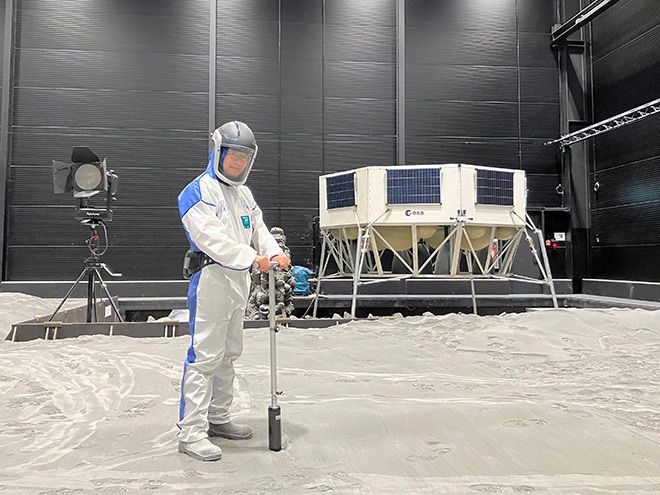
The U.S.-led Artemis mission that will send humans to the moon for the first time in half a century has adopted a system developed by Japanese researchers to study the lunar surface.
The equipment, called the Portable Active Seismic Source (PASS), was created by researchers with the University of Tokyo and other Japanese institutions.
It is designed to generate small vibrations on the moon’s surface. The way the shocks propagate will be used to study structures of the lunar interior and to help locate potential water and mineral resources.
Takeshi Tsuji, a leading member of the research team, said the PASS is designed to be operated by an astronaut near seismometers deployed on the lunar surface and to repeatedly generate small, artificial vibrations.
Tsuji, a professor of geophysical exploration with the University of Tokyo graduate school, explained the shocks propagate through the moon’s interior in the form of waves, which will be monitored by the seismometers.
Variations in wave speeds and intensities can reveal differences in ground hardness levels and deduce lunar subsurface structures.
The Artemis IV mission is expected to intensively explore the lunar surface, including geological surveys, with the participation of a Japanese astronaut.
Lift-off is scheduled for the second half of 2028 at the earliest.
There are plans to make wave velocity profiles to depths of about 5 meters beneath the moon’s surface. That will help assess ground conditions for suitable base locations and obtain clues on how the moon was formed, Tsuji said.
The PASS system’s strengths lie in its compactness, light weight and ease of handling.
Seven centimeters in diameter and 20 cm in length, a PASS unit is roughly the size of a large juice can and weighs about 800 grams. It is designed to be applied to the end of a stick.
Astronauts can elucidate 3-D interior structures more closely if they can work quickly and generate vibrations at more locations during their limited time on the moon’s surface.
JAPANESE DREAM
Tsuji said he envisages use of the Lunar Cruiser, a moon surface exploration vehicle being developed by Toyota Motor Corp., to move the positions of the seismic source and seismometers during the measurements.
That would enable exploration to depths of more than 80 meters, he said.
The PASS system was initially developed for terrestrial use. It has been deployed, for example, to monitor underground storage of carbon dioxide and to check deterioration of water pipes, tunnels and other concrete structures.
For use on the moon’s surface, the PASS has been improved to withstand vacuum and extreme temperature changes and to block the invasion of lunar sand (regolith).
Tsuji said he hopes to spread the use of PASS on the Earth’s surface as a “tool that allows anyone to explore subsurface structures easily.”
“I am yearning to see a Japanese astronaut holding this device to explore the moon,” Tsuji added.
AloJapan.com