
Photos by Nobusuke Ohki
By the time I arrive at my hotel on Yakushima Island, I’m a day late for my reservation and soaking wet. Fifteen seconds between the ferry terminal’s awning and my taxi were enough to saturate me to the bone. Inside the taxi, the driver’s seats were covered in neoprene—an island-level concession to the fact that almost everything and everyone here is wet, almost all of the time.
To get to this 500-square-kilometre island off Japan’s southernmost mainland prefecture, one must be patient…if not outright stubborn. Yakushima is the rainiest place in the country, and the combination of open Pacific weather and steep, unforgiving mountainous terrain means travel plans are conditional. Ferries stop for days on end, as does the lone daily turboprop flight from Kagoshima city on the mainland. Meaning guests are let in and out by the good grace of the gods.
Why might one go through such inconvenient lengths to visit one of the wettest corners of the world? For some, it’s the chance to stand before one of the oldest living trees on earth. Others, to hike the woodlands that inspired Hayao Miyazaki’s animated masterpiece Princess Mononoke.
I first learned about Yakushima in a thoroughly twenty-first-century way: a YouTube vlog. A family that had spent a decade sailing around the world arrived here and declared it the most beautiful place they had ever seen. That line lodged itself somewhere, and now here I am: soaked and finally on the island that had been working its way into my imagination for years.
“To arrive on Yakushima at all is a sign the island chose you,” says Ono Christine, the front desk manager at Samana hotel, while checking me in. I take her comment far too personally, chuffed that the island has decided I’m worthy of entry.
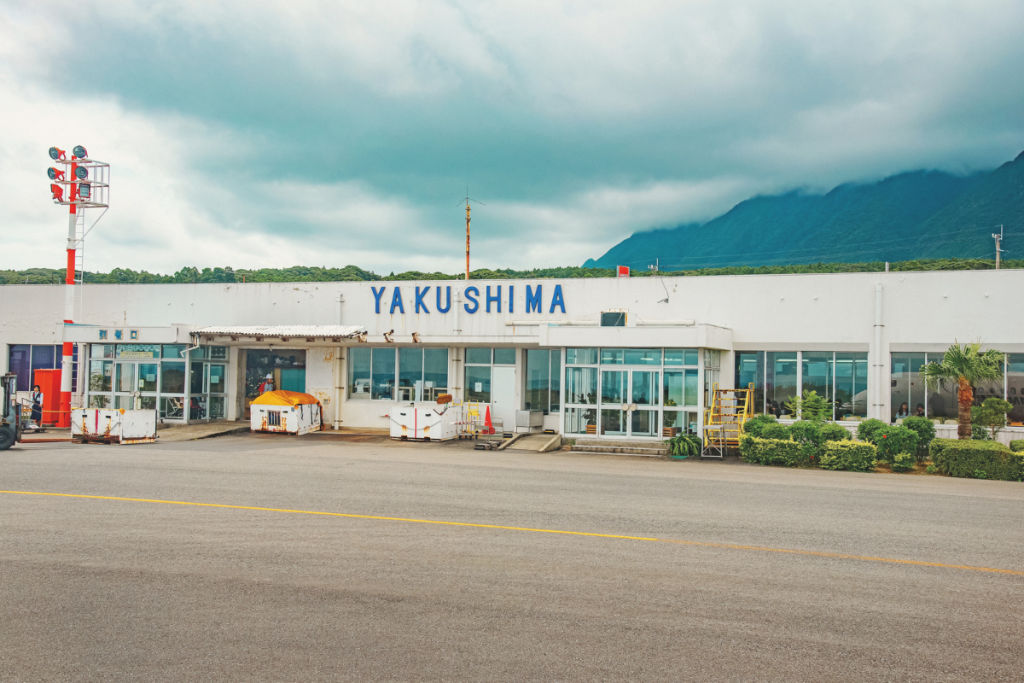 Yakushima airport.
For most of the previous day I’d been convinced that arriving late would unravel the whole trip. Yakushima doesn’t offer many places to sleep (only about 10 percent of the island is suitable for habitation, the rest vertical granite) and the better properties—Samana and its luxury sibling, Sankara—fill up months in advance.
GOTOKU, the Kyushu travel outfit run by Alex and Chisato Bradshaw who helped plan my trip, seemed unfazed by the delay.
Over lunch of local black-pork shabu in Kagoshima, Chisato explained that the hotels had already shifted my reservation and would keep adjusting it until the ferries ran again. No drama. She even found me a last-minute room near the port and steered me to a small, natural wine-serving oden counter where a simple bowl of cabbage in broth changed my life. Only in Japan.
I was at the Toppy ferry terminal by 7 a.m. the next morning to check the status of the crossing. I stood out—not just as one of the few foreigners, but as the only person who hadn’t already changed into an Arc’teryx shell and waterproof shoes. I regretted that as soon as our jet foil approached Yakushima, the rain forming a grey wall so dense I couldn’t tell where the ocean ended and the sky began.
I’m from America’s Pacific Northwest, where it rains more than 170 days a year, but I’ve spent the past decade in Thailand, where the downpours are hot, forceful and brief. As my cab wound from the northern port toward Samana on the island’s southern tip, I was surprised by how familiar the gloom and dense green felt. Except here, the fir trees shared soil with palms and orange groves.
Yakushima rises nearly 2,000 metres straight out of the sea, and its climate shifts with altitude at a pace you can feel in your lungs. Warm, humid air from the Kuroshio Current keeps the coast subtropical. A few hundred metres up, the vegetation turns to temperate evergreen forest. Higher still, the ancient cedars take over—massive, slow-growing, and indifferent to visitors. Near the peaks, the air hardens and the flora thins into subalpine shrubs more typical of central Japan’s highest mountains. So unique is its compressed, vertical spectrum of ecosystems that Yakushima became one of Japan’s first natural sites inscribed on the UNESCO World Heritage list in 1993.
I learned all of this later that day while circumnavigating the island by car with my guide, and new friend, Nobusuke. Nobu was born outside Tokyo and lived in Dallas, Texas until he was eight because of his father’s job. He speaks English like a native, though he credits that mostly to the years he spent travelling as an alpine mountaineer and climbing guide on Mount Fuji. In a past life, he chased some of the world’s highest peaks—K2 and Nemjung in the Himalayas, and Denali in Alaska. Too many close calls, and too many funerals, pushed him off the high mountains for good.
When he first moved to Yakushima, he kept guiding for a while before joining Sankara as activities director. He still leads the occasional hike and island drive, but he also helps the gardeners figure out what should grow where, and he drags the hotel staff out on exploration days so they can understand the island beyond lobby talking points. He’s also my photographer for this assignment, trained under Japanese alpine photography legend Shiro Shirahata, though he’d never tell you that unless you ask him in desperation to help you use the camera you brought along.
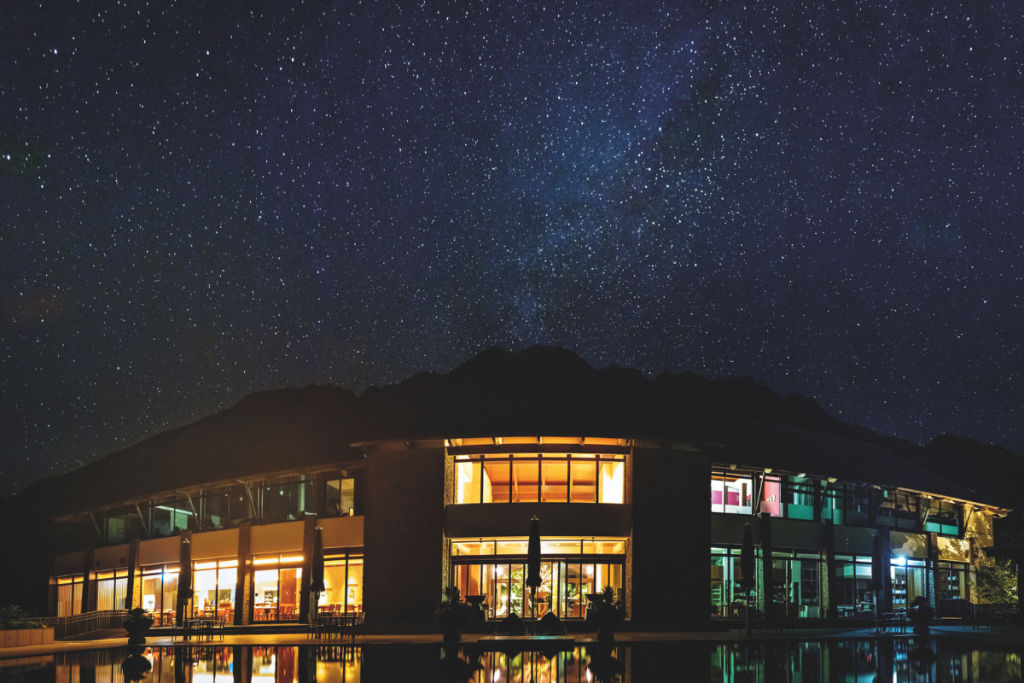 Samana Hotel
I’m fully kitted out in my Decathlon hiking boots and pants when Nobu picks me up for our first day of exploring. I can tell he is embarrassed when he has to explain to me that all the roads leading up the mountains are closed because of the rain. Another curveball from an island whose main draw sits somewhere in its forests, currently unreachable. It’s late October—past typhoon season, supposedly the start of prime hiking—and yet here we are, shut out again. If I’m learning anything from Yakushima, it’s that nature runs the show here and planning is mostly fiction. Instead of hiking, we drive.
Any disappointment evaporates as soon as we reach our first stop, Ohko Waterfall. The 88-metre drop is listed as one of Japan’s best, and after a week of nonstop rain it’s living up to the billing—more a vertical river than a waterfall. Nobu glances at my shoes and asks if I want to get closer. He hops off the viewing platform and onto the wet, uneven boulders below. I try to act unfazed, put my faith in my Decathlon boots, and follow. The spray hits my face hard as I edge toward the closest rock I can stand upright on. Nobu is soon at least six metres ahead, completely steady. I think about catching up, remember his mountaineering past, then think better of it.
By the time we climb back into the car, I have a small, ridiculous adrenaline rush going—which spikes when we pass a family of monkeys clinging to the guardrails along a stretch of road. Then a solitary deer. Then, a few bends later, a whole congregation of them: a dozen monkeys and a couple more deer stretched out together across the only patch of dry asphalt they could find, sunning themselves after the downpour.
I’ve seen monkeys in Thailand, and deer were practically lawn ornaments where I grew up, but never like this—together, unhurried, and so secure in their place that a car approaching at a crawl didn’t even register as a threat. On Yakushima, animals barely see humans, and when they do, nothing ever happens to them. Fear would be illogical, so they don’t bother with it. The whole scene was deeply moving in a way I didn’t expect. I tried to swallow the lump in my throat so I wouldn’t alarm Nobu with my teary eyes.
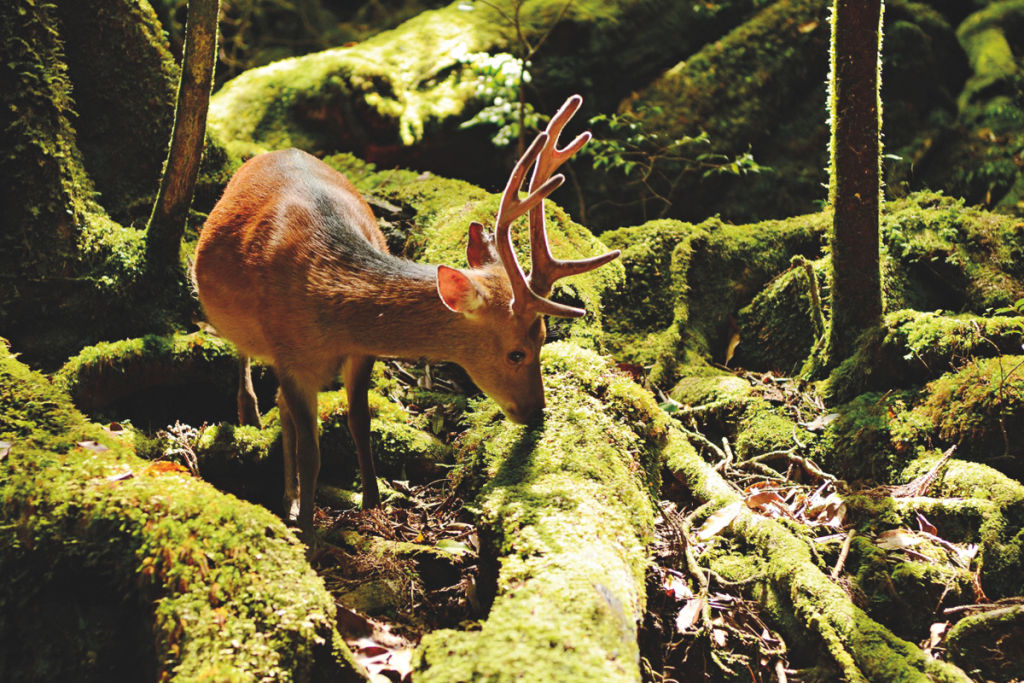 Yakushima deer
As we curve along the coastal road, the sky finally appears. The island’s west side sits in Yakushima’s rain shadow, and the change is sudden: thick forest giving way to slopes washed in sunlight. Dodging monkeys, we crawl along a narrow track built for tiny Japanese cars and tiny Japanese cars only. Nobu points out places where past landslides have wiped out entire chunks of hillside. I can’t understand how the whole forest hasn’t slipped off its slick granite pedestal.
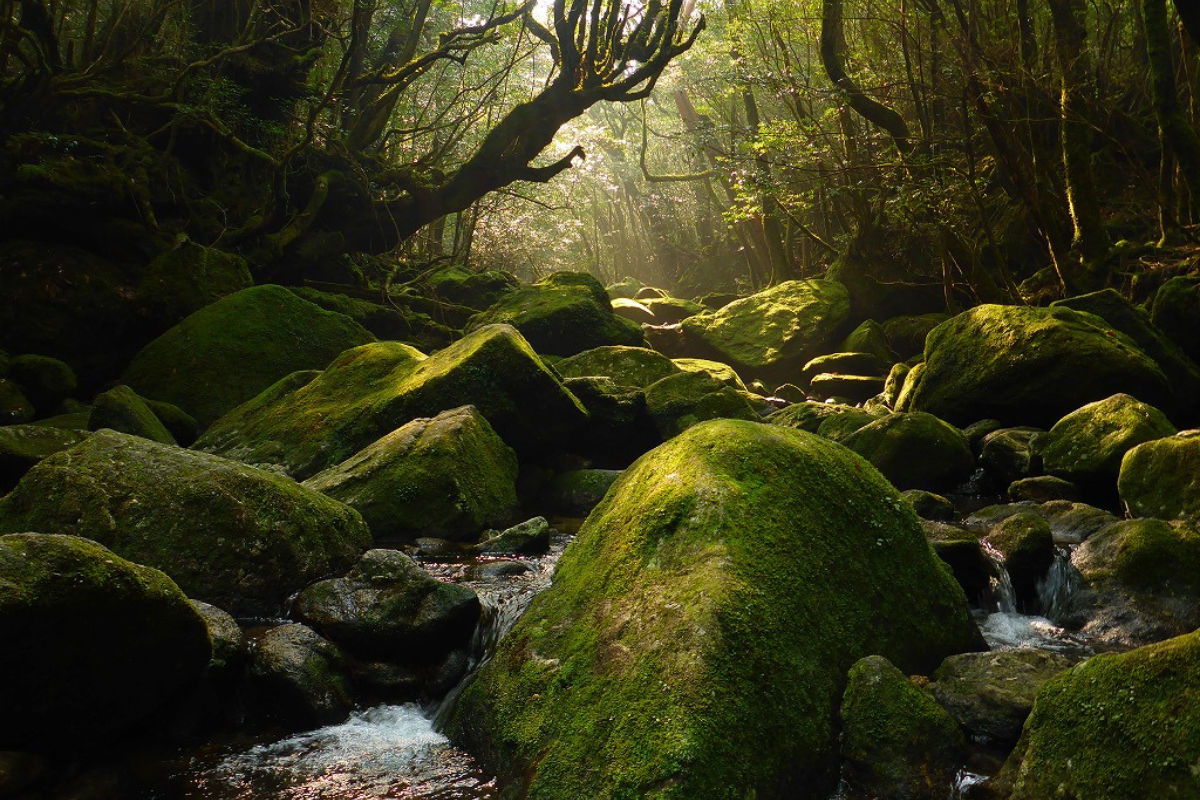
“They hold each other up,” Nobu says. He pulls over so I can see for myself. At the base of the trees, there’s hardly any soil—just a lattice of roots gripping the granite and weaving into the roots of neighbouring trees. The whole forest is one interconnected structure, less a collection of individuals than what looked like a single nervous system.
He takes out his phone and showed me a sepia photograph that makes me uneasy. The island, stripped bare.
Hills shaved into neat squares. “That’s Yakushima in the early 1900s,” he tells me. “It used to be one of the most important timber sites in Japan. They cut the big cedars for decades. Sometimes the trees were so old and dense the wood wouldn’t split, so they shaved the heartwood into sheets for roofing tiles. Entire villages made a living hauling cedar off the mountain.”
By the 1970s, the forests were so depleted that logging was finally halted, and the remaining ancient trees were protected. The younger slopes have been recovering ever since. In places where the cedars are centuries old, the earth holds. But where the logging was aggressive, the roots run shallower, and the land still gives way after heavy rains. It’s a testament to Yakushima’s stubborn, almost unreasonable fertility that the forests returned at all.
To understand what the forest becomes after it falls, Nobu takes me to meet Gakunan, an 80-year-old carpenter who works only with fallen yakusugi—Japanese cedars that are at least a thousand years old. His house and workshop sit on a shaded patch of land just before the forest begins to rise. The sweet, balsamic smell of cedar hits us before his wife comes out to greet us.
The master was already at work, bent over a slab of yakusugi, sanding it into something between a bowl and a plate. He holds up the undoubtedly heavy piece of wood and shows me the tight, delicate lines—rings that had taken a millennium to form, now creating their own natural pattern. “The yakusugi speaks to me,” he said. “I don’t choose what to make. Each cut tells me what it wants to become.”
Gakunan was born and raised on Yakushima, leaving only briefly as a young man to find work on Honshu. He returned in 1976, at age 31, after what he describes as being “spoken to” by Jōmon-sugi, the island’s great cedar believed to be between three and seven thousand years old. The spirits of the yakusugi, he said, beckoned him to become their caretaker.
Surrounding his small showroom were pieces both modest and monumental. Tables were crowded with his work—smooth, warm objects carved entirely from yakusugi and nothing else. No glue, no nails, no ornamentation. Just ancient cedar coaxed into whatever form the tree, as he put it, asks him to make. I’m especially fascinated by the pieces that hold old kirikomi scars, small cuts left by Edo-era loggers testing the cedar’s quality before committing to fell it—marks the tree spent centuries healing over, burying the wound in new wood before ending up in this craft-master’s hands.
While the couple carefully wrap two sake cups for me, I ask Gakunan how he feels about the recent development on Yakushima and the slow rise in tourism here. “He doesn’t like it,” Nobu translates. “In his day, no one depended on ferries to bring in food. Now, if the boats stop, everything stops.”
It’s true. The island’s steep, wet terrain makes farming difficult and leaves little room for livestock. These days, understandably, most residents rely on grocery stores stocked with meat and produce shipped in from Kagoshima. Yakushima may be one of the last places in Japan without a single convenience store, but it can’t defend itself from change, however slow it arrives.
Even so, the number of visitors here is modest—nothing like Hakone or Nikko, where tour buses come and go all day. But to Gakunan, the issue isn’t the volume, it’s the intent. “It’s sad,” Nobu translated. “People come to see the yakusugi, but most only want a photo and then they move on. These forests are sacred. They deserve more.”
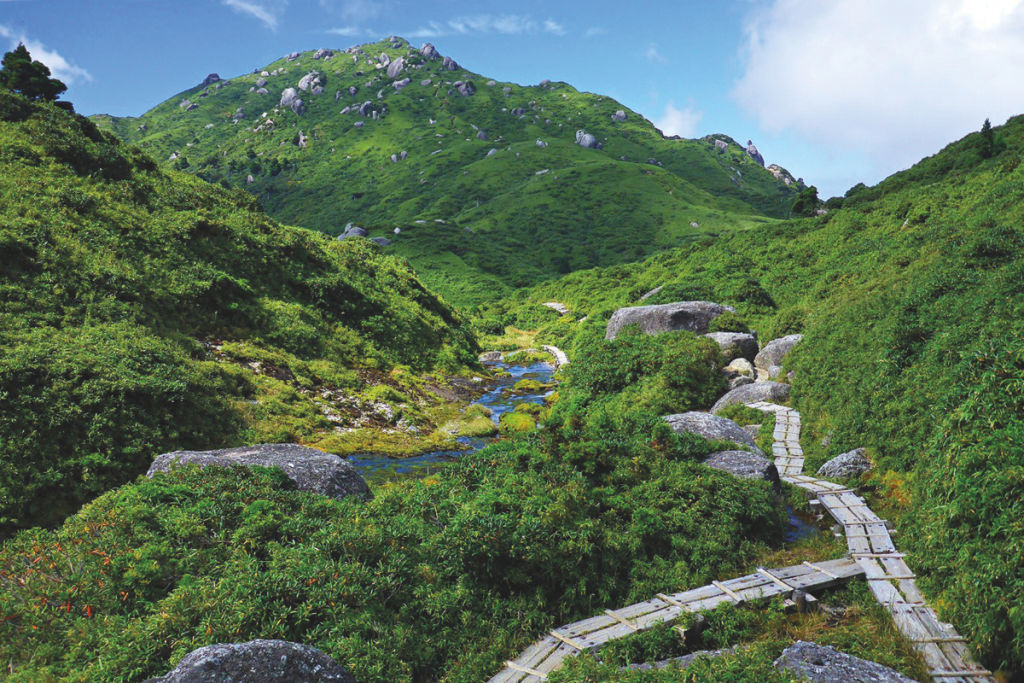 Yakushima on a clear day
On my last day on the island, Nobu and I are finishing a lunch feast of deep-fried Yakushima tiger prawns when his phone buzzes with news that one of the roads up the mountain has reopened. We have just enough daylight left to make the trip up to Yakusugi Land, one of Yakushima’s main gateways into the ancient cedar forests.
As we climb up the mountain, we watch the temperature on the car screen drop degree by degree, the vegetation shifting with it—broadleaf giving way to moss-heavy cedars, everything turning denser, darker, quieter.
Yakusugi Land is more of a walk than a hike, but it still feels like a privilege to be let into the forests at all, in whatever capacity they are willing to allow. The path winds between cedar trunks the width of a small car, over boardwalks slick with rain, past roots twisted like ship ropes. Everything is damp, vivid, and hushed.
Nobu points out the old cedar stumps scarred with axe marks from the Edo period. We stand there for a moment, trying to imagine anyone hauling that dense, resin-heavy timber down 1,500 metres of slick granite without machinery or mercy.
The walk culminated at Kigensugi, a cedar tree estimated to be around 3,000 years old. Unlike the redwoods and towering firs I grew up around, the yakusugi aren’t showy in height. Most are thick and stumpy, their height often boosted only by other trees growing on or around them. The more shade a tree grows in, Nobu explains, the slower it shoots upward. And the shorter it stays, the less likely it is to topple over in the island’s endless rain and wind. It’s all about holding your ground.
I leave Yakushima the next morning at 6 a.m., the sun rising behind a sky scrubbed clean. For the first time all week, the island’s ridgelines are fully visible. I can’t help but smile. Yakushima hadn’t given me what I’d planned to see, but it had given me what it wanted to. That seemed fair.
THE DETAILS
How to Get There
If you’re planning a trip to Yakushima, keep your itinerary loose; transport to and from the island bends to the weather more than the clock. There are daily flights from Kagoshima and Fukuoka on small turboprops, and ferries from Kagoshima—either the high-speed Toppy (about two hours) or the slower car ferry (around four). Both arrive on the island’s north side.
If you’d rather not juggle shifting ferry schedules on your own, GOTOKU makes the whole process smoother. They’re Kyushu’s only luxury cultural DMC, crafting bespoke, access-driven itineraries for travellers who want more than the standard route. With deep ties across the region, they handle everything—from hotel reshuffles when ferries are delayed to last-minute port-side stays—and build trips that follow the island’s moods. On Yakushima, that kind of help is worth its weight in rain gear. gotoku.travel; contact for prices.
Where to stay
Sankara
Yakushima’s best take on luxury is this 29-room hideaway tucked into the forest above the island’s south coast. Rooms feel like cabins in the woods, with polished teak floors and furniture, ocean views framed by trees, and an ensuite onsen that was ridiculously hard to peel away from. They recently converted their pool bar into an sauna, a small update that says a lot about the kind of traveller Yakushima draws.
Sankara is also home to the island’s only fine-dining restaurant, Okas, where the tasting menu is French in structure but unmistakably local in flavour and ingredients, with dishes like fried baby sardines, Kagoshima pork rillettes with potato soufflé, and a special course of local katsuobushi (dried bonito) over rice .
What I appreciated most, though, is that Sankara’s polish doesn’t exist in a vacuum. Every guest contributes ¥500 per stay to the Sankara Fund, which goes straight toward projects that support the island. During my visit, the hotel was gathering donations for the Sea Turtle Fund—Yakushima’s Nagata Beach is the largest nesting site for loggerhead turtles in the North Pacific, now threatened by invasive raccoon dogs that raid the eggs and prey on hatchlings. The fund has also helped build an irrigation system at a local elementary school and supports programs that teach students about native species.
One of the hotel’s biggest strengths is its connection to the island through people. Guests can venture out with guides like Nobu, a former alpine mountaineer turned activities director, whose knowledge of Yakushima comes from years spent living, climbing, and paying close attention. sankarahotel-spa.com; rooms from ¥80,000
Samana
Sankara’s sister property is simpler in design but just as comfortable. Set right on the rocky edge of the south coast, it has the best ocean views of any hotel on the island—nothing but open water and the occasional fishing boat drifting past. Its onsen is a destination on its own, open to the public until sunset, with floor-to-ceiling windows and an outdoor pool that sits so close to the cliff you feel the wind lift off the sea. samanahotel.jp; rooms from ¥53,000
Share:

Written By
AloJapan.com