
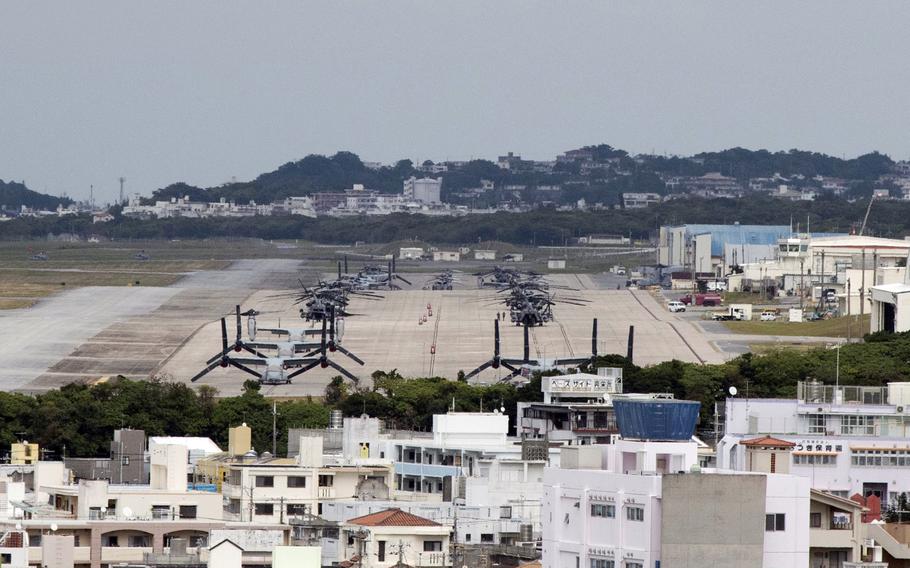
Marine Corps Air Station Futenma is home to the 1st Marine Aircraft Wing and other units in Ginowan, Okinawa. (Keishi Koja/Stars and Stripes)
A recent Pentagon statement that it will not return Marine Corps Air Station Futenma to Japan until it provides an alternate runway of similar length is not a change from the original agreement, according to Japan’s defense minister.
The Department of Defense included the statement in its fiscal 2026 budget report, responding to a 2017 Government Accountability Office recommendation that the Pentagon identify “other runways that would support mission requirements” before vacating Marine Corps Air Station Futenma.
A replacement facility for MCAS Futenma is under construction at Camp Schwab on the northern end of Okinawa.
“Pursuant to the terms of our arrangement, finalizing the selection of that alternative runway is the responsibility of the Government of Japan, and the Futenma facility will not be returned to Japan until it makes that selection,” the budget report states.
The 2013 Consolidated Plan for U.S. Forces Facilities and Area in Okinawa also allows for “improved emergency use of civilian facilities” by the U.S. military.
“The necessary legal framework is already in place” for civilian facilities to be used by the Marine Corps in an emergency, Defense Minister Shinjiro Koizumi wrote Friday on X. “We do not envision a situation in which MCAS Futenma is not returned even after the relocation to Henoko is complete because this condition is not met.”
The Okinawa Times reported Feb. 15 that the language marked “the first time that an official document mentions that Futenma will not be returned if the conditions are not met.”
However, similar wording appeared in documentation accompanying the Pentagon’s fiscal 2025 budget.
Koizumi wrote Friday that “although this is being brought up as a new point of contention, nothing has changed from before.”
The DOD’s response “simply restates the American position on the relocation of Futenma,” David Layfield, a professor of history and government at the University of Maryland Global Campus, told Stars and Stripes by email Sunday.
“Construction of the new facilities at Camp Schwab has been more difficult and is taking a lot longer than the 2013 agreement envisaged,” he wrote.
The United States and Japan agreed in 1996 to relocate the airfield from densely populated Ginowan to rural Henoko. Construction is expected to continue until at least 2033.
“The Marine Corps continues to implement the conditions-based realignment of U.S. forces in accordance with bilateral agreements, including the construction of the Futenma Replacement Facility and the return of Marine Corps Air Station Futenma,” Headquarters Marine Corps spokesman Capt. Steven Keenan said by email Thursday.
The GAO concluded in 2017 that the runway under construction at Schwab would be too short. Plans call for two milelong runways in a V shape, according to construction documents posted on Okinawa prefectural websites. MCAS Futenma’s existing runway is about 1.7 miles long.
The 1996 agreement requires that capabilities such as strategic airlift, logistics and emergency diversion that “cannot be supported by the shorter runway of the [sea-based facility] … must be fully supported elsewhere.”
Identifying an alternative runway “has always been the difficulty for the Japanese side,” Layfield said. Proposed options have included shared use of Naha Airport, sites in Kyushu or relocation to Kansai Airport.
“So far, the Japanese government’s plans for an alternative long runway have been a little vague,” he wrote.
AloJapan.com