
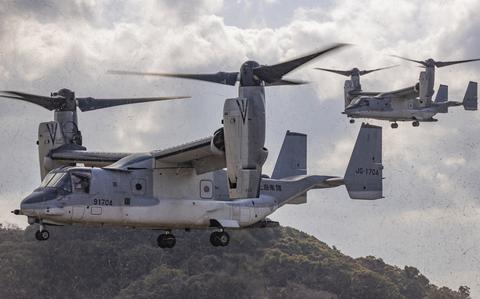
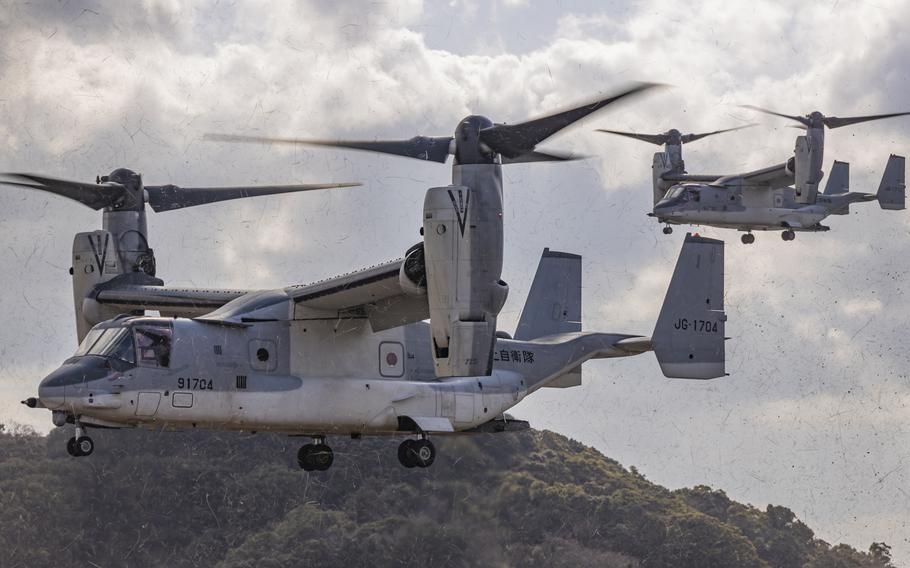
Japan Ground Self-Defense Force V-22 Ospreys prepare to land during Iron Fist 25, at Camp Ainoura, Sasebo, Nagasaki, Japan, Feb. 23, 2025. (Tyler Andrews/U.S. Marine Corps)
CAMP FOSTER, Okinawa — Japan’s army will not fly its V-22 Ospreys to Okinawa during the ongoing Iron Fist exercise with the U.S. Marine Corps, according to the Japan Ground Staff.
The Japan Ground Self-Defense Force has decided to halt its training with the tiltrotor aircraft in the prefecture during the series of exercises, a Ground Staff spokesman said by phone Thursday.
He did not say when the decision was made, but the Ospreys had not yet traveled to Okinawa. The aircraft will operate as scheduled in Kyushu, he added.
Two Japanese V-22 Ospreys were scheduled to operate on unspecified dates during the exercise at Camp Hansen, Kin Blue Beach and Ie Shima Auxiliary Airfield alongside Marine Corps MV-22 Ospreys, according to a Jan. 20 news release from the Okinawa Defense Bureau.
It was to be the first time that Japanese Ospreys operated from U.S. facilities on Okinawa, a Ground Staff spokesman said at the time.
The Ospreys also were scheduled to use Marine Corps Air Station Futenma and Japan’s Camp Naha for maintenance and refueling, the spokesman said Thursday.
The Osprey flight plans led to fresh complaints from the prefecture. On Jan. 29, it filed a request through the Okinawa Defense Bureau – an arm of Japan’s Ministry of Defense – that the U.S. and Japan not fly Ospreys during the exercise, according to a post that day on social media platform X by the prefecture’s Military Base Affairs Division.
The prefecture also asked the military to reduce aircraft noise, including at night, and that the exercise not interfere with residents’ lives and business activities.
The Ground Staff spokesman on Thursday declined to say whether the Osprey flights were cancelled in response to the prefecture’s objections, saying only that “training plans” caused the suspension.
Some Japanese government officials may speak to the press only on condition of anonymity.
The Marine Corps will fly its Ospreys during the exercise as planned, 3rd Marine Expeditionary Brigade spokesman 1st Lt. Giovanni Jimenez said by email Thursday. He did not say if Japan’s decision to pull its tiltrotors would affect training.
“This aircraft is a critical asset that provides speed, range, and versatility, which is essential for the dynamic nature of the training scenarios in Iron Fist,” he wrote.
The 20th iteration of Iron Fist started Feb. 11 and runs through March 9. It is designed to hone the allies’ abilities to make amphibious landings together and defend the Nansei Island territories just east of Taiwan. It takes place throughout Japan, including on Okinawa and 19 spots — three more than last year — in the islands, according to the release.
Japan grounded its 17 Ospreys for two weeks in October 2024 after one of the aircraft struck the ground during the bilateral Keen Sword exercise as it attempted to take off from Camp Yonaguni, a Japanese base on a remote island west of Okinawa. No one was injured.
An investigation determined the pilot forgot to turn on an interim power switch that provides additional engine power for takeoffs. Flight procedures require the switch to be turned on after the engine is started and during takeoff.
The Ground Self-Defense Force in August moved tiltrotor aircraft from Camp Kisarazu near Tokyo to the newly constructed Camp Saga in northwestern Kyushu.
AloJapan.com