

The scale of damage from fraud is no longer limited to the underground economy. Targeting the public, it has grown to the point where every possible step is needed to root out the problem.
Japan’s National Police Agency has announced that the total damage caused by special fraud and investment/romance fraud using social media reached a record high of ¥324.1 billion JPY (about $3.2 billion USD) in 2025. That represents a 1.6-fold increase in just one year from 2024. There were 42,900 victims, amounting to a 37% increase from 2024. Among the victims, there were 27,758 cases of special fraud (a 31% increase) and 15,142 cases of investment or romance fraud (a 47% increase) using social media.
Financial losses in special fraud cases accounted for the largest share of the sudden increase. Fraud in this category nearly doubled from 2024, reaching approximately ¥141.4 billion (about $920 million) in losses.
Fraudsters posing as police officers also pushed up the losses. In fact, deceptions involving criminals pretending to be police accounted for approximately 70% of the damage from special fraud. Misuse of internet banking and other services was also a factor contributing to the swelling financial losses.
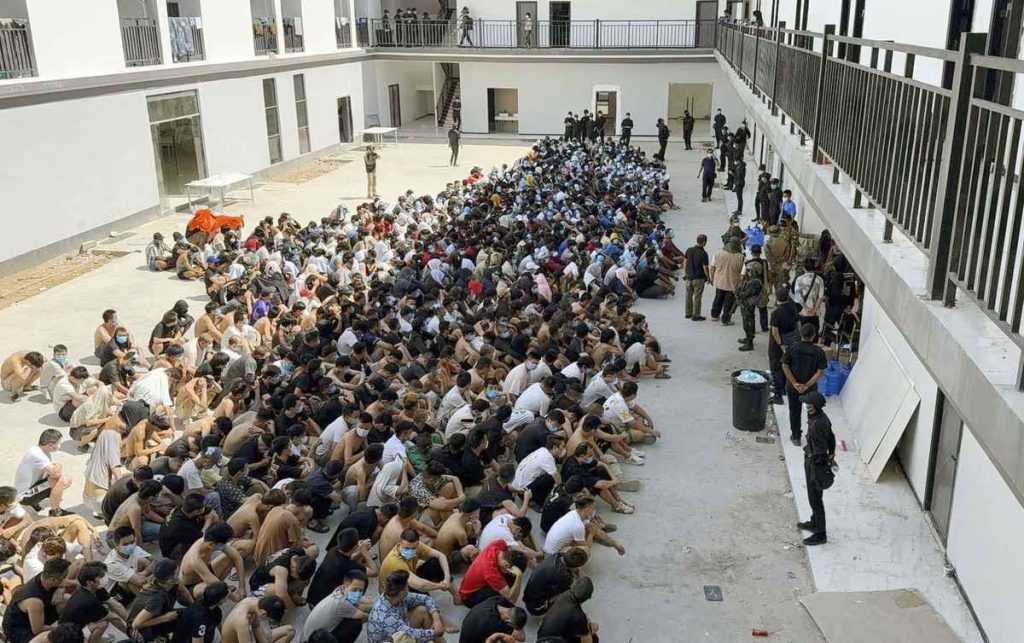 Police gathered foreign recruits at a large-scale criminal fraud base in Myanmar on February 16, 2025 (©Kyodo)
Preying on the Weak
Actually, many victims themselves admitted they suspected fraud while interacting with the scammers. However, intimidated by threats that they would be “arrested,” they went ahead and transferred money to show they were cooperating with “investigations.” Clearly, these crimes were designed to prey on the weak.
In truth, the police never make inquiries through social media. Moreover, they never demand money.
The police need to make these facts more widely known. They also need to create a system that helps the public avoid becoming victims when they receive suspicious contacts. That means raising public awareness to hang up the phone and immediately report any suspicious contacts or interactions.
Addressing the Fraud Bases Overseas
The dimensions of fraud are also changing. For example, some criminal groups have established bases in Southeast Asia, where surveillance is lax. There, they expand the fraud by deceptively luring Japanese recruits with promises of high salaries. However, once they get there, the recruits are forced to call possible targets to perpetrate fraud.
One result is that fewer of these fraudsters can be arrested in Japan.
 Two robbery ring suspects deported from the Philippines arrive in Japan on February 7, 2023, on their way to the Tokyo Metropolitan Police Department. (© Sankei by Kanata Iwasaki)
As long as such organized criminal groups are operating overseas, it will be difficult for the Japanese police alone to improve the situation. International cooperation is therefore essential.
In 2025, 54 people were arrested after raids on bases in four countries, including Thailand, Cambodia, and Malaysia. Cooperation from the local police proved vital in all of these cases. In some cases, international pressure has also led to crackdowns, such as at a mammoth Myanmar fraud complex in 2024.

Using All Available Tools
Japanese police need to deepen cooperation with Southeast Asian countries and China. Together, they should establish an international system to track criminal proceeds and block withdrawals.
Advances in AI are expected to facilitate even more sophisticated fraud. Affected countries and their police need to fight fire with fire by utilizing AI to counter this tool’s malicious use. Furthermore, the development and widespread adoption of “white AI” is needed to detect fraud and prevent damage from it.
In other countries, police are allowed to use legal malware or computer viruses to investigate criminal organizations. Perhaps the time has also come for Japan to consider using them. Everything possible must be done to fight this plague. That is how serious the damage caused by fraud has become.
RELATED:
(Read the editorial in Japanese.)
Author: Editorial Board, The Sankei Shimbun
Continue Reading
AloJapan.com