
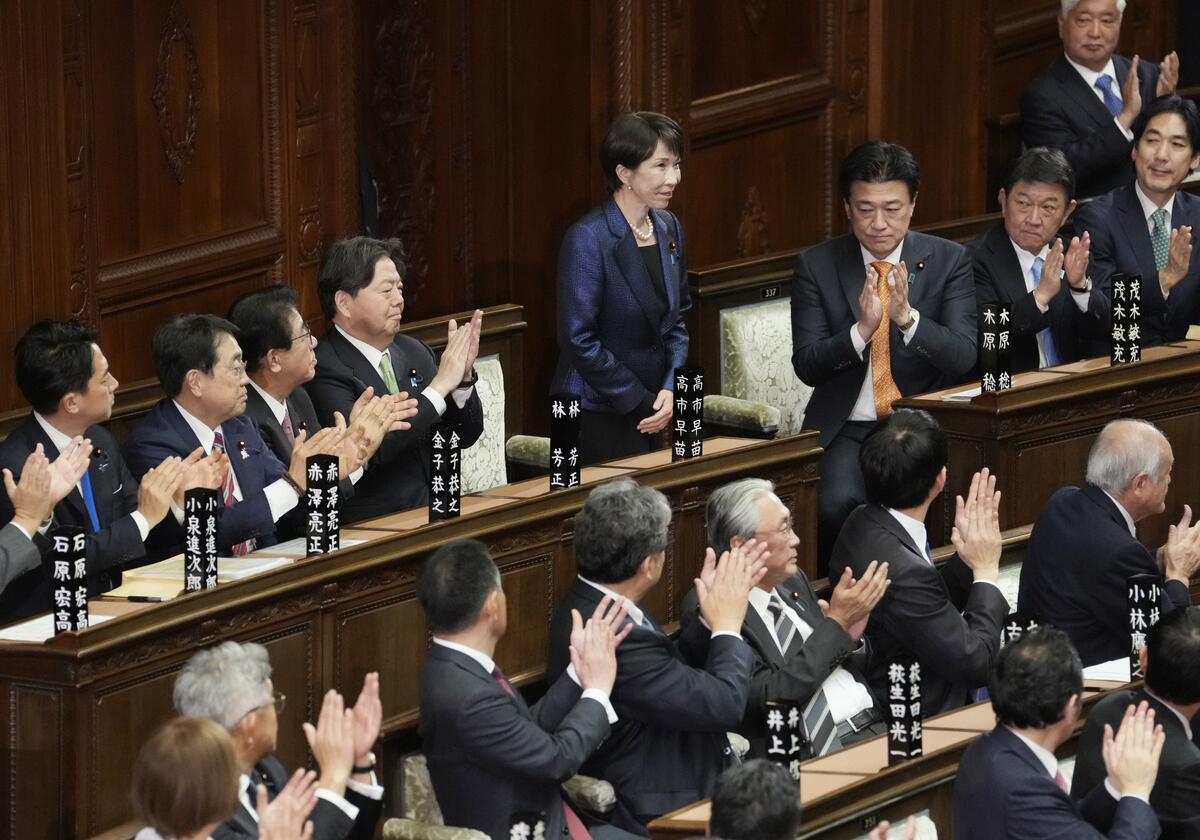
TOKYO – Sanae Takaichi was reelected as Japan’s prime minister in parliament on Wednesday as the Diet convened a special session following her Liberal Democratic Party’s historic landslide victory in the Feb. 8 House of Representatives election.
Takaichi formed a new Cabinet, retaining all ministers from her previous one that had enjoyed solid approval ratings since its launch in October when she became the country’s first female premier.
Takaichi, known for her hawkish views on defense and security, received overwhelming majority support with 354 votes in the lower house, controlled by her ruling coalition.
In the House of Councillors, where the ruling camp remains in a minority, she was elected prime minister in a runoff by winning 125 votes against 65 for Junya Ogawa, head of the main opposition party.
Foreign Minister Toshimitsu Motegi, Finance Minister Satsuki Katayama and Defense Minister Shinjiro Koizumi retained their portfolios amid pressure to curb tax burdens for inflation-hit households, worsening Sino-Japanese ties and a severe security environment that necessitates more defense spending.
In a minor change to its executive lineup, the LDP is considering naming former industry minister Yasutoshi Nishimura, who was involved in a high-profile slush fund scandal, as its new election strategy headquarters chief, according to a source familiar with the matter.
Takaichi is scheduled to hold a press conference on Wednesday night to explain her “responsible yet aggressive” fiscal policy and plan to suspend the consumption tax on food products for two years.
She plans to hear an interim conclusion before the summer by a cross-party “national council” on whether and how to freeze the tax, currently at 8 percent.
Riding on high public support, Takaichi looks set to forge ahead with policy priorities that she said could “split public opinion” during the 150-day parliamentary session through July 17.
Takaichi has expressed her desire to work toward amending the pacifist Constitution, the LDP’s long-held goal, and has called for bolstering the country’s defense capabilities.
A high procedural bar is set, however, for any revision of the supreme law, with proposals needing support from two-thirds of legislators in both chambers of parliament before being put to a national referendum.
While taking heed of her conservative support base, Takaichi must also manage ties with China amid tensions caused by her parliamentary remarks in November suggesting that Japan could act in the event of an attack on Taiwan, a self-ruled island claimed by Beijing.
Her government is poised to boost Japan’s intelligence capabilities by setting up a national intelligence committee to cope with growing security risks and enacting anti-espionage legislation, a sensitive issue.
Despite the opposition camp’s significantly reduced presence in the lower house, their leaders are expected to ramp up pressure on Takaichi’s government.
At a party meeting on Wednesday morning, Ogawa, head of the newly formed Centrist Reform Alliance, said he would oppose any “high-handedness and delinquency by gigantic ruling parties.”
The powerful lower house elected Eisuke Mori, a veteran LDP lawmaker and former justice minister, as its speaker and Keiichi Ishii, a member of the CRA, as vice speaker.
Ishii is a former leader of the Komeito party, which established the CRA last month with the Constitutional Democratic Party of Japan for their lower house members. In October, Komeito ended its 26-year partnership with the LDP, which then formed a new ruling coalition with the Japan Innovation Party later that month.
In the general election, the conservative LDP gained a record 316 of the 465 seats in the lower house, up from 198 before the contest, the first time a single party has secured a supermajority in the postwar era.
Takaichi called a snap election by dissolving the chamber at the outset of this year’s ordinary Diet session on Jan. 23 in a bid to capitalize on high support ratings for her Cabinet and improve the LDP-JIP camp’s standing in the lower house.
The center-right JIP, known as Nippon Ishin, gained 36 seats, up from 34 prior to the election.
The joint leaders of the CRA stepped down after it secured only 49 seats in the lower house contest, less than a third of the 167 it held prior to the election, with Ogawa chosen as new leader last week to embark on a revamp and generational shift of the party.
AloJapan.com