
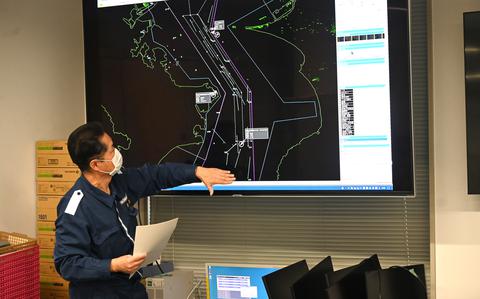
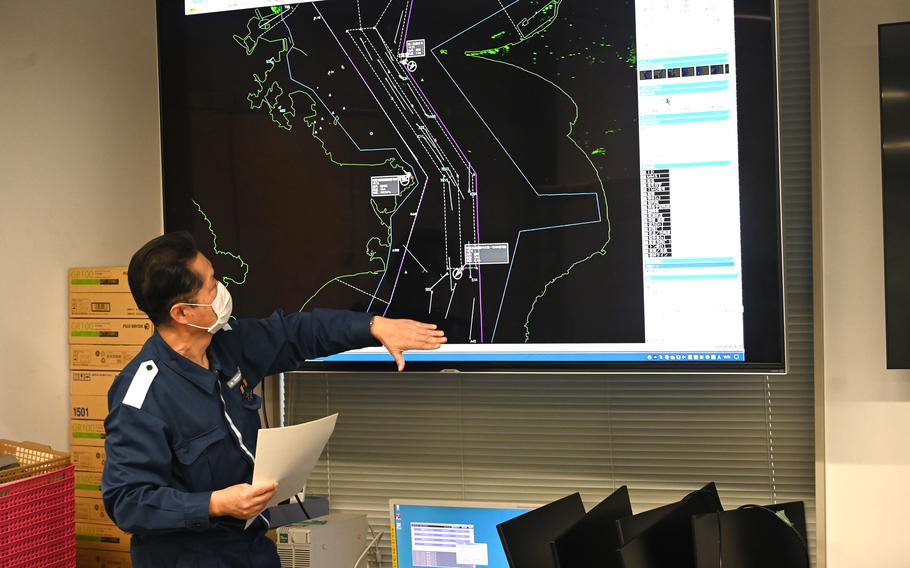
The deputy chief of the Tokyo Wan Vessel Traffic Service Center in Yokohama, Japan, explains how the center tracks and predicts vessel movements on Tokyo Bay on Feb. 10, 2026. (Alex Wilson/Stars and Stripes)
YOKOHAMA, Japan — Around 350 ships thread the narrow Uraga Channel into Tokyo Bay every day, navigating one of the planet’s most crowded maritime corridors.
From a control room inside a nondescript government office building, a round-the-clock crew of Japan Coast Guard personnel keeps watch.
At the Tokyo Wan Vessel Traffic Service Center — a five-minute walk from the landmark Yokohama Red Brick Warehouse — four teams of 20 marine traffic controllers monitor the hundreds of cargo ships and other vessels that traverse Tokyo Bay.
The teams rotate through day and night shifts and rest periods, and spend their working hours surrounded by digital displays fed with data from eight radar stations, 32 closed-circuit TV cameras and automatic ship identification systems that track and predict routes, according to the center’s deputy chief.
Due to internal policy, the deputy chief was not identified by name. Some Japanese government officials may speak to the press on condition of anonymity.
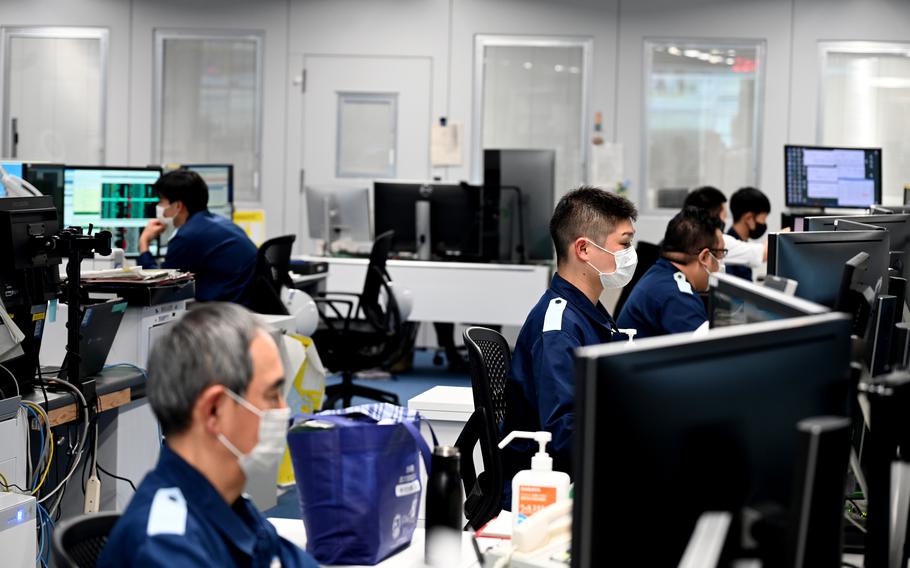
About 80 Japan Coast Guard personnel, split in to teams of 20, monitor Tokyo Bay’s maritime traffic on a 24-hour basis, as seen here at the Tokyo Wan Vessel Traffic Service Center in Yokohama, Japan, on Feb. 10, 2026. (Alex Wilson/Stars and Stripes)
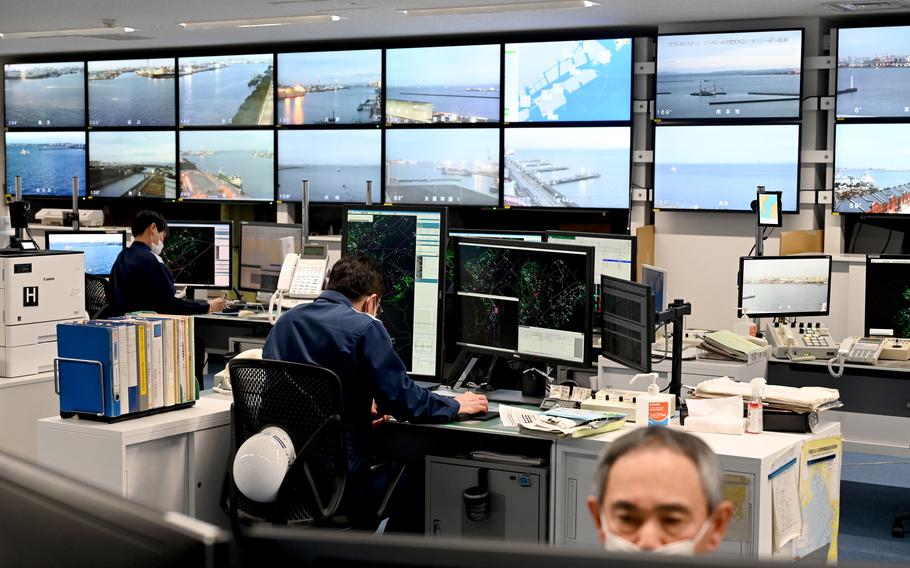
The Tokyo Wan Vessel Traffic Service Center in Yokohama, Japan, seen here on Feb. 10, 2026, utilizes eight radar stations, 32 closed-circuit TV cameras and automatic ship identification systems to monitor traffic on Tokyo Bay. (Alex Wilson/Stars and Stripes)
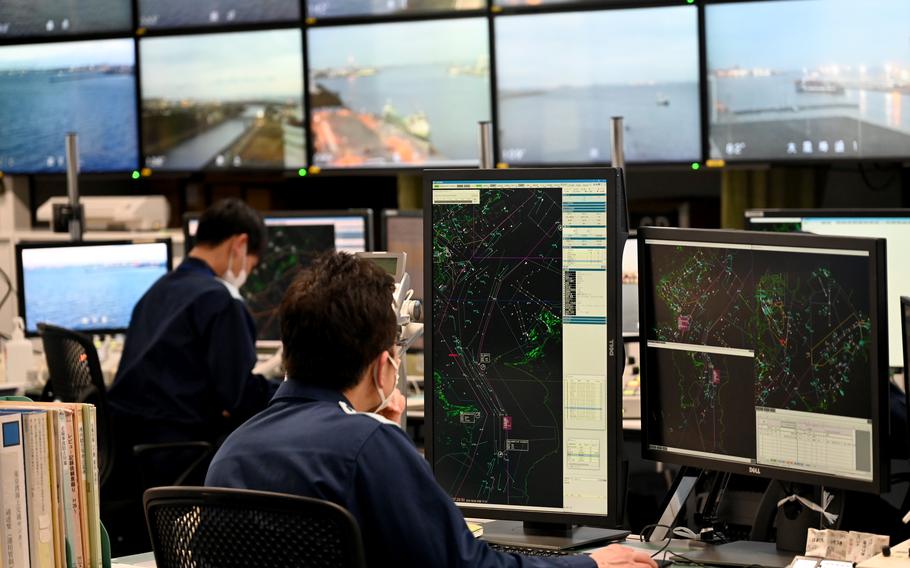
The Tokyo Wan Vessel Traffic Service Center in Yokohama, Japan, seen here on Feb. 10, 2026, creates and monitors five-minute vectors for each ship active on Tokyo Bay. (Alex Wilson/Stars and Stripes)
The controllers’ work is critical to the waterway, he told reporters during a Feb. 10 tour of coast guard facilities.
Tokyo Bay lacks the density or complexity of cargo volumes of the world’s largest ports, but it ranks highly among other key corridors such as the English Channel or the Bosphorus Strait in Turkey.
“Globally speaking, Tokyo Bay is a very rare environment. It’s extremely narrow – only about [4 to 4.3 miles] wide at the entrance – with heavy traffic, large ships, and curved channels due to seabed depth constraints,” the deputy chief said.
Ship’s courses are predicted to five-minute intervals, and if any collisions are anticipated, warnings are issued, he said.
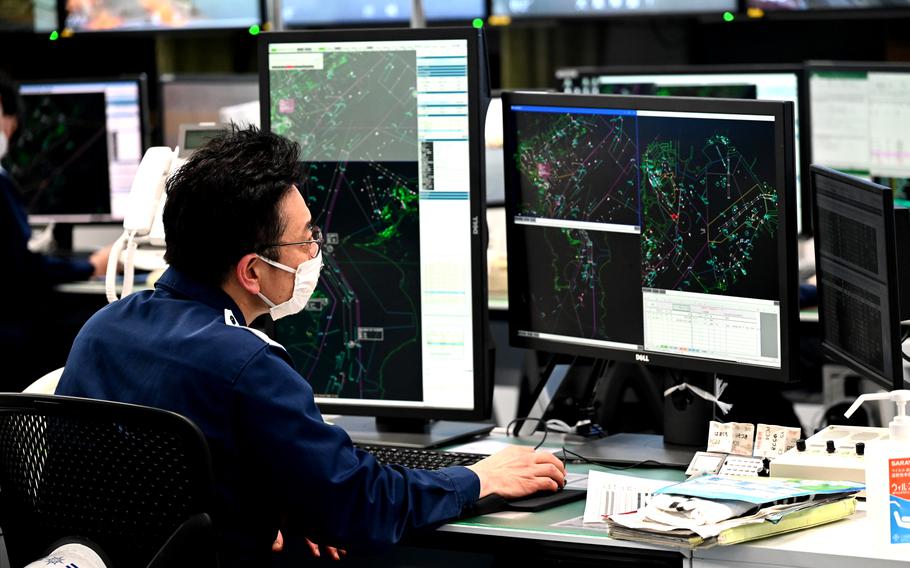
About 350 ships travel through Tokyo Bay on a daily basis, with activity monitored by the Tokyo Wan Vessel Traffic Service Center, seen here Feb. 10, 2026. (Alex Wilson/Stars and Stripes)
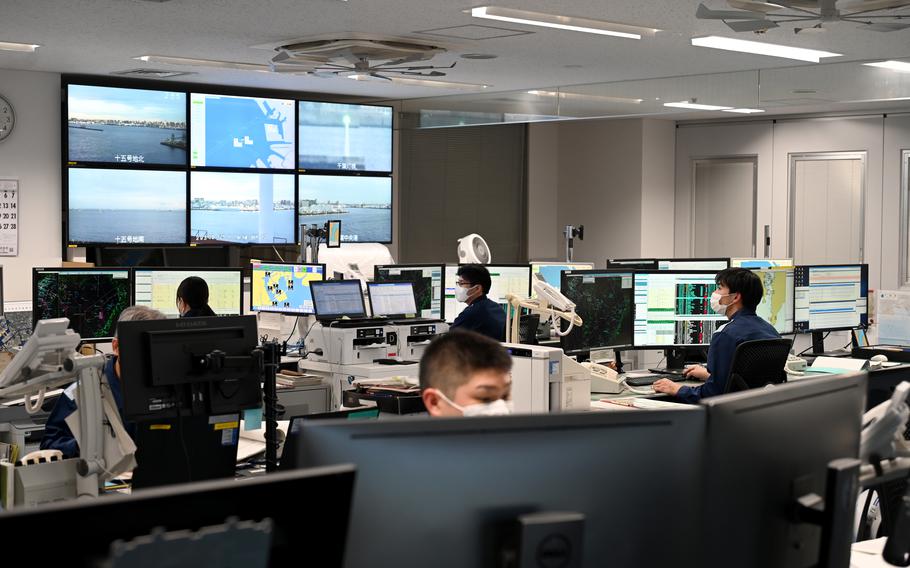
Staff at Tokyo Wan Vessel Traffic Service Center in Yokohama, Japan, seen here on Feb. 10, 2026, lack authority to issue legally binding instructions to ships’ captains, according to the deputy chief. (Alex Wilson/Stars and Stripes)
While the center closely resembles an air traffic control center, its staff lacks the authority to issue legally binding instructions, according to the deputy chief.
Instead, they provide observations and advice – ship captains ultimately bear the final responsibility for safe navigation.
But mistakes could be costly, the deputy chief said.
“Tokyo Bay is considered one of the most complex and high-risk maritime areas in Japan, due to the concentration of large vessels and ships carrying hazardous materials such as oil and gas,” he said.
He recalled the Nov. 9, 1974, collision of the Pacfic Ares, a Liberian cargo ship laden with steel, and the Yuyo Maru No. 10, a Japanese tanker carrying liquified petroleum gas and naphtha, a highly flammable liquid hydrocarbon.
“The tanker carrying petroleum products exploded and caught fire, and for a very long time navigation in this area was halted,” the deputy chief said.
Five of the Yuyo Maru crew members and 28 on the Pacific Ares were killed, according to the Maritime Integrated Decision Support Information System on Transport of Chemical Substances website.
This article was translated using generative AI to be able to reach new audiences. It has been reviewed by our team to ensure accuracy. Send feedback to Stars and Stripes Member Services at MemberServices@Stripes.com.
AloJapan.com