
JAPAN Forward launched its “Ignite” series of English essays to directly share the voices of students in Japan with their global peers. It is a privilege to share the thoughts and ideas of these future leaders. For junior high school student Taishi Sushidabanchi, that includes sharing what he learned from family members of Japanese abduction victims ー citizens uprooted from their lives by North Korea ー and his ideas to resolve the issue.
Annually, the Headquarters for the Abduction Issue holds a North Korean Human Rights Violations Awareness Week Essay Contest for junior and senior high school students across the country. (The Government of Japan established the Headquarters, an organization led by the Prime Minister and composed of all the Ministers of State, to resolve the abductions issue.) It aims to raise awareness of the abduction issue through viewing films and stage plays, reading books related to the issue, and other opportunities to help the students understand the feelings of abduction victims and their families.
The winning 2025 English essayists were honored in person at the Government of Japan’s December 13, 2025, Symposium on the Abductions Issue. In this 30th winning essay in the series, Ignite, Taishi Sushidabanchi deeply considers how to resolve an issue that has directly impacted junior high school students for six decades. He has something to tell us, so let’s listen.
Thirtieth in the Series, ‘Ignite’
 Taishi Sushidabanchi delivers his winning essay to the audience on December 13, 2025. (©Prime Minister’s Office)
Taishi Sushidabanchi, Winner of the 2025 North Korean Human Rights Violations Awareness Week Junior High School English Essay Grand Prize
Abduction. When people hear the word “abduction,” I believe they imagine a villain demanding money in exchange for the person they have kidnapped. But in this case, it is very different. A government abducting a person. It’s not one person abducting someone; it’s a government abducting someone.
This may seem absurd to hear, but it has happened many times over the past 60 years. Japanese people have been abducted by the North Korean government. 17 abductions by the North Korean government have been certified. But more than 800 people are on a list of “likely abductees.” In all 47 Japanese prefectures, there is not one prefecture that does not have someone on a list.
In September 2002, the prime minister of Japan at the time, Mr Junichiro Koizumi, was able to start talks with the North Korean government, better known as the Japan-North Korea Summit meetings. Here, the North Korean government admitted to abducting 17 Japanese citizens and apologized. In the end, 5 were sent home to Japan. When Japan asked about the remaining 12, North Korea’s response was: 8 dead, 4 never made it into the country.
Devastated Lives
When someone is abducted, families are devastated. How do people with family members who were abducted feel? I was fortunate to have the opportunity to talk to one of the victims in a lesson at my school. His name is Mr Hajime Matsumoto, brother of the abductee Ms Kyoko Matsumoto. Ms Matsumoto was abducted on October 21st, 1977. She was headed to a knitting class close to her house when she was stopped by two men who likely abducted her.
In the lesson, Mr Matsumoto talked about his sister’s hobbies. He said that she was a great knitter and loved traveling. She had plans to go to a shopping mall that weekend and was planning trips. He also talked about his mother, who died without seeing her daughter, and told us that people are getting old. Many families die without seeing their loved ones.
In the lesson, I was able to ask Mr Matsumoto a couple of questions. One of the questions I asked him was what he would say if and when Ms Matsumoto came back. His response was “okaeri,” which means “welcome home” in Japanese.
When I heard this, I thought of my family and how small actions like saying “Hello,” “Good-bye,” and “Thank you” are very special. For people like Mr Matsumoto, these small things no longer exist.
What We Can Do
I believe the best thing that we can do is to let people all over the world know about this tragedy and not look at these abductions as someone else’s problem, but as all of humanity’s mission to solve, as abduction is a human rights violation. It has never been and never will be okay.
We all must acknowledge, understand, and tell what happened. So that this tragedy never happens again, and that the ones that did happen are solved as soon as possible. We must never forget what happened.
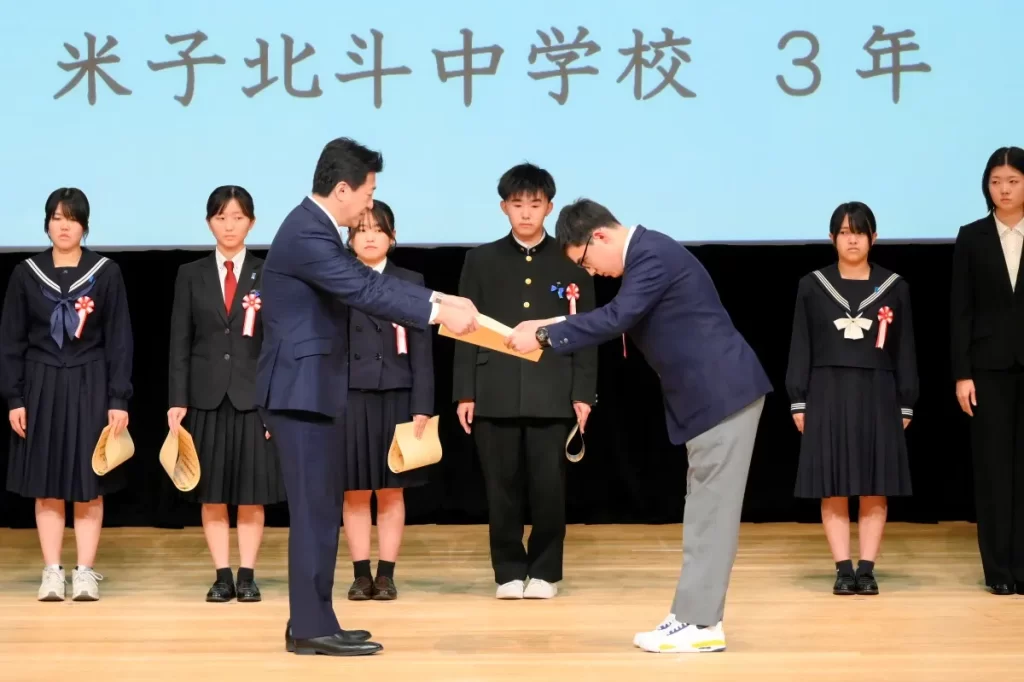 Chief Cabinet Secretary and Minister for the Abductions Minoru Kihara presents the Grand Prize certificate to Taishi Sushidabanchi. December 13, 2025 (©Prime Minister’s Office)
About the Author
When he wrote this essay, Taishi Sushidabanchi was a third-year junior high school student at Yonago Hokuto Junior High School in Yonago City, Tottori Prefecture. His inspiration for the essay came from a special lecture by Hajime Matsumoto. He is the brother of Kyoko, one of the young Japanese abducted near her home in 1977 by North Korean agents. Taishi Sushidabanchi shared this comment upon receiving the Grand Prize for his English Essay by a Junior High School Student:
“The abduction issue may seem distant, but it is actually a problem that is very close to home. Rather than thinking of it as someone else’s concern, each and every Japanese citizen must recognize and understand the issue as if it were our own, and raise our voices to bring the victims home as soon as possible.”

RELATED:
(Read this essay in Japanese.)
Author: Taishi Sushidabanchi, Student
Yonago Hokuto Junior High School
Continue Reading
AloJapan.com