
WHEN you picture Japan, what comes to mind?
Ultra-modern cities drenched in neon lights? Steam rising from a bowl of soul-warming ramen?
Sign up for The Irish Sun newsletter
Thank you!
Three moats once protected the path leading to Himeji Castle, designed to disorient attackersCredit: Jenna Stevens
Maybe it’s the stillness of a Zen garden, or the striking silhouette of a Japanese castle. Perhaps it’s Sashimi hand-crafted with the freshest of fish.
You may think that experiencing all of the above means spending weeks journeying across the country with a rail pass and a backpack.
Luckily, you can find them all in one underrated region: Hyōgo prefecture.
Next door to touristy Kyoto, Hyōgo offers Samurai castles, hot spring baths, thrilling theme parks and world-class Wagyu all in one place.
Read more on Japan travel

EAT UP
I went to the foodie capital of the world – I had the best meals on the cheap
TEN OUT OF YEN
Newly-affordable long-haul holiday hotspot has 85p meals & cheap theme parks
Hyōgo truly earns its nickname “Japan in Miniature”, as it packs some of Japan’s finest cultural and historical sights into one diverse region.
Plus, there’s never been a better time for Brits to visit Japan.
With the new JESTA travel authorisation system expected to arrive in 2028 – which will require Brits to pre-register before travelling – it’s worth ticking the trip off of your bucket list before the new program and its fees are introduced.
Plus, the yen remains weak against the British pound in 2026, so you can stretch your money further on food, shopping and hotels than ever before.
I enjoyed bowls of delicious ramen for just ¥700 (£3.28), and went shopping for high-quality clothing in UNIQLO for a fraction of UK prices.
So to see what this underrated region has to offer, I explored Hyōgo Prefecture from top to bottom – from the coastal hot spring town of Kinosaki Onsen, down to the glitz of Kobe.
Himeji – samurai era castles, Japanese gardens and traditional restaurants
You might recognise this castle as Tiger Tanaka’s ninja training school in the Bond film You Only Live Twice.
Himeji Castle has also appeared in many classic samurai films such as Ran and Kagemusha, but this is much more than a famous filming location.
Himeji Castle is Japan’s most-visited castle – and it’s widely considered the most beautiful, too.
It’s easy to see why, I thought, as I approached the strikingly white hilltop fortress.
I eventually made it to a vast courtyard with impressive views of the castle and Himeji cityCredit: Jenna Stevens
There are a series of false entrances and misleading pathways on the approach to Himeji CastleCredit: Jenna Stevens
Himeji Castle is a listed UNESCO World Heritage site, renowned as the best-preserved feudal era samurai castle in Japan.
Although the hilltop fortification has existed since 1333, the castle as we see it today was built back in the early 17th century.
Since then, Himeji Castle remains remarkably intact, surviving events such as WWII bombing.
The bright white exterior and elegant tiered roofs are said to resemble a heron taking flight, earning it the nickname of the White Heron Castle.
Actually getting inside the castle, however, was quite the task.
Expertly designed to ward off intruders, you must get past multiple moats and a whopping 83 defensive features to make it inside.
These include false entrances, terrifying stone drops, plenty of gun ports and a disorienting, winding path up to the castle.
“Sama” are shaped holes in the walls designed for firearm use whilst staying protectedCredit: Jenna Stevens
Inside, dark wooden beams slot together like an intricate architectural puzzleCredit: Jenna Stevens
Although many visit Japan in spring for its Sakura season, I preferred the autumn coloursCredit: Jenna Stevens
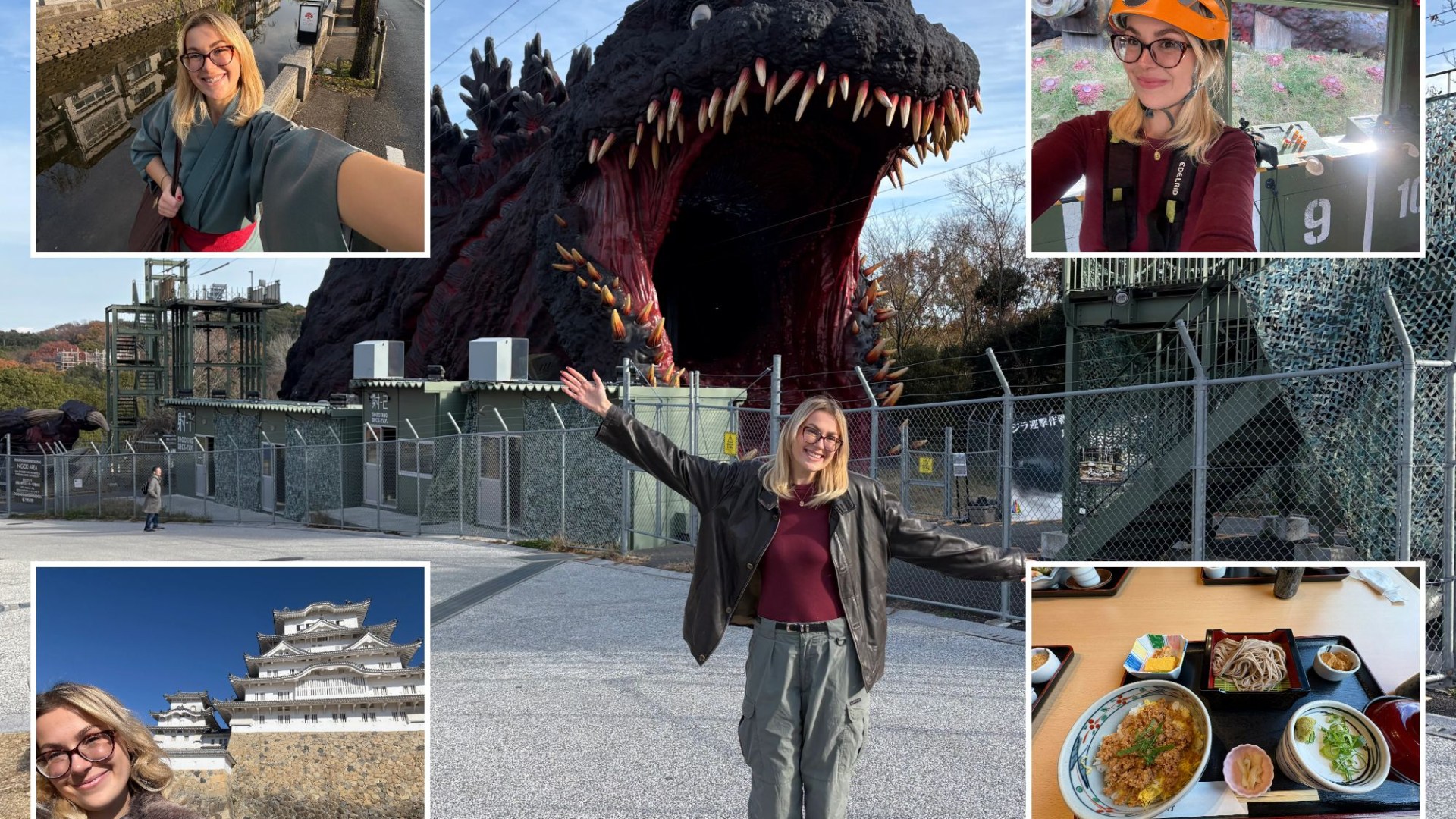
I enjoyed soba noodles, egg, chicken-covered rice and miso soup – all washed down with green teaCredit: Jenna Stevens
Even the plants beside the stone walls were a strategic part of the defence, with thorny, tangled overgrowth designed to stop attackers who tried to escape.
“Imagine you were an intruder trying to get in” said my Himeji Castle tour guide, as she pointed out endless stone drops, hidden gun ports and false entrances. “It would be near impossible!”
After admiring the architecture, I walked just five minutes to the peaceful grounds of the Kōko-en Garden.
Inside Kōko-en are nine Japanese gardens built upon the grounds of old samurai residences, with a large koi fish pond and traditional tea house.
These gardens are a must-see no matter which season you visit Japan.
Spring brings cherry blossoms, summer bursts with greenery and lotus flowers, whilst my winter visit still glowed with autumnal orange.
After wandering through bamboo, crossing stone bridges and hopping stepping stones over glossy waters, I settled down in the garden’s restaurant for a bite to eat.
Here you have your choice between lunch sets including grilled eel, crispy tempura and fluffy pancakes – all served with plenty of green tea and calming waterfall views.
Himeji felt like a snapshot of Japanese excellence, where expert craftsmanship and manicured gardens sit side by side in one unmissable city.
Kobe – world-famous Wagyu and glitzy nightlife
Just a 20-minute ride on the ultra-fast Shinkansen will take you from the historical marvels of Himeji straight to Hyōgo’s bustling capital: Kobe.
This glitzy city was made for wandering into jazz bars and soaking up neon lights, the lively promenade watched over by the glowing red Kobe Port Tower.
The hourglass-shaped Kobe Port Tower is the city’s most famous landmark, and is 354 feet tallCredit: Jenna Stevens
Kobe wakes up at night with the bright lights of busy bars and restaurantsCredit: Jenna Stevens
The streets surrounding Kobe’s chinatown are dotted with unique independent clothing shopsCredit: Jenna Stevens
I spent days drifting between independent streetwear shops and artsy cafes, as well as making sure to stock up on clothes from trendy UNIQLO – which costs a fraction of the price in Japan compared to the UK.
Down by the waterfront at night, Kobe Harborland is the city at its most lively.
This area is packed with shops, museums, restaurants and a giant Ferris wheel, coming alive after dark.
But Kobe is best-known for its world-famous delicacy: Kobe beef.
To see if it lived up to the hype, I took a counter seat at a Teppanyaki restaurant to watch the chef cook the world-famous steak before my eyes.
I started by trying some Kobe beef sushi, priced at ¥1,260 (£6) – a dish I was unsure of at first, bu the raw beef dissolved on the tongue, leaving a rich, sweet flavour long after eating the rice.
Next came a whole platter packed with thin slices of delicate roast Kobe beef, served cold with a sweet sauce, priced at ¥2,970 (£14).
Last up was the dish I’d been waiting for: a Kobe beef fillet steak, which was buttery soft, oozing with juices and packed with Umami flavour.
Kobe beef steaks can certainly be a splurge (steak with veggies starts at ¥6,600, or £31 at Plaisir) but you can enjoy excellent Japanese beef on a budget too.
The beef sushi in Teppanyaki restaurant Plaisir melted in the mouth in mere secondsCredit: Jenna Stevens
Teppanyaki restaurants offer counter style seating with a view of the chef preparing your mealCredit: Jenna Stevens
A premium Japanese beef burger, for example, costs just ¥1,300 (£6.16) at popular restaurant Brisk Stand.
In 2025, their signature Kittayatsu burger even won the Japan Burger Championship – not bad for a bite under £7.
Awaji Island – theme park paradise
Just a 30-minute bus hop from Kobe over the Akashi-Kaikyo suspension bridge, is Awaji Island – the home of jaw-dropping amusement parks.
Take your pick from three Hello Kitty attractions, fairy-tale and dinosaur worlds at Onokoro Theme Park, and anime fan heaven at a Naruto: Boruto themed land.
I chose to visit the Nijigen no Mori theme park – and whizz down a zip line into a giant Godzilla head.
The Godzilla themed world at Nijigen no Mori provides a surreal immersive experienceCredit: Jenna Stevens
Enter NIGOD, and be tasked with a mission to save Awaji from the giant monsterCredit: Jenna Stevens
Even the public transport on Awaji Island is on-theme, with Hello Kitty and Godzilla busesCredit: Jenna Stevens
The Godzilla Intercept Operation Awaji is the world’s largest Godzilla theme park land, made with the production company of the original movies.
The area includes a zip line, miniature movie, shooting game, museum, themed cafe and merchandise shop.
I opted for a light ticket, which grants access to the movie, zip line and shooting game for ¥2,800 (£13.25) per adult and ¥1,800 (£8.52) for children.
I shakily climbed several sets of stairs, and was asked if I’d prefer to zip past Godzilla’s body at 499 feet, or directly into his mouth at 531 feet.
I didn’t travel 13 hours to this Japanese island for nothing, so the choice to me was obvious.
The giant Godzilla head is super detailed, and even more terrifying up closeCredit: Jenna Stevens
The next and final task was to shoot at glowing targets on Godzilla’s body, whilst ducking down to avoid being seen by the creature.
I ended my visit by shopping for exclusive Godzilla gifts and eyeing up the unique meals on offer at the cafe – a Burning Godzilla Curry for ¥2,200 (£10.41) and Destroyah Hamburger Combo at ¥2,000 (£9.46).
You can book a ticket to the Godzilla Intercept Operation directly via the Nijigen no Mori website, or on apps such as Klook and GetYourGuide.
Kinosaki Onsen – a magical hot spring town
For something a little more relaxing, there’s the hot springs of Kinosaki Onsen Town.
An onsen is a traditional Japanese hot spring bath. These soothing geothermal pools are found all over Japan, thanks to the country’s volcanic landscape.
Onsens are said to have numerous health benefits due to their mineral-rich waters, and I was excited to check out their restorative reputation.
Kinosaki Onsen is a 1,300 year-old town where visitors can go onsen hopping, dipping in and out of seven public bathhouses lining its high street.
Visitors are encouraged to wear yukata (a lightweight Japanese robe), geta (traditional wooden sandals), as well as tabi (split-toe socks).
Kinosaki is a postcard-perfect town set along a quiet canal, lined by glowing stone lanterns and drooping willows. Dressed in traditional attire, I set out to explore its streets – and take part in the ritual of onsen.
Kinosaki Onsen is decorated with pretty stone bridges and traditional stone lanternsCredit: Jenna Stevens
In classic seaside town fashion, ice cream shops were everywhere in Kinosaki OnsenCredit: Jenna Stevens
Ichino-yu houses a cave bath surrounded by rocks and bouldersCredit: Jenna Stevens
The public bath experience is an unforgettable ritual, with a few customs to follow. Once shoes and belongings are stored away, you must bring only a small towel inside with you – which is often neatly folded upon your head when entering the water.
Once you’re in, it’s bliss, and I left with silky skin, and fully warmed through by the 40°C baths, ready to face the winter weather.
A Kinosaki day pass lets you dip in as many onsens as you please for just¥1,500 (£7.10).
They are available to buy at any of the seven bathhouses.
Glowing souvenir shops illuminate the streets of Kinosaki Onsen at nighttimeCredit: Jenna Stevens
Kinosaki Onsen is also home to delicious snow crab – served as Sashimi at Sanpou NishimurayaCredit: Jenna Stevens
AloJapan.com