
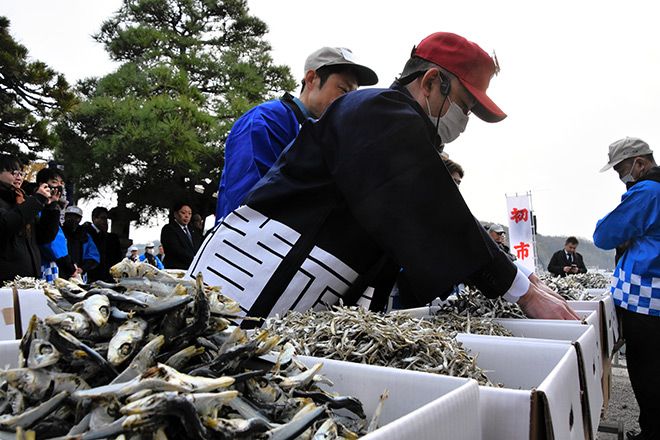
Today is Valentine’s Day. But in Japan, it’s also said to be “Niboshi no hi” –literally “day of niboshi,” the latter being small, dried fish used in Japanese cooking to make “dashi” soup stock.
But what does Feb. 14 have to do with niboshi? It’s because this date can be written as 2/14.
The number 2 is “ni” in Japanese. The number 1 looks like a vertical stick, so let’s call it “bo,” while 4 is pronounced as “shi.”
Strung together, what do these three numbers say? Ni-bo-shi, of course.
Mariko Kobayashi, 74, of Saitama Prefecture, was a junior high school science teacher for many years. She is actually quite a celebrity among those who knew of her use of niboshi in biology class, about which she authored a book titled “Niboshi no Kaibo Kyoshitsu” (Niboshi dissection class).
I recently asked her to personally teach me how to dissect these little dried fish.
“Don’t worry about botching it because we can redo it a few times,” Kobayashi assured me kindly, and produced a big handful of dried sardines.
The first step was an external examination. The fish’s back is black, but the belly is white. Why?
One theory is that this protects the fish in the sea.
Next, the fish’s mouth was opened to check its teeth. Then, the belly was slit open, and a toothpick was used to probe the internal organs, such as the stomach and intestines.
When I carefully removed the backbone, Kobayashi said, “You are very good.” It felt so good to be praised by the teacher.
My deboning skill owed to years of practice learning to eat “yakizakana teishoku” (a set meal featuring bone-in grilled fish) without making a mess.
Tiny as those dried sardines were, I found their anatomy to be surprisingly similar to that of us humans. It was actually moving to realize the obvious—that we share this planet Earth with those little creatures.
I joined my hands in gratitude as I bit into the head of one of them. It was slightly bitter, and it jogged my fond memory of the taste of the ocean from many years ago.
“My goal was to make my classes fun for the kids,” said Kobayashi.
Thanking her, I left for home. That evening, I had “aji no hiraki” (a whole horse mackerel that has been split-open, salted, dried and then grilled) for supper. I deboned the fish more meticulously than usual.
When the “sanma” (Pacific saury) season comes, I will enjoy it with the “harawata” (guts) intact. I can’t wait.
–The Asahi Shimbun, Feb. 14
* * *
Vox Populi, Vox Dei is a popular daily column that takes up a wide range of topics, including culture, arts and social trends and developments. Written by veteran Asahi Shimbun writers, the column provides useful perspectives on and insights into contemporary Japan and its culture.
AloJapan.com