
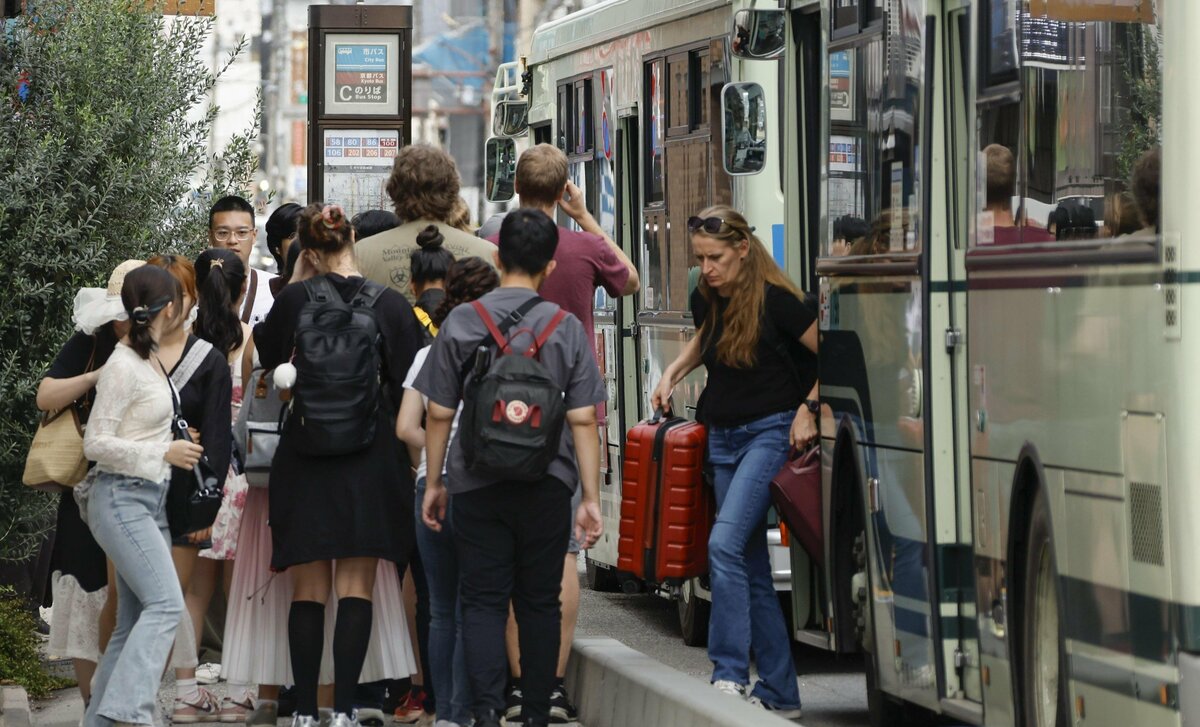

Foreign tourists wait in line at a bus stop in Kyoto, western Japan, on Oct. 15, 2025. (Kyodo)
TOKYO, Japan Wire – In its draft budget for fiscal 2026, the western Japan city of Kyoto allocated over 270 million yen ($1.8 million) toward the introduction of a pricing system for city buses and other services, offering local residents lower fares than visitors.
Kyoto identified measures to make tourism more compatible with the lives of its residents as one of the main areas to strengthen funding in the budget announced on February 4, which it says prioritizes residents above all.
As part of efforts to address issues related to overtourism, funding will be put toward alleviating congestion on public transportation, including 271 million yen for the preparation of a resident-priority pricing system on municipal and private buses which, if realized, would be the first of its kind in Japan.
Starting with municipal buses, Kyoto aims to introduce the system in fiscal 2027. Dual pricing distinguishing between residents and visitors is also being considered for public facilities such as Nijo Castle, a UNESCO World Heritage site that served as the Kyoto residence of the first Tokugawa shogun, Ieyasu.
While the process of revising fares has yet to begin, Kyoto Mayor Koji Matsui said he hopes to present a basic framework and specific pricing as soon as possible. Speaking to reporters after the budget announcement, Matsui said that there will likely be a considerable gap between fares for residents and those for non-residents.
“We want residents to understand that the city of Kyoto is steering public transportation and urban development in a new direction — one in which we are asking people from outside the city to bear some of the burden,” he said.
The fare for passengers riding buses within Kyoto’s flat fare zone currently stands at 230 yen. Limited express sightseeing buses that travel to major tourism sites with fewer stops from Kyoto Station charge a flat 500 yen. Regular fares for the city’s subway vary by distance, from 220 yen to 360 yen.
An identification system to distinguish residents from non-residents and facilitate dual pricing, possibly linking My Number identification cards to transportation IC cards, will be introduced and made available to private businesses, according to the mayor.
“As Kyoto develops as a tourism and cultural hub, we must consider how to approach various pricing structures. But while we will provide the framework, it will be up to the individual how they want to use it,” he said.
The draft budget will be deliberated during the city’s February assembly before being put to a vote in March. In the same month, Kyoto will introduce its planned hike in lodging taxes for people staying at hotels and other accommodations.
The revised rates will be 200 yen for stays costing under 6,000 yen per person per night, going up to 10,000 yen for stays costing 100,000 yen or more.
The mayor stressed that measures like the lodging tax and dual pricing are not about the city simply collecting money where it can.
“It is about having visitors help to sustain its attractions, including cultural properties which are difficult to preserve,” he said.
This article was submitted by a contributing writer for publication on Japan Wire.
AloJapan.com