
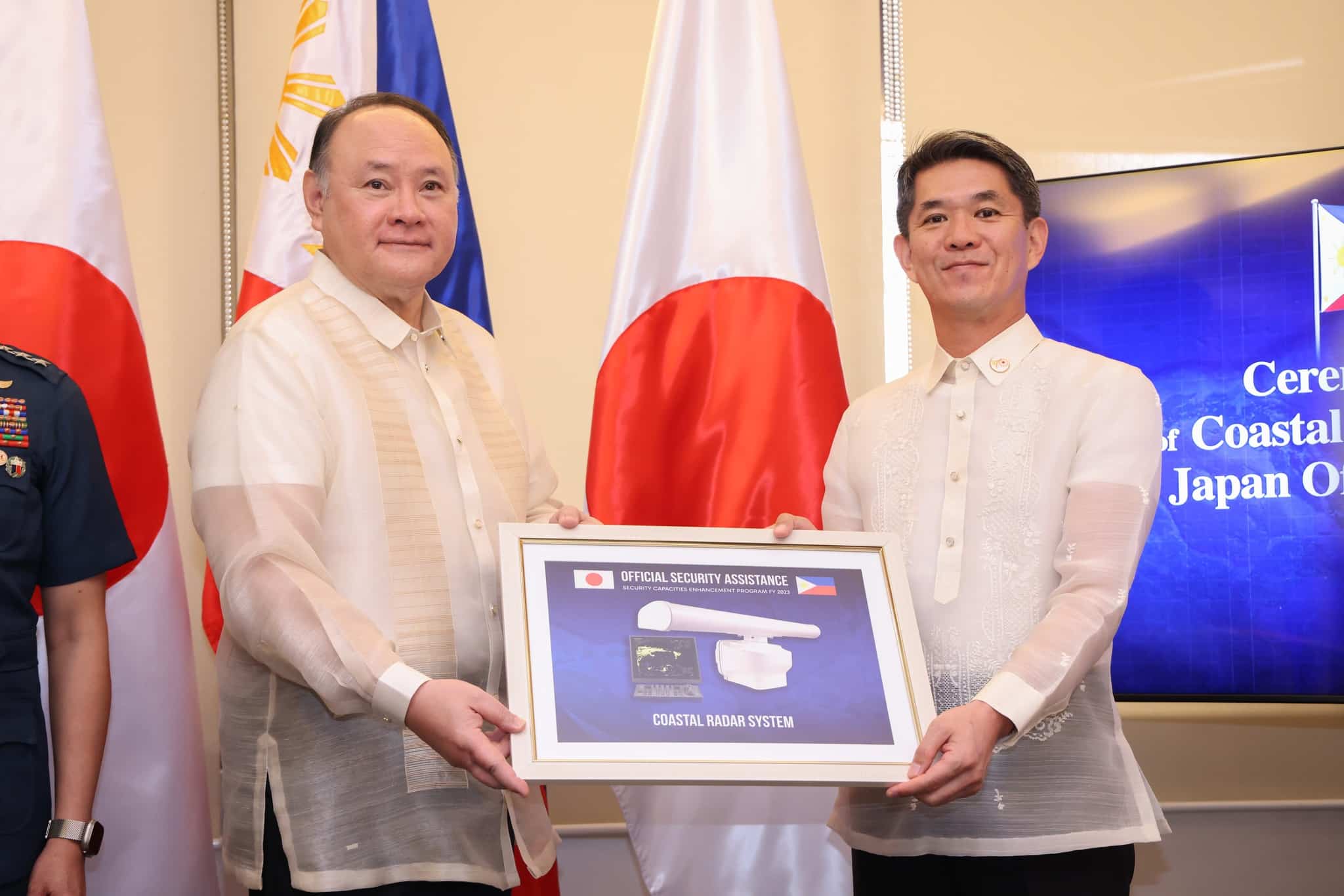
The Japanese government on Wednesday officially turned over five coastal radar systems to the Philippines as part of efforts to bolster Manila’s maritime domain awareness amid China’s continuing aggressive actions in the region.
The radars were part of Japan’s official security assistance for fiscal year 2023, the year the grant aid framework for like-minded countries was established.
“The South China Sea is a vital sea lane for many countries through which a large portion of our trade and energy supplies pass. Safety, openness, and stability of these waters are therefore of direct importance to our own security and prosperity,” Japanese ambassador Kazuya Endo said in his speech during the handover ceremony. “Enhancing the Philippines’ maritime domain capability is not only an investment in the Philippines’ security, but also a meaningful contribution to regional and global stability,” he added, without mentioning China, which claims these waters almost entirely. Beijing’s coast guard and military vessels have repeatedly engaged in aggressive encounters with Philippine ships near disputed shoals and atolls within Manila’s exclusive economic zone.
The Philippine Navy will be the end user of the coastal radars, amounting to JPY 600 million (P228 million). The package includes radar units, surveillance and monitoring equipment, communications systems, and other support components.
“Once operational by the Philippine Navy, they are expected to significantly enhance the country’s maritime domain awareness by improving the ability to monitor activities in the surrounding waters,” Endo said.
The Philippines is the only country that has been a recipient of the OSA for three consecutive years. For the second fiscal year, the Philippines is expected to receive JPY 900 million worth of rigid-hulled inflatable boats. For the current fiscal year, Japan will fund the construction of facilities for these boats, the first infrastructure project under the OSA.
Philippines’ Defense Secretary Gilberto Teodoro Jr., in his remarks, thanked the Japanese government for its contributions and expressed confidence that the relationship between the two countries will continue to deepen.
“Japan’s approach to its bilateral relations with the Philippines has been rooted in fundamental sincerity and values. Unlike the transactional approach to diplomatic relationships by other countries full of guile and full of insincerity in this regard, which is why approaches by countries who approach the Philippines with guile and insincerity have been soundly rejected by the Filipino people, unlike a partner country like Japan and other countries, which is welcomed with warm embrace by the Filipino people,” said Teodoro, a known China critic, without naming the country directly.
Last month, the Philippines and Japan signed a new deal called the Acquisition and Cross-Servicing Agreement, which will permit the tax-free provision of supplies and services between the two nations when they undertake joint military exercises. This was in support of the Reciprocal Access Agreement that the two countries signed in 2024.
AloJapan.com