
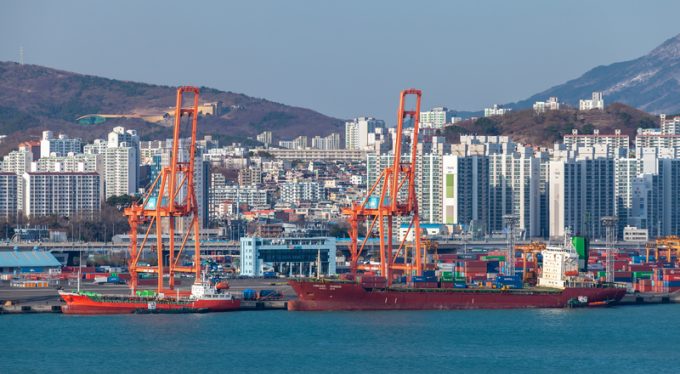
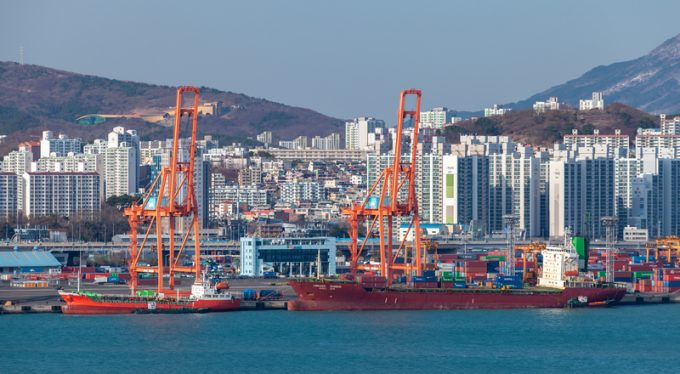
Port of Busan © Eugenesergeev
South Korea’s main container port, Busan, is looking to Japan to bolster its status as East Asia’s largest transhipment centre.
Japan will lose its last direct container shipping connection with Europe in April when the Premier Alliance cuts the nation’s ports from its Asia-Europe services.
This is expected to raise demand for feedering and transhipment from Japan, and Busan Port Authority held seminars in Japan last week, explaining to local shippers how they could save as much as 30% by transhipping in Busan.
In June, Blue Ocean Shipping, a joint-venture between Singapore-based Samudera Shipping and Japanese feeder operator Imoto Lines will launch, targeting coastal and regional routes connecting to Japan.
The mainline operators’ decision to remove direct links between Japan and Europe reflects its faltering export strength – Japan now accounting for less than 3% of EU imports.
During its meetings with Japanese shippers last week, BPA focused on Niigata, the largest hub port on Japan’s west coast, and Hachinohe, on the east coast, which has a well-developed feeder network with Busan, to promote the South Korean port’s strategic value and strengthen logistics cooperation.
During the briefing, BPA highlighted Busan’s role as a north-east Asian hub port and its ability to provide stable transhipment services based on its strong connectivity, featuring approximately 260 weekly scheduled routes.
BPA executives added that the Premier Alliance (HMM, ONE, and Yang Ming) plans to strengthen its transhipment capabilities at Busan from April, which would further enhance the reliability of transhipment there.
Linerlytica analyst Tan Hua Joo told The Loadstar: “Busan is the largest transhipment hub in North Asia and offers the widest selection of network connections for the region. [Other South Korean ports] Incheon and Gwangyang do not have sufficient capacity to handle the transhipment volumes for the region.”
In 2025, 14.1m teu was transhipped through Busan, 4% more than in 2024 and contributing nearly 57% of its throughput. Furthermore, with rising inland transport costs in Japan, BPA also pointed out that transhipping cargo at Busan would reduce logistics costs, compared with transporting cargo by land to major ports.
BPA executives calculated that when transporting cargo from the Niigata region to Hamburg, transhipping at Busan resulted in similar lead times to using major Japanese ports, but logistics costs would be reduced by approximately 30%.
Busan Port Authority president Song Sang-geun said: “We’ll visit shippers and logistics companies in Japan to promote the effectiveness of using Busan port, and we will continue to work to ensure that South Korea-Japan logistics cooperation leads to tangible results.”
AloJapan.com