
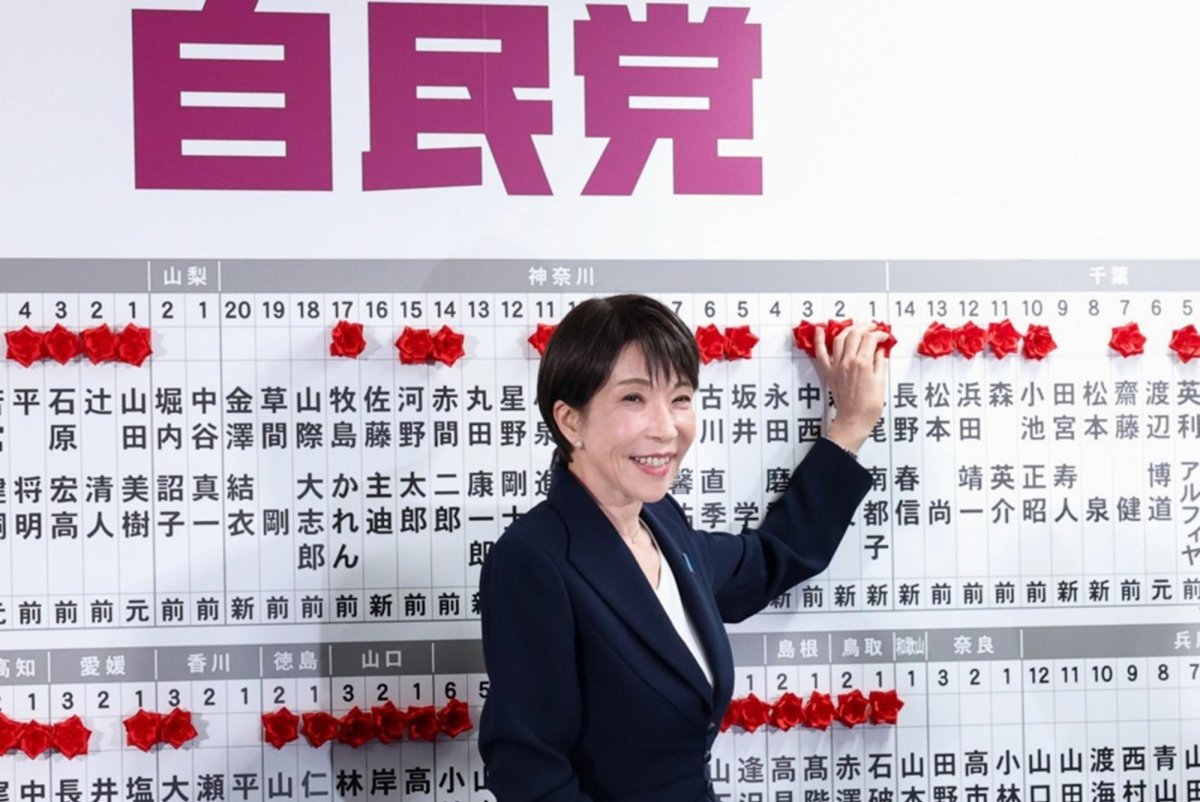
Japan’s Prime Minister Sanae Takaichi, leader of the ruling Liberal Democratic Party (LDP), places a red paper rose on the name of an elected candidate at the LDP headquarters on general election day in Tokyo, Japan, February 8, 2026. Photo by Kim Kyung-Hoon / EPA
Feb. 11 (Asia Today) — Japan’s ruling Liberal Democratic Party, led by Prime Minister Sanae Takaichi, secured 316 of 465 seats in the House of Representatives, surpassing the two-thirds threshold required to initiate constitutional revision.
The result marks the first time since World War II that a single party has secured enough seats to propose amending Japan’s Constitution, including Article 9, which renounces war. Supporters view the outcome as a mandate to strengthen national defense. Critics warn it could signal a departure from Japan’s postwar pacifist posture.
Takaichi campaigned on expanding the role of the Self-Defense Forces, increasing defense spending and reinforcing the U.S.-Japan alliance. The election took place amid heightened regional tensions involving China, North Korea and the war in Ukraine, factors that analysts say influenced voter sentiment.
With a stable parliamentary majority, the government is expected to accelerate debate on acquiring counterstrike capabilities, developing long-range missiles and revising legal frameworks related to national security.
Shifting regional dynamics
Observers say the outcome could reshape the strategic balance in Northeast Asia. Japan has already outlined plans to strengthen joint operational coordination with the United States and expand its defense capabilities under what it calls a more proactive security policy.
If Japan advances constitutional revision and broadens the operational scope of its Self-Defense Forces, it may play a more visible role in contingencies involving the Taiwan Strait or the Korean Peninsula.
Some analysts argue this could enhance deterrence against regional threats, particularly from North Korea and China. Others caution that deeper military integration among the United States, Japan and South Korea could also heighten tensions and revive historical sensitivities between Seoul and Tokyo.
Implications for South Korea
For South Korea, Japan’s political shift presents both strategic opportunities and challenges.
Expanded Japanese defense capabilities could reinforce trilateral security coordination in missile defense, intelligence sharing and maritime operations. At the same time, concerns persist within South Korea over historical disputes and the possibility of Japanese military activity near the Korean Peninsula.
Experts say Seoul will need to balance its alliance with the United States, manage practical security cooperation with Japan and maintain strategic autonomy amid intensifying U.S.-China competition.
As Northeast Asia faces overlapping pressures from U.S.-China rivalry, North Korea’s nuclear program and Japan’s evolving defense posture, the column argues that South Korea should pursue a pragmatic approach centered on national interest rather than ideology.
Joo Eun-sik (Director, Korea Institute for Strategic Studies)
The views expressed in this column are those of the author and do not necessarily reflect the views of Asia Today.
— Reported by Asia Today; translated by UPI
© Asia Today. Unauthorized reproduction or redistribution prohibited.
Original Korean report: https://www.asiatoday.co.kr/kn/view.php?key=20260211010004134
AloJapan.com