
Ten years of venture investment in university Takeda
Development of dream new drugs, eventually failed to achieve
Nevertheless, evaluation of ‘successful defeat’
K Industry-Academic Cooperation, we need to develop this coolness
 사진 확대 Kyoto University iPS Cell Research Institute
Predicting the future is difficult. Since there is no magic bead that reflects the future, companies look at “people” first and second. Only when you have a strong belief in talent can you make R&D investments. The Korean economy, which has not had a drop of oil, has come this far because of the strong supply and demand dynamics of the talent market. High-bandwidth memory (HBM), which supports Korea now, is also a myth that is used with the sweat and passion of talented people when they peel off the corporate sign of “Hank and Samjeon.”
So, even if it’s difficult, we shouldn’t miss people until the end when we face failure as much as the moment of success. It is necessary to encourage and take care of the dog, rather than blaming the dog when the result is bad. The news of the breakup between Japan’s “Takeda Pharmaceutical” and “Kyoto University” on the 3rd gives shivers in its form and emotion. Ten years ago, the largest industry-academic new drug development project in Japanese history was launched, and it was officially announced that it would end its journey. If it were in Korea, the company that gave money to the university that brought it would have quietly covered up and hoped that it would be forgotten from the world’s memories.
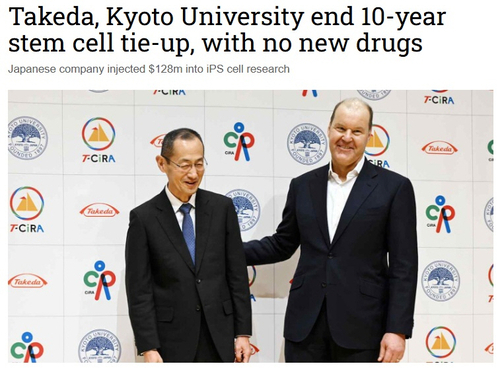
Takeda was the first to propose a consensus in 2016. I visited Kyoto University to create treatments that were not available in the world for severe heart failure and type 1 diabetes. At that time, Professor Shinya Yamanaka, the world’s leading researcher on induced pluripotent stem cells (iPS), was at the university. He received the 2012 Nobel Prize in Physiology and Medicine for his work in developing iPS. Takeda made unprecedented physical and human investments in the innovation research of Nobel Prize talent. In addition to contributing 200 billion won in pure research funds, research facilities and equipment worth 120 billion won were separately provided. Corporate and university researchers were also dispatched to each other.
However, in the development of new drugs, Death Valley is notoriously deep and rough. A section of death where you have good skills but give up because you can’t bear a huge cost to produce results. Takeda and Kyoto University eventually failed to cross the valley. In 10 years, 58 patents have been filed and 66 papers have been published, but the expected ‘clinical application’ has failed.
At a press conference between the heads of the two organizations, which calmly evaluates 10 years of cooperation, these days, the feeling of “losing.” The financial pain caused by numbers in the business world must have plagued Takeda’s management. The determination to disclose failure to the world, at least, will be an ethos that emerges when we do not doubt that each other has done their best.
 사진 확대 Professor Shinya Yamanaka (left) and Christophe Weber Takeda at the press conference on the 3rdPharmaceutical President
It is said that it takes a whole village to raise a child. Industry-academia challenges that connect the small fruits of basic science to market demand are no different. The data, talent, and experience of failure that Takeda and Kyoto University have accumulated over 10 years will be nourished throughout the Japanese bio industry’s microvessels.
Challenges such as ‘national scientist’, ‘national researcher’, and ‘making 10 Seoul National University’ have begun in the Lee Jae Myung government. It is an experiment that aims to expand the K talent ecosystem quantitatively and qualitatively. In addition to the government’s attempts, I would like to see each other in industry-academia relations, not just the end of success and failure, but also the middle level of “successful failure.” Do we have this coolness right now.
In addition, just as factories and jobs escape to the United States due to the expansion of investment in the U.S., industry-academic cooperation opportunities provided by companies will continue to flow overseas. For example, Samsung Electronics started the “START Project” with prestigious universities in North America last year. It is a method in which local university engineering students participate in solving the technology limitations faced by the company. The thickness of the domestic industry-academic pipeline, which was considered a natural opportunity, will continue to narrow. Let’s face this harsh reality and make the university even fiercer.
 사진 확대
사진 확대
AloJapan.com