
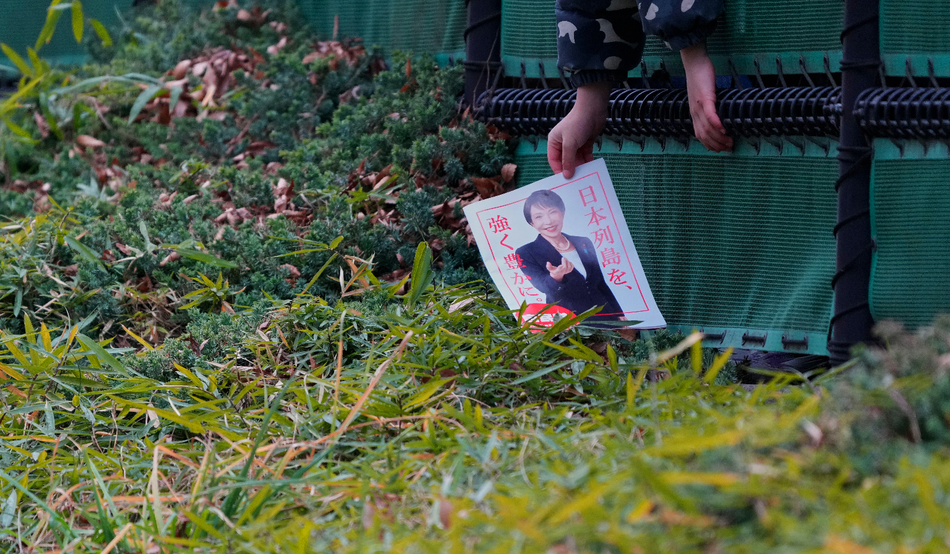
It is difficult to overstate Sanae Takaichi’s success in Japan’s election on Sunday. Having called the vote just three months into the job, Japan’s first female prime minister was rewarded with a super-majority in the powerful lower house, securing 316 of its 465 seats.
Her victory was so decisive that the party had to cede 14 seats to other parties because it did not have enough unelected candidates left to fill the seats awarded proportionally according to national vote share. Takaichi, the leader of Japan’s dominant Liberal Democratic Party (LDP), will not follow the string of scandal-ridden prime ministers since the late Shinzo Abe.
The election ultimately hinged on two issues: the cost of living and Takaichi’s personality. Given that it was the shortest campaign in Japan’s democratic history (just 12 days), there was little space for much else. Despite her party’s deep unpopularity, Takaichi’s ratings have remained high since she became leader in October. The stern conservative, who can also rock out with the South Korean president on a drum kit, has captured hearts across the country. “Sanamania” has swept the country—and a pledge to cut food taxes for two years likely helped secure Sunday’s expected result.
But Takaichi wanted to focus on other issues. She tried, in the televised leader’s debate, to shift the conversation onto defence policy and revising the pacifist constitution. “We have made a major policy change [on defence policy],” she declared, “we have decided to seek a public mandate.”
In its manifesto, the LDP pledged to amend Article 9 of the Japanese constitution, the “no-war” clause. This forever renounces war as a sovereign right of Japan. Takaichi argued that exceptions ought to be included, including the ability to declare a state of national emergency and a broader role for the Japanese Self-Defence Forces, the country’s military. It is a policy which the party has been committed to in various forms for more than 20 years, but has rarely gained saliency.
The size of Takaichi’s super-majority now creates the conditions for Japan’s pacifist identity to be fundamentally reshaped. Parties opposed to constitutional reform, like the Japanese Communist Party (JCP), have been quick to argue that the victory is not an endorsement of the policy. Given that the prime minister’s handbag received more attention in the campaign than pacifism, the argument has some merit. But the political landscape post-election makes meaningful opposition difficult.
The case for reform is relatively simple. The Japanese constitution was written for a different age. Pacificism was a condition written into Japanese national identity following defeat in 1945, imposed by the Allies and made possible only through the military support of the United States. With the White House changing its position in the world, Japan must respond. In the US’s 2025 National Security Strategy, Japan was explicitly urged to increase spending and decrease reliance on Washington.
Trump and Takaichi have a warm relationship, evidenced by his glowing endorsement for her re-election last week. Even if she can be the “Trump Whisperer”, a nickname given to Shinzo Abe during Trump’s first term, the demands from the US administration are clear.
Few would dispute Takaichi’s claim that Japan’s position is insecure, with China, Russia, and North Korea as neighbours. China, in particular, is testing Tokyo, recently locking radars on Japanese aircraft and restricting exports of rare earth minerals. Furthermore, the heavy defeat of the most pro-China party, the JCP, on Sunday suggests there is little appetite among voters for a soft approach to Beijing.
Sanseitō, the far-right party, is deeply supportive of Takaichi’s stance on defence. The populist party performed well on Sunday, gaining seats but falling short of stated targets. Following a breakthrough performance in last year’s elections, its 48-year-old leader Sohei Kamiya has expressed dissatisfaction with the outcome. His messaging in both elections has centred on presenting a blunt diagnosis: too many foreigners.
Kamiya’s party started out of a YouTube show in 2020 and has developed into a notable populist force. The far-right leader has been accused of promoting Covid conspiracies and antisemitism, having previously said that Jewish financiers were getting rich from the pandemic, and that he would not sell Japan out to “Jewish capital”. He has denied being antisemitic.
Kamiya has also said the government has gone “too far” in encouraging young women in the workplace, advocating instead for them to have children, and calling diversity and political correctness “communism”. He believes sanctions on Russia should be weakened.
While the results undoubtedly disappointed Kamiya, the result does not indicate a stalling of populism. This election presented unique challenges for Sanseitō. Winter in many parts of Japan is harsh, and some polls closed early due to extreme weather. In combination with a short campaign, this gave the more established parties an advantage. Equally, Takaichi’s image as a self-made woman and her highly successful online campaign undermined Sanseitō’s typical criticisms of the LDP as a stale, exhausted political force. Nevertheless, Sanseitō fielded their largest ever slate of candidates and further refined their “assassin” strategy, deliberately targeting the seats of junior, older or scandal-ridden politicians.
Whilst Sanseitō continues to rise, other parties such as the Centrist Reform Alliance suffered extreme losses. But for now, both are irrelevant as Japan will march to the beat of Takaichi’s drum.
AloJapan.com